
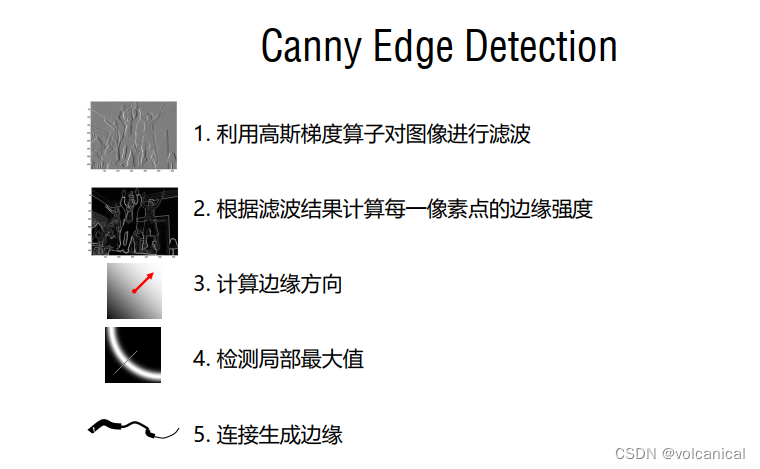
1.梯度强度计算与梯度方向计算
计算每个点的梯度强度与梯度方向
sobel_x = np.array([[1, 0, -1], [1, 0, -1], [1, 0, -1]]) sobel_y = np.array([[1, 1, 1], [0, 0, 0], [-1, -1, -1]]) grad_x = signal.convolve2d(b, sobel_x, 'same') grad_y = signal.convolve2d(b, sobel_y, 'same') ans = grad_x2 + grad_y2 # 梯度强度矩阵 ans = ans0.5 # np.set_printoptions(1) degree = grad_y / grad_x # 梯度方向矩阵 degree = np.arctan(degree) 讯享网
2.梯度方向离散化
将梯度方向离散化为四个方向

讯享网# 梯度方向矩阵离散化 for i in range(row): for j in range(col): if degree[i, j] < 0: degree[i, j] += np.pi if degree[i, j] > 7 * np.pi / 8: degree[i, j] = np.pi - degree[i, j] if (np.pi / 8 > degree[i, j] >= -np.pi / 8): degree[i, j] = 0 elif (3 * np.pi / 8 > degree[i, j] >= np.pi / 8): degree[i, j] = np.pi / 4 elif (5 * np.pi / 8 > degree[i, j] >= 3 * np.pi / 8): degree[i, j] = np.pi / 2 elif (7 * np.pi / 8 > degree[i, j] >= 5 * np.pi / 8): degree[i, j] = 3 * np.pi / 4
3.极大值抑制
将梯度方向上不是最大值的点舍弃
# 极大值抑制 yizhi = np.zeros((row, col)) for i in range(row): for j in range(col): if not np.isnan(degree[i, j]): if degree[i, j] == 0: if ans[i, j] > ans[i, max(0, j - 1)] and ans[i, j] > ans[ i, min(8, j + 1)]: yizhi[i][j] = 1 if degree[i, j] == np.pi / 4: if ans[i, j] > ans[max(0, i - 1), min(8, j + 1)] and ans[i, j] > ans[min(8, i + 1), max(0, j - 1)]: yizhi[i][j] = 1 if degree[i, j] == np.pi / 2: if ans[i, j] > ans[max(0, i - 1), j] and ans[i, j] > ans[min(8, i + 1), j]: yizhi[i][j] = 1 if degree[i, j] == 3 * np.pi / 4: if ans[i, j] > ans[max(0, i - 1), max(0, j - 1)] and ans[i, j] > ans[min(8, i + 1), min(8, j + 1)]: yizhi[i][j] = 1 4. 边缘连接
设置两个阈值,大于大的阈值可以直接被视为边缘点,介于两个阈值之间的边缘点需要看有没有绝对边缘点与其邻接,如果有可以视为边缘点,否则不视为边缘点。
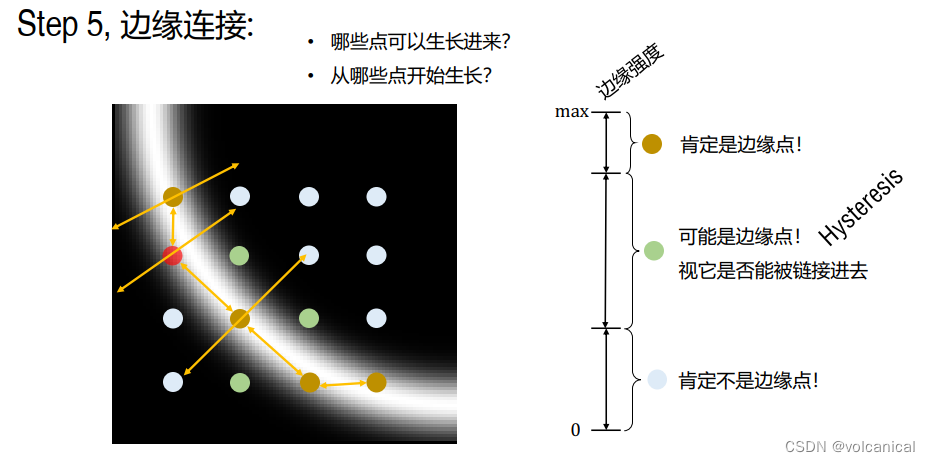
讯享网# step4. 双阈值算法检测、连接边缘 W3, H3 = yizhi.shape DT = np.zeros([W3, H3]) # 定义高低阈值 TL = 0.2 * np.max(yizhi) TH = 0.3 * np.max(yizhi) for i in range(1, W3-1): for j in range(1, H3-1): if (yizhi[i, j] < TL): DT[i, j] = 0 elif (yizhi[i, j] > TH): DT[i, j] = 1 elif ((yizhi[i-1, j-1:j+1] < TH).any() or (yizhi[i+1, j-1:j+1]).any() or (yizhi[i, [j-1, j+1]] < TH).any()): DT[i, j] = 1
# -*- coding:utf-8 -*- from scipy import signal import numpy as np from PIL import Image import os def file_name(file_dir): L = [] N = [] for root, dirs, files in os.walk(file_dir): for file in files: if os.path.splitext(file)[1] == '.jpg': L.append(os.path.join(root, file)) N.append(file) return L, N np.set_printoptions(1) sobel_y = np.array([[1, 1, 1], [0, 0, 0], [-1, -1, -1]]) name, filename = file_name('D:/Canny-publish/Images') print(filename) # 阈值 yuzhi = 5 b = Image.open(f'{
     name[1]}') b = b.convert('L') b = np.array(b) sobel_x = np.array([[1, 0, -1], [1, 0, -1], [1, 0, -1]]) grad_x = signal.convolve2d(b, sobel_x, 'same') grad_y = signal.convolve2d(b, sobel_y, 'same') ans = grad_x2 + grad_y2 # 梯度强度矩阵 ans = ans0.5 # np.set_printoptions(1) degree = grad_y / grad_x # 梯度方向矩阵 degree = np.arctan(degree) row, col = b.shape # 梯度方向矩阵离散化 for i in range(row): for j in range(col): if degree[i, j] < 0: degree[i, j] += np.pi if degree[i, j] > 7 * np.pi / 8: degree[i, j] = np.pi - degree[i, j] if (np.pi / 8 > degree[i, j] >= -np.pi / 8): degree[i, j] = 0 elif (3 * np.pi / 8 > degree[i, j] >= np.pi / 8): degree[i, j] = np.pi / 4 elif (5 * np.pi / 8 > degree[i, j] >= 3 * np.pi / 8): degree[i, j] = np.pi / 2 elif (7 * np.pi / 8 > degree[i, j] >= 5 * np.pi / 8): degree[i, j] = 3 * np.pi / 4 # 极大值抑制 yizhi = np.zeros((row, col)) for i in range(row): for j in range(col): if not np.isnan(degree[i, j]) and ans[i, j] > yuzhi: if degree[i, j] == 0: if ans[i, j] > ans[i, max(0, j - 1)] and ans[i, j] > ans[ i, min(8, j + 1)]: yizhi[i][j] = 1 if degree[i, j] == np.pi / 4: if ans[i, j] > ans[max(0, i - 1), min(8, j + 1)] and ans[i, j] > ans[min(8, i + 1), max(0, j - 1)]: yizhi[i][j] = 1 if degree[i, j] == np.pi / 2: if ans[i, j] > ans[max(0, i - 1), j] and ans[i, j] > ans[min(8, i + 1), j]: yizhi[i][j] = 1 if degree[i, j] == 3 * np.pi / 4: if ans[i, j] > ans[max(0, i - 1), max(0, j - 1)] and ans[i, j] > ans[min(8, i + 1), min(8, j + 1)]: yizhi[i][j] = 1 yizhi = yizhi * ans print(yizhi) W3, H3 = yizhi.shape DT = np.zeros([W3, H3]) # 定义高低阈值 TL = 0.2 * np.max(yizhi) TH = 0.3 * np.max(yizhi) for i in range(1, W3-1): for j in range(1, H3-1): if (yizhi[i, j] < TL): DT[i, j] = 0 elif (yizhi[i, j] > TH): DT[i, j] = 255 elif ((yizhi[i-1, j-1:j+1] > TH).any() or (yizhi[i+1, j-1:j+1] > TH).any() or (yizhi[i, [j-1, j+1]] > TH).any()): DT[i, j] = 255 print(DT) DT = Image.fromarray(DT) DT.convert('1') DT.show()
版权声明:本文内容由互联网用户自发贡献,该文观点仅代表作者本人。本站仅提供信息存储空间服务,不拥有所有权,不承担相关法律责任。如发现本站有涉嫌侵权/违法违规的内容,请联系我们,一经查实,本站将立刻删除。
如需转载请保留出处:https://51itzy.com/kjqy/123228.html