
有没有想过强化学习 (RL) 是如何工作的?
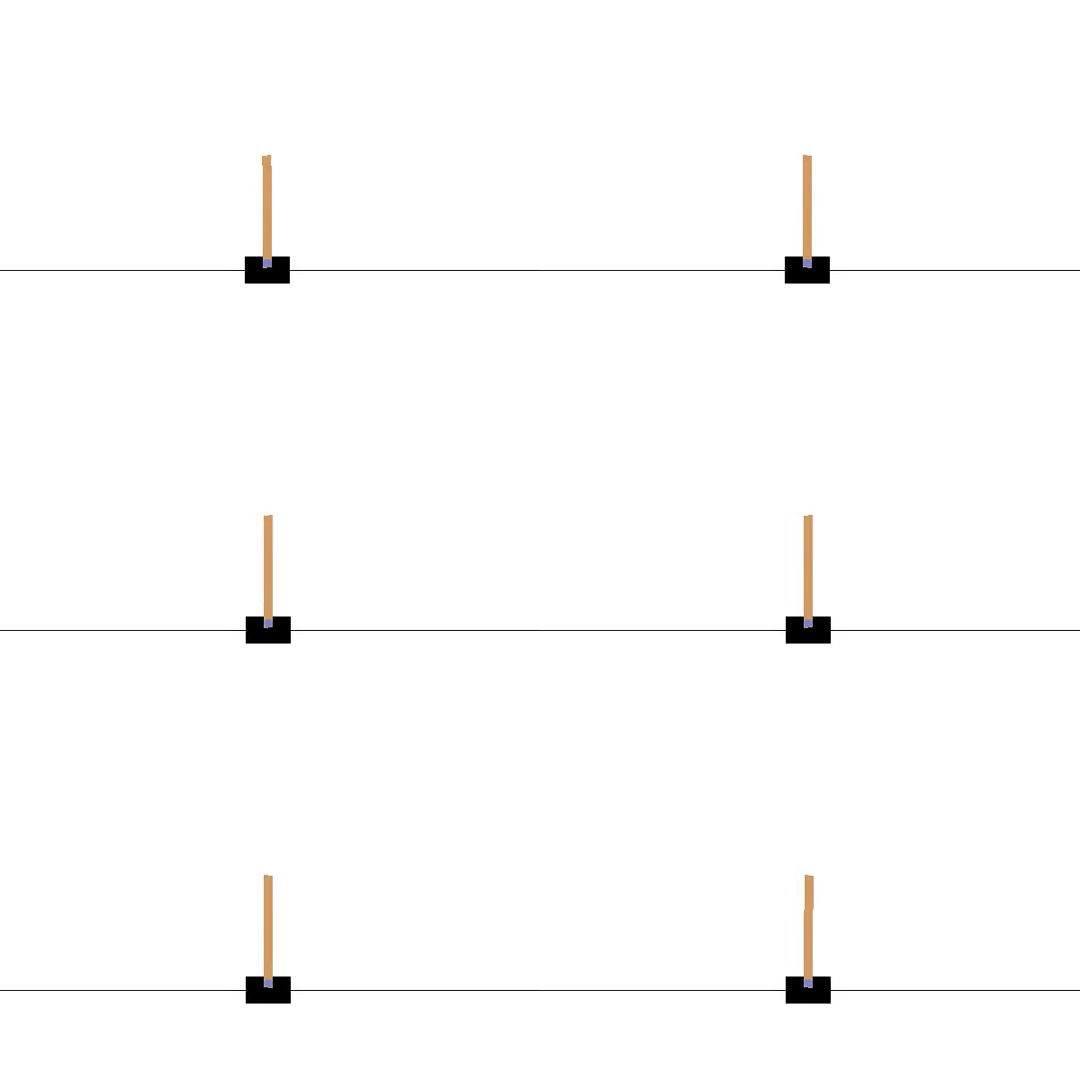
在本文中,我们将从头开始构建最简单的强化学习形式之一 —普通策略梯度(VPG)算法。 然后,我们将训练它完成著名的 CartPole 挑战 — 学习从左向右移动购物车以平衡杆子。 在此过程中,我们还将完成对 OpenAI 的 Spinning Up 学习资源的第一个挑战。
NSDT工具推荐: Three.js AI纹理开发包 - YOLO合成数据生成器 - GLTF/GLB在线编辑 - 3D模型格式在线转换 - 可编程3D场景编辑器 - REVIT导出3D模型插件 - 3D模型语义搜索引擎
本文的代码可以在 这里 找到。
1、我们的方法
我们将通过创建一个简单的深度学习模型来解决这个问题,该模型接受观察并输出随机策略(即采取每个可能行动的概率)。
然后,我们需要做的就是通过在环境中采取行动并使用此策略来收集经验。
当我们有足够的批量经验(几个episode经验的集合)后,我们需要转向梯度下降来改进模型。 在较高层面上,我们希望增加策略的预期回报,这意味着调整权重和偏差以增加高预期回报行动的概率。 就 VPG 而言,这意味着使用策略梯度定理,该定理给出了该预期回报的梯度方程(如下所示)。
这就是全部内容了—所以让我们开始编码吧!
2、创建模型
我们将首先创建一个带有一个隐藏层的非常简单的模型。 第一个线性层从 CartPole 的观察空间获取输入特征,最后一层返回可能结果的值。
def create_model(number_observation_features: int, number_actions: int) -> nn.Module: """Create the MLP model Args: number_observation_features (int): Number of features in the (flat) observation tensor number_actions (int): Number of actions Returns: nn.Module: Simple MLP model """ hidden_layer_features = 32 return nn.Sequential( nn.Linear(in_features=number_observation_features, out_features=hidden_layer_features), nn.ReLU(), nn.Linear(in_features=hidden_layer_features, out_features=number_actions), )讯享网
3、获取策略
我们还需要为每个时间步获取一个模型策略(以便我们知道如何采取行动)。 为此,我们将创建一个 get_policy 函数,该函数使用模型输出策略下每个操作的概率。 然后,我们可以返回一个分类(多项式)分布,该分布可用于选择根据这些概率随机分布的特定动作。

讯享网def get_policy(model: nn.Module, observation: np.ndarray) -> Categorical: """Get the policy from the model, for a specific observation Args: model (nn.Module): MLP model observation (np.ndarray): Environment observation Returns: Categorical: Multinomial distribution parameterized by model logits """ observation_tensor = torch.as_tensor(observation, dtype=torch.float32) logits = model(observation_tensor) # Categorical will also normalize the logits for us return Categorical(logits=logits)
4、从策略中采样动作
从这个分类分布中,对于每个时间步长,我们可以对其进行采样以返回一个动作。 我们还将获得该动作的对数概率,这在稍后计算梯度时会很有用。
def get_action(policy: Categorical) -> tuple[int, float]: """Sample an action from the policy Args: policy (Categorical): Policy Returns: tuple[int, float]: Tuple of the action and it's log probability """ action = policy.sample() # Unit tensor # Converts to an int, as this is what Gym environments require action_int = action.item() # Calculate the log probability of the action, which is required for # calculating the loss later log_probability_action = policy.log_prob(action) return action_int, log_probability_action5、计算损失
梯度的完整推导如这里所示。 宽松地说,它是每个状态-动作对的对数概率之和乘以该对所属的整个轨迹的回报的梯度。 额外的外层和汇总若干个情节(即一批),因此我们有重要的数据。

要使用 PyTorch 计算此值,我们可以做的是计算下面的伪损失,然后使用 .backward() 获取上面的梯度(注意我们刚刚删除了梯度项):

这通常被称为损失,但它并不是真正的损失,因为它不依赖于模型的性能。 它只是对于获取策略梯度有用。
讯享网def calculate_loss(epoch_log_probability_actions: torch.Tensor, epoch_action_rewards: torch.Tensor) -> float:
    """Calculate the 'loss' required to get the policy gradient

    Formula for gradient at
    https://spinningup.openai.com/en/latest/spinningup/rl_intro3.html#deriving-the-simplest-policy-gradient

    Note that this isn't really loss - it's just the sum of the log probability
    of each action times the episode return. We calculate this so we can
    back-propagate to get the policy gradient.

    Args:
        epoch_log_probability_actions (torch.Tensor): Log probabilities of the
            actions taken
        epoch_action_rewards (torch.Tensor): Rewards for each of these actions

    Returns:
        float: Pseudo-loss
    """
    return -(epoch_log_probability_actions * epoch_action_rewards).mean()
6、单个epoch训练
将以上所有内容放在一起,我们现在准备好训练一个epoch了。 为此,我们只需循环播放情节(episode)即可创建批次。 在每个情节中,创建一系列可用于训练模型的动作和奖励(即经验)。
def train_one_epoch(env: gym.Env, model: nn.Module, optimizer: Optimizer, max_timesteps=5000, episode_timesteps=200) -> float: """Train the model for one epoch Args: env (gym.Env): Gym environment model (nn.Module): Model optimizer (Optimizer): Optimizer max_timesteps (int, optional): Max timesteps per epoch. Note if an episode is part-way through, it will still complete before finishing the epoch. Defaults to 5000. episode_timesteps (int, optional): Timesteps per episode. Defaults to 200. Returns: float: Average return from the epoch """ epoch_total_timesteps = 0 # Returns from each episode (to keep track of progress) epoch_returns: list[int] = [] # Action log probabilities and rewards per step (for calculating loss) epoch_log_probability_actions = [] epoch_action_rewards = [] # Loop through episodes while True: # Stop if we've done over the total number of timesteps if epoch_total_timesteps > max_timesteps: break # Running total of this episode's rewards episode_reward: int = 0 # Reset the environment and get a fresh observation observation = env.reset() # Loop through timesteps until the episode is done (or the max is hit) for timestep in range(episode_timesteps): epoch_total_timesteps += 1 # Get the policy and act policy = get_policy(model, observation) action, log_probability_action = get_action(policy) observation, reward, done, _ = env.step(action) # Increment the episode rewards episode_reward += reward # Add epoch action log probabilities epoch_log_probability_actions.append(log_probability_action) # Finish the action loop if this episode is done if done == True: # Add one reward per timestep for _ in range(timestep + 1): epoch_action_rewards.append(episode_reward) break # Increment the epoch returns epoch_returns.append(episode_reward) # Calculate the policy gradient, and use it to step the weights & biases epoch_loss = calculate_loss(torch.stack( epoch_log_probability_actions), torch.as_tensor( epoch_action_rewards, dtype=torch.float32) ) epoch_loss.backward() optimizer.step() optimizer.zero_grad() return np.mean(epoch_returns)7、运行算法
现在可以运行算法了。
讯享网def train(epochs=40) -> None: """Train a Vanilla Policy Gradient model on CartPole Args: epochs (int, optional): The number of epochs to run for. Defaults to 50. """ # Create the Gym Environment env = gym.make('CartPole-v0') # Use random seeds (to make experiments deterministic) torch.manual_seed(0) env.seed(0) # Create the MLP model number_observation_features = env.observation_space.shape[0] number_actions = env.action_space.n model = create_model(number_observation_features, number_actions) # Create the optimizer optimizer = Adam(model.parameters(), 1e-2) # Loop for each epoch for epoch in range(epochs): average_return = train_one_epoch(env, model, optimizer) print('epoch: %3d \t return: %.3f' % (epoch, average_return)) if __name__ == '__main__': train()
大约 40 个 epoch 后,可以看到模型已经很好地学习了环境(得分 180+/ 200):
epoch: 26 return: 118.070 epoch: 27 return: 114.659 epoch: 28 return: 135.405 epoch: 29 return: 144.000 epoch: 30 return: 143.972 epoch: 31 return: 152.091 epoch: 32 return: 166.065 epoch: 33 return: 162.613 epoch: 34 return: 166.806 epoch: 35 return: 172.933 epoch: 36 return: 173.241 epoch: 37 return: 181.071 epoch: 38 return: 186.222 epoch: 39 return: 176.793原文链接:普通策略梯度实现 - BimAnt
版权声明:本文内容由互联网用户自发贡献,该文观点仅代表作者本人。本站仅提供信息存储空间服务,不拥有所有权,不承担相关法律责任。如发现本站有涉嫌侵权/违法违规的内容,请联系我们,一经查实,本站将立刻删除。
如需转载请保留出处:https://51itzy.com/kjqy/42552.html