
Tensor Flow Object Detection API is the framework for creating a deep learning network that solves object detection problems.
Tensor Flow对象检测API是用于创建解决对象检测问题的深度学习网络的框架。
There are pre-trained models in TF framework known as Model Zoo , which are trained with various architectures such as Resnet-50, Resnet -101 and Inception. These models trained on various datasets such as COCO, KITTI and Open Images. These models can be directly consumed for prediction to detect categories available in those datasets.
在TF框架中有称为Model Zoo的预训练模型,它们使用各种架构(例如Resnet-50,Resnet -101和Inception)进行训练。 这些模型在各种数据集(例如COCO,KITTI和Open Images)上进行了训练。 这些模型可以直接用于预测,以检测那些数据集中可用的类别。
To develop model with custom data, we can leverage the existing pre-trained models and their configuration in TF Object Detection API, all we have to do is select the algorithm from the model zoo -> transform the input data to required TF format-> train & evaluate model.
要使用自定义数据开发模型,我们可以利用现有的预训练模型及其在TF Object Detection API中的配置,我们要做的就是从模型Zoo中选择算法->将输入数据转换为所需的TF格式->训练和评估模型。
Once the model is built, operationalization is also equally important. We will see how to orchestrate the model into Azure MLS.
建立模型后,可操作性也同样重要。 我们将看到如何将模型编排到Azure MLS中。

什么是Azure MLS? (What is Azure MLS?)
Azure Machine Learning service (AMLS) helps to automate the model build, train, and tracking in an Azure Machine Learning Workspace. It helps to keep a track of various model experiments and metrics in one place.
Azure机器学习服务(AMLS)可帮助在Azure机器学习工作区中自动化模型的构建,训练和跟踪。 它有助于在一处跟踪各种模型实验和度量。
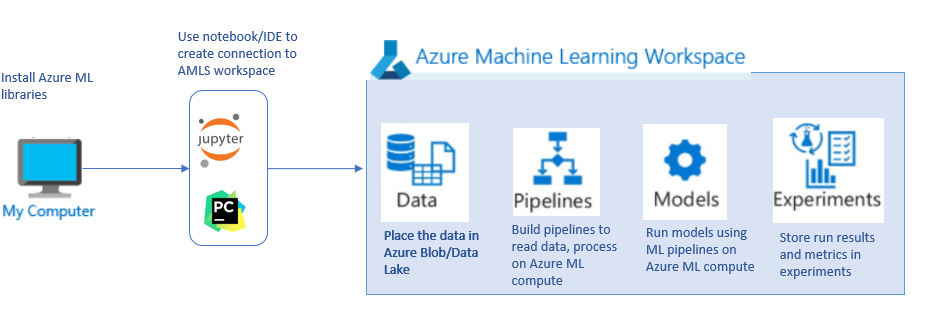
Once the baseline model is built in VM / local computer, next step is to automate the model training process ,below are the steps to get started with AMLS:
在VM /本地计算机中构建了基准模型后,下一步是使模型训练过程自动化,以下是开始使用AMLS的步骤:
- Copy the input data (images and its annotations file) into Azure Blob 将输入数据(图像及其注释文件)复制到Azure Blob中
- Create Azure ML pipelines: An Azure Machine Learning pipeline can be as simple as one that calls a Python script, which reads the input from source, processes and writes output results. we need to prepare Azure ML pipeline for data preparation, model training and deployment. 创建Azure ML管道:Azure机器学习管道可以像调用Python脚本一样简单,该Python脚本从源中读取输入,进行处理并写入输出结果。 我们需要准备Azure ML管道以进行数据准备,模型训练和部署。
- To start building pipeline, we can use the local computer with Jupyter notebook, the prerequisites is to install azure ml libraries. 要开始构建管道,我们可以将本地计算机与Jupyter Notebook一起使用,前提条件是要安装Azure ml库。
版权声明:本文内容由互联网用户自发贡献,该文观点仅代表作者本人。本站仅提供信息存储空间服务,不拥有所有权,不承担相关法律责任。如发现本站有涉嫌侵权/违法违规的内容,请联系我们,一经查实,本站将立刻删除。
如需转载请保留出处:https://51itzy.com/kjqy/13955.html