

Agenda 目录/议题
- 编译通信软件
- 硬件和软件带来的挑战
- 为什么需要libfabric
- libfabric架构
- API分组
- socket应用 VS libfabric应用区别
- GPU数据传输示例

编译通信软件

- 可靠面向连接的TCP和无连接的数据报UDP协议
- 高性能计算HPC或人工智能AI

软硬件复杂性带来的挑战

- 上千个节点的集群, 不同的网络类型(以太网, IB, 光纤等), 熊猫博士提到的CPU/GPU/XPU/IPU等等
- xelink, nvlink, gpu
- 软件库, 如nccl,intel mpi等
- 所以咱们需要一个通用的通信库来桥接这些复杂的软硬件资源
libfabric来解决上面的问题

- 统一API, 让程序员更轻松
- 高性能和高可扩展性
- 核心组件: 众多网卡提供者的库, 核心服务, 测试程序等
为什么需要libfabric

- 承上启下, 桥接底层复杂多样的网络(socket, rdma, gpu, 共享内存等)和上层MPI, CCL, 共享内存等应用
socket编程与libfabric编程对比

- 语义类似, 如获取信息, bind, connect等, 但是libfabric底层支持多种网络类型
支持GPU通信

- gpu通信示例, 支持intel gpu, dpu, 或者其他供应商
架构与四种服务

- 控制类: 发现底层设备, 属性, 能力等
- 通信接口: 建立连接, 初始资源等
- 数据传输: 发送和接收数据
- 完成服务: 报告发送或接收状态
libfabric API分组

- 整合底层提供者和上层开发者使用统一的API编程, 就像熊猫博士说的那样, 方便了提供者更方便的提供插件, 也方便了上层应用开发者
tcp socket 代码截图


socket收发数据示例

server端启动:./example_socket客户端连接和发送:./example_socket 192.168.5.6Hello server this is client.讯享网
example_socket.c 源码
讯享网#include <stdio.h> #include <string.h> #include <sys/socket.h> #include <arpa/inet.h> char *dst_addr = NULL; int main(int argc, char *argv[]) { int socket_desc, client_sock, client_size; struct sockaddr_in server_addr, client_addr; char server_message[2000], client_message[2000]; dst_addr = inet_addr(argv[1]); // Clean buffers: memset(server_message, '\0', sizeof(server_message)); memset(client_message, '\0', sizeof(client_message)); // Create socket: socket_desc = socket(AF_INET, SOCK_STREAM, 0); if(socket_desc < 0){ printf("Error while creating socket\n"); return -1; } printf("Socket created successfully\n"); // Set port and IP: server_addr.sin_family = AF_INET; server_addr.sin_port = "43192"; server_addr.sin_addr.s_addr = inet_addr("127.0.0.1"); if (!dst_addr) { // Bind to the set port and IP: if(bind(socket_desc, (struct sockaddr*)&server_addr, sizeof(server_addr))<0){ printf("Couldn't bind to the port\n"); return -1; } printf("Binding complete\n"); // Listen for clients: if(listen(socket_desc, 1) < 0){ printf("Error while listening\n"); return -1; } printf("Listening for incoming connections...\n"); // Accept an incoming connection: client_size = sizeof(client_addr); client_sock = accept(socket_desc, (struct sockaddr*)&client_addr, &client_size); if (client_sock < 0){ printf("Can't accept\n"); return -1; } printf("Client connected at IP: %s and port: %i\n", inet_ntoa(client_addr.sin_addr), ntohs(client_addr.sin_port)); // Receive client's message: if (recv(client_sock, client_message, sizeof(client_message), 0) < 0){ printf("Couldn't receive\n"); return -1; } printf("Msg from client: %s\n", client_message); // Respond to client: strcpy(server_message, "This is the server's message."); if (send(client_sock, server_message, strlen(server_message), 0) < 0){ printf("Can't send\n"); return -1; } } if (dst_addr) { // Send connection request to server: if(connect(socket_desc, (struct sockaddr*)&server_addr, sizeof(server_addr)) < 0){ printf("Unable to connect\n"); return -1; } printf("Connected with server successfully\n"); // Get input from the user: printf("Enter message: "); gets(client_message); // Send the message to server: if(send(socket_desc, client_message, strlen(client_message), 0) < 0){ printf("Unable to send message\n"); return -1; } // Receive the server's response: if(recv(socket_desc, server_message, sizeof(server_message), 0) < 0){ printf("Error while receiving server's msg\n"); return -1; } printf("Server's response: %s\n",server_message); } // Close the client socket: close(client_sock); // Closing the server socket: close(socket_desc); return 0; }
libfabric收发数据示例截图

服务端启动: ./example_msg客户端连接发送数据: ./example_msg 192.168.5.6 客户端连接发送数据: ./example_msg 192.168.5.6参考代码
讯享网https://github.com/ssbandjl/libfabric/blob/main/fabtests/functional/example_msg.c /* * * This software is available to you under the BSD license * below: * * Redistribution and use in source and binary forms, with or * without modification, are permitted provided that the following * conditions are met: * * - Redistributions of source code must retain the above * copyright notice, this list of conditions and the following * disclaimer. * * - Redistributions in binary form must reproduce the above * copyright notice, this list of conditions and the following * disclaimer in the documentation and/or other materials * provided with the distribution. * * THE SOFTWARE IS PROVIDED "AS IS", WITHOUT WARRANTY OF ANY KIND, * EXPRESS OR IMPLIED, INCLUDING BUT NOT LIMITED TO THE WARRANTIES OF * MERCHANTABILITY, FITNESS FOR A PARTICULAR PURPOSE AND * NONINFRINGEMENT. IN NO EVENT SHALL THE AUTHORS OR COPYRIGHT HOLDERS * BE LIABLE FOR ANY CLAIM, DAMAGES OR OTHER LIABILITY, WHETHER IN AN * ACTION OF CONTRACT, TORT OR OTHERWISE, ARISING FROM, OUT OF OR IN * CONNECTION WITH THE SOFTWARE OR THE USE OR OTHER DEALINGS IN THE * SOFTWARE. */ #include <stdio.h> #include <stdlib.h> #include <getopt.h> #include <netinet/in.h> #include <arpa/inet.h> #include <netdb.h> #include <rdma/fabric.h> #include <rdma/fi_domain.h> #include <rdma/fi_endpoint.h> #include <rdma/fi_cm.h> #include <shared.h> //Build with //gcc -o example_msg example_msg.c -L<path to libfabric lib> -I<path to libfabric include> -lfabric //gcc -o example_msg example_msg.c -L/home/xb/project/libfabric/libfabric/build/lib -I/home/xb/project/libfabric/libfabric/build/include -I/home/xb/project/libfabric/libfabric/build/include -lfabric #define BUF_SIZE 64 char *dst_addr = NULL; char *port = "9228"; struct fi_info *hints, *info, *fi_pep; struct fid_fabric *fabric = NULL; struct fid_domain *domain = NULL; struct fid_ep *ep = NULL; struct fid_pep *pep = NULL; struct fid_cq *cq = NULL; struct fid_eq *eq = NULL; struct fi_cq_attr cq_attr = {0}; struct fi_eq_attr eq_attr = { .wait_obj = FI_WAIT_UNSPEC }; //const struct sockaddr_in *sin; char str_addr[INET_ADDRSTRLEN]; int ret; char buffer[BUF_SIZE]; fi_addr_t fi_addr = FI_ADDR_UNSPEC; struct fi_eq_cm_entry entry; uint32_t event; ssize_t rd; /* Initializes all basic OFI resources to allow for a server/client to exchange a message */ static int start_client(void) { ret = fi_getinfo(FI_VERSION(1,9), dst_addr, port, dst_addr ? 0 : FI_SOURCE, hints, &info); if (ret) { printf("fi_getinfo: %d\n", ret); return ret; } ret = fi_fabric(info->fabric_attr, &fabric, NULL); if (ret) { printf("fi_fabric: %d\n", ret); return ret; } ret = fi_eq_open(fabric, &eq_attr, &eq, NULL); if (ret) { printf("fi_eq_open: %d\n", ret); return ret; } ret = fi_domain(fabric, info, &domain, NULL); if (ret) { printf("fi_domain: %d\n", ret); return ret; } /* Initialize our completion queue. Completion queues are used to report events associated * with data transfers. In this example, we use one CQ that tracks sends and receives, but * often times there will be separate CQs for sends and receives. */ cq_attr.size = 128; cq_attr.format = FI_CQ_FORMAT_MSG; ret = fi_cq_open(domain, &cq_attr, &cq, NULL); if (ret) { printf("fi_cq_open error (%d)\n", ret); return ret; } /* Bind our CQ to our endpoint to track any sends and receives that come in or out on that endpoint. * A CQ can be bound to multiple endpoints but one EP can only have one send CQ and one receive CQ * (which can be the same CQ). */ ret = fi_endpoint(domain, info, &ep, NULL); if (ret) { printf("fi_endpoint: %d\n", ret); return ret; } ret = fi_ep_bind(ep, &cq->fid, FI_SEND | FI_RECV); if (ret) { printf("fi_ep_bind cq error (%d)\n", ret); return ret; } ret = fi_ep_bind((ep), &(eq)->fid, 0); if (ret) { printf("fi_ep_bind: %d\n", ret); return ret; } ret = fi_enable(ep); if (ret) { printf("fi_enable: %d\n", ret); return ret; } ret = fi_connect(ep, info->dest_addr, NULL, 0); if (ret) { printf("fi_connect: %d\n", ret); return ret; } rd = fi_eq_sread(eq, &event, &entry, sizeof(entry), -1, 0); if (rd != sizeof(entry)) { ret = (int) rd; printf("fi_eq_sread: %d\n", ret); return ret; } return 0; } static int start_server(void) { const struct sockaddr_in *sin; /* The first OFI call to happen for initialization is fi_getinfo which queries libfabric * and returns any appropriate providers that fulfill the hints requirements. Any applicable * providers will be returned as a list of fi_info structs (&info). Any info can be selected. * In this test we select the first fi_info struct. Assuming all hints were set appropriately, * the first fi_info should be most appropriate. * The flag FI_SOURCE is set for the server to indicate that the address/port refer to source * information. This is not set for the client because the fields refer to the server, not * the caller (client). */ /* 初始化时发生的第一个 OFI 调用是 fi_getinfo,它查询 libfabric 并返回满足提示要求的任何适当的提供程序。 任何适用的提供程序都将作为 fi_info 结构 (&info) 列表返回。 可以选择任何信息。 在此测试中,我们选择第一个 fi_info 结构。 假设所有提示均已正确设置,第一个 fi_info 应该是最合适的。 为服务器设置标志FI_SOURCE以指示地址/端口引用源信息。 这不是为客户端设置的,因为这些字段引用服务器,而不是调用者(客户端) */ ret = fi_getinfo(FI_VERSION(1,9), dst_addr, port, dst_addr ? 0 : FI_SOURCE, hints, &fi_pep); if (ret) { printf("fi_getinfo error (%d)\n", ret); return ret; } /* Initialize our fabric. The fabric network represents a collection of hardware and software * resources that access a single physical or virtual network. All network ports on a system * that can communicate with each other through their attached networks belong to the same fabric. */ ret = fi_fabric(fi_pep->fabric_attr, &fabric, NULL); // 打开fabric, 初始化任何资源前需要打开fabric if (ret) { printf("fi_fabric error (%d)\n", ret); return ret; } /* Initialize our endpoint. Endpoints are transport level communication portals which are used to * initiate and drive communication. There are three main types of endpoints: * FI_EP_MSG - connected, reliable * FI_EP_RDM - unconnected, reliable * FI_EP_DGRAM - unconnected, unreliable * The type of endpoint will be requested in hints/fi_getinfo. Different providers support different * types of endpoints. TCP supports only FI_EP_MSG but when used with RxM, can support FI_EP_RDM. * In this application, we requested TCP and FI_EP_MSG. */ ret = fi_eq_open(fabric, &eq_attr, &eq, NULL); // 打开事件队列EQ, 一般用于建连, 收发数据产生的事件 if (ret) { printf("fi_eq_open: %d\n", ret); return ret; } ret = fi_passive_ep(fabric, fi_pep, &pep, NULL); // 打开被动端点, 常用与服务端监听端口, 支持多个客户端domain连接进来 if (ret) { printf("fi_passive_ep: %d\n", ret); return ret; } ret = fi_pep_bind(pep, &eq->fid, 0); // 为端点绑定事件队列 if (ret) { printf("fi_pep_bind %d", ret); return ret; } ret = fi_listen(pep); // 监听端点, 等待客户端连接请求 if (ret) { printf("fi_listen %d", ret); return ret; } return 0; } static int complete_connection(void) { rd = fi_eq_sread(eq, &event, &entry, sizeof(entry), -1, 0); // 等待读取客户端触发的服务端事件, 读取事件, 推动进展(驱动程序运转) if (rd != sizeof entry) { ret = (int) rd; printf("fi_eq_sread: %d", ret); if (ret) goto err; } ret = fi_domain(fabric, info, &domain, NULL); // domain域用于将资源分组, 可基于域来做管理 if (ret) { printf("fi_domain: %d\n", ret); return ret; } ret = fi_domain_bind(domain, &eq->fid, 0); if (ret) { printf("fi_domain_bind: %d\n", ret); return ret; } /* * Initialize our completion queue. Completion queues are used to report events associated * with data transfers. In this example, we use one CQ that tracks sends and receives, but * often times there will be separate CQs for sends and receives. */ cq_attr.size = 128; cq_attr.format = FI_CQ_FORMAT_MSG; ret = fi_cq_open(domain, &cq_attr, &cq, NULL); if (ret) { printf("fi_cq_open error (%d)\n", ret); return ret; } /* Bind our CQ to our endpoint to track any sends and receives that * come in or out on that endpoint. A CQ can be bound to multiple * endpoints but one EP can only have one send CQ and one receive CQ * (which can be the same CQ). */ ret = fi_endpoint(domain, info, &ep, NULL); // 用于客户端, 主动端点, 发起建连 if (ret) { printf("fi_endpoint: %d\n", ret); return ret; } ret = fi_ep_bind(ep, &cq->fid, FI_SEND | FI_RECV); if (ret) { printf("fi_ep_bind cq error (%d)\n", ret); return ret; } ret = fi_ep_bind((ep), &(eq)->fid, 0); if (ret) { printf("fi_ep_bind: %d\n", ret); return ret; } ret = fi_enable(ep); if (ret) { printf("fi_enable: %d", ret); return ret; } ret = fi_accept(ep, NULL, 0); if (ret) { printf("fi_accept: %d\n", ret); return ret; } rd = fi_eq_sread(eq, &event, &entry, sizeof(entry), -1, 0); if (rd != sizeof(entry)) { ret = (int) rd; printf("fi_eq_read: %d\n", ret); return ret; } return 0; err: if (info) fi_reject(pep, info->handle, NULL, 0); return ret; } static void cleanup(void) { int ret; /* All OFI resources are cleaned up using the same fi_close(fid) call. */ if (ep) { ret = fi_close(&ep->fid); if (ret) printf("warning: error closing EP (%d)\n", ret); } if (pep) { ret = fi_close(&pep->fid); if (ret) printf("warning: error closing PEP (%d)\n", ret); } ret = fi_close(&cq->fid); if (ret) printf("warning: error closing CQ (%d)\n", ret); ret = fi_close(&domain->fid); if (ret) printf("warning: error closing domain (%d)\n", ret); ret = fi_close(&eq->fid); if (ret) printf("warning: error closing EQ (%d)\n", ret); ret = fi_close(&fabric->fid); if (ret) printf("warning: error closing fabric (%d)\n", ret); if (info) fi_freeinfo(info); if (fi_pep) fi_freeinfo(fi_pep); } /* Post a receive buffer. This call does not ensure a message has been received, just * that a buffer has been passed to OFI for the next message the provider receives. * Receives may be directed or undirected using the address parameter. Here, we * pass in the fi_addr but note that the server has not inserted the client's * address into its AV, so the address is still FI_ADDR_UNSPEC, indicating that * this buffer may receive incoming data from any address. An application may * set this to a real fi_addr if the buffer should only receive data from a certain * peer. * When posting a buffer, if the provider is not ready to process messages (because * of connection initialization for example), it may return -FI_EAGAIN. This does * not indicate an error, but rather that the application should try again later. * This is why we almost always wrap sends and receives in a do/while. Some providers * may need the application to drive progress in order to get out of the -FI_EAGAIN * loop. To drive progress, the application needs to call fi_cq_read (not necessarily * reading any completion entries). */ static int post_recv(void) { int ret; do { ret = fi_recv(ep, buffer, BUF_SIZE, NULL, fi_addr, NULL); if (ret && ret != -FI_EAGAIN) { printf("error posting recv buffer (%d\n", ret); return ret; } if (ret == -FI_EAGAIN) (void) fi_cq_read(cq, NULL, 0); } while (ret); return 0; } /* Post a send buffer. This call does not ensure a message has been sent, just that * a buffer has been submitted to OFI to be sent. Unlike a receive buffer, a send * needs a valid fi_addr as input to tell the provider where to send the message. * Similar to the receive buffer posting porcess, when posting a send buffer, if the * provider is not ready to process messages, it may return -FI_EAGAIN. This does not * indicate an error, but rather that the application should try again later. Just like * the receive, we drive progress with fi_cq_read if this is the case. */ static int post_send(void) { char *msg = "Hello, server! I am the client you've been waiting for!\0"; int ret; (void) snprintf(buffer, BUF_SIZE, "%s", msg); do { ret = fi_send(ep, buffer, BUF_SIZE, NULL, fi_addr, NULL); if (ret && ret != -FI_EAGAIN) { printf("error posting send buffer (%d)\n", ret); return ret; } if (ret == -FI_EAGAIN) (void) fi_cq_read(cq, NULL, 0); } while (ret); return 0; } /* Wait for the message to be sent/received using the CQ. fi_cq_read not only drives progress * but also returns any completed events to notify the application that it can reuse * the send/recv buffer. The returned completion entry will have fields set to let the application * know what operation completed. Not all fields will be valid. The fields set will be indicated * by the cq format (when creating the CQ). In this example, we use FI_CQ_FORMAT_MSG in order to * use the flags field. */ static int wait_cq(void) { struct fi_cq_err_entry comp; int ret; do { ret = fi_cq_read(cq, &comp, 1); if (ret < 0 && ret != -FI_EAGAIN) { printf("error reading cq (%d)\n", ret); return ret; } } while (ret != 1); if (comp.flags & FI_RECV) printf("I received a message!\n"); else if (comp.flags & FI_SEND) printf("My message got sent!\n"); return 0; } static int run(void) { int ret; if (dst_addr) { printf("Client: send to server %s\n", dst_addr); ret = post_send(); if (ret) return ret; ret = wait_cq(); if (ret) return ret; } else { printf("Server: post buffer and wait for message from client\n"); ret = post_recv(); if (ret) return ret; ret = wait_cq(); if (ret) return ret; printf("This is the message I received: %s\n", buffer); } return 1; } int main(int argc, char argv) { int ret; /* Hints are used to request support for specific features from a provider */ hints = fi_allocinfo(); // if (!hints) return EXIT_FAILURE; /* Server run with no args, client has server's address as an argument */ dst_addr = argv[1]; //Set anything in hints that the application needs /* Request FI_EP_MSG (reliable datagram) endpoint which will allow us * to reliably send messages to peers without having to listen/connect/accept. */ hints->ep_attr->type = FI_EP_MSG; // 可靠数据报端点, 类似socket, 但无须执行listen/connect/accept /* Request basic messaging capabilities from the provider (no tag matching, * no RMA, no atomic operations) */ hints->caps = FI_MSG; /* Specifically request the tcp provider for the simple test */ // hints->fabric_attr->prov_name = "tcp"; // 类似socket的, 面向连接的消息类型端点 hints->fabric_attr->prov_name = "ofi_rxm;verbs"; /* Specifically request SOCKADDR_IN address format to simplify addressing for test */ hints->addr_format = FI_SOCKADDR_IN; /* Default to FI_DELIVERY_COMPLETE which will make sure completions do not get generated * until our message arrives at the destination. Otherwise, the client might get a completion * and exit before the server receives the message. This is to make the test simpler */ /* 默认为 FI_DELIVERY_COMPLETE,这将确保在我们的消息到达目的地之前不会生成完成(等待)。 否则,客户端可能会在服务器收到消息之前完成并退出。 这是为了让测试更简单 */ hints->tx_attr->op_flags = FI_DELIVERY_COMPLETE; //Done setting hints if (!dst_addr) { ret = start_server(); if (ret) { goto out; return ret; } } ret = dst_addr ? start_client() : complete_connection(); if (ret) { goto out; return ret; } ret = run(); out: cleanup(); return ret; }

socket vs libfabric消息类型示意图(两者都可完成建连和消息收发)

GPU数据传输示例
左边是内存直接访问DMA ibv verbs示例, 右边是DMA libfabric统一API的语义的示例


verbs 服务端: ./rdmabw-xe -m host 客户端: ./rdmabw-xe -m host -S 1 -t write 192.168.5.6 #都是用主机内存, 完成1字节的远程内存写操作主机对主机GPU libfabric 内存直接访问DMA示例

讯享网libfabric, host -> host DMA 服务端: ./fi-rdmabw-xe -m host 客户端: ./fi-rdmabw-xe -m host -S 1 -t write 192.168.5.6 #都是用主机内存, 完成1字节的远程内存写操作 verbs 代码相对位置: fabtests/component/dmabuf-rdma/rdmabw-xe.c
主机发给GPU设备 内存直接访问DMA libfabric示例

libfabric GPU设备 -> host 服务端: ./fi-rdmabw-xe -m device #使用GPU设备的内存 客户端: ./fi-rdmabw-xe -m host -S 1 -t write 192.168.5.6 #用主机内存, 完成1字节的远程内存写操作 libfabric 代码相对位置: fabtests/component/dmabuf-rdma/fi-rdmabw-xe.c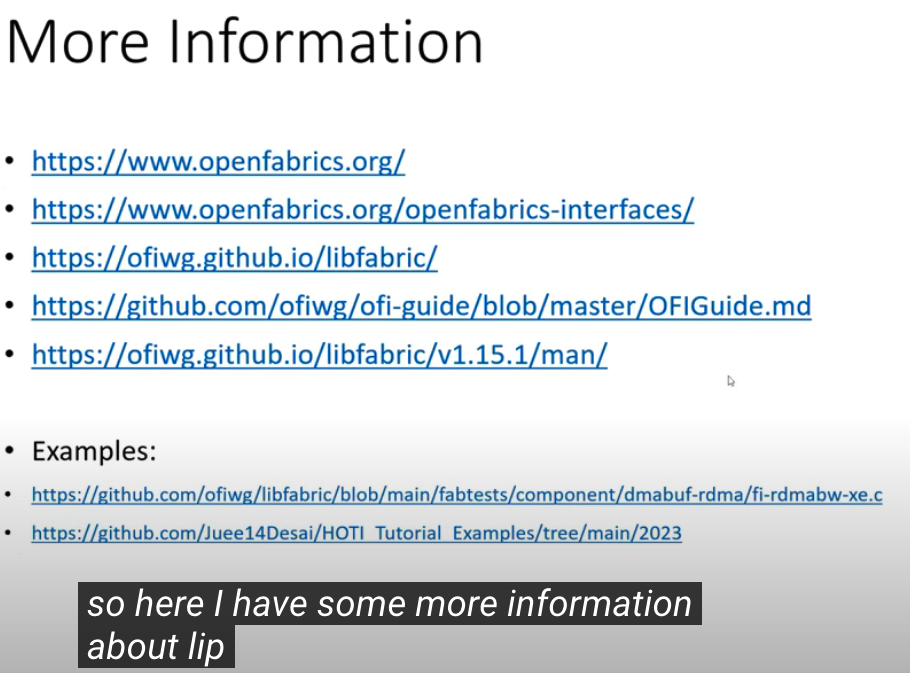
版权声明:本文内容由互联网用户自发贡献,该文观点仅代表作者本人。本站仅提供信息存储空间服务,不拥有所有权,不承担相关法律责任。如发现本站有涉嫌侵权/违法违规的内容,请联系我们,一经查实,本站将立刻删除。
如需转载请保留出处:https://51itzy.com/kjqy/86734.html