
在android开发中,经常会在子线程中进行一些操作,当操作完毕后会通过handler发送一些数据给主线程,通知主
线程做相应的操作。 探索其背后的原理:子线程 handler 主线程 其实构成了线程模型中的经典问题 生产者-消费者
模型。 生产者-消费者模型:生产者和消费者在同一时间段内共用同一个存储空间,生产者往存储空间中添加数据,
消费者从存储空间中取走数据。

源码分析:
Handler
Handler机制的相关类
- 创建Looper
- 创建MessageQueue以及Looper与当前线程的绑定
- Looper.loop()
- 创建Handler
- 创建Message
- Message和Handler的绑定
- Handler发送消息
- Handler处理消息
Handler机制的相关类
创建Looper
创建Looper的方法是调用Looper.prepare() 方法
在ActivityThread中的main方法中为我们prepare了
public static void main(String[] args) { Trace.traceBegin(Trace.TRACE_TAG_ACTIVITY_MANAGER, "ActivityThreadMain"); //其他代码省略... Looper.prepareMainLooper(); //初始化Looper以及MessageQueue ActivityThread thread = new ActivityThread(); thread.attach(false); if (sMainThreadHandler == null) { sMainThreadHandler = thread.getHandler(); } if (false) { Looper.myLooper().setMessageLogging(new LogPrinter(Log.DEBUG, "ActivityThread")); } // End of event ActivityThreadMain. Trace.traceEnd(Trace.TRACE_TAG_ACTIVITY_MANAGER); Looper.loop(); //开始轮循操作 throw new RuntimeException("Main thread loop unexpectedly exited"); }讯享网
Looper.prepareMainLooper();
讯享网public static void prepareMainLooper() { prepare(false);//消息队列不可以quit synchronized (Looper.class) { if (sMainLooper != null) { throw new IllegalStateException("The main Looper has already been prepared."); } sMainLooper = myLooper(); } }
public static void prepare() { prepare(true);//消息队列可以quit } //quitAllowed 主要 private static void prepare(boolean quitAllowed) { if (sThreadLocal.get() != null) {//不为空表示当前线程已经创建了Looper throw new RuntimeException("Only one Looper may be created per thread"); //每个线程只能创建一个Looper } sThreadLocal.set(new Looper(quitAllowed));//创建Looper并设置给sThreadLocal,这样get的 时候就不会为null了 }创建MessageQueue以及Looper与当前线程的绑定
讯享网private Looper(boolean quitAllowed) { mQueue = new MessageQueue(quitAllowed);//创建了MessageQueue mThread = Thread.currentThread(); //当前线程的绑定 }
MessageQueue的构造方法
MessageQueue(boolean quitAllowed) { //mQuitAllowed决定队列是否可以销毁 主线程的队列不可以被销毁需要传入false, 在MessageQueue的quit()方法 就不贴源码了 mQuitAllowed = quitAllowed; mPtr = nativeInit(); }Looper.loop()
同时是在main方法中 Looper.prepareMainLooper() 后Looper.loop(); 开始轮询
讯享网public static void loop() { final Looper me = myLooper();//里面调用了sThreadLocal.get()获得刚才创建的Looper对象 if (me == null) { throw new RuntimeException("No Looper; Looper.prepare() wasn't called on this thread."); }//如果Looper为空则会抛出异常 final MessageQueue queue = me.mQueue; // Make sure the identity of this thread is that of the local process, // and keep track of what that identity token actually is. Binder.clearCallingIdentity(); final long ident = Binder.clearCallingIdentity(); for (;;) { //这是一个死循环,从消息队列不断的取消息 Message msg = queue.next(); // might block if (msg == null) { //由于刚创建MessageQueue就开始轮询,队列里是没有消息的,等到Handler sendMessage enqueueMessage后 //队列里才有消息 // No message indicates that the message queue is quitting. return; } // This must be in a local variable, in case a UI event sets the logger Printer logging = me.mLogging; if (logging != null) { logging.println(">>>>> Dispatching to " + msg.target + " " + msg.callback + ": " + msg.what); } msg.target.dispatchMessage(msg);//msg.target就是绑定的Handler,详见后面Message的部 分,Handler开始 //后面代码省略..... msg.recycleUnchecked(); } }
创建Handler
最常见的创建handler
Handler handler=new Handler(){ @Override public void handleMessage(Message msg) { super.handleMessage(msg); } };在内部调用 this(null, false);
讯享网public Handler(Callback callback, boolean async) { //前面省略 mLooper = Looper.myLooper();//获取Looper,注意不是创建Looper! if (mLooper == null) { throw new RuntimeException( "Can't create handler inside thread that has not called Looper.prepare()"); } mQueue = mLooper.mQueue;//创建消息队列MessageQueue mCallback = callback; //初始化了回调接口 mAsynchronous = async; }
Looper.myLooper();
//这是Handler中定义的ThreadLocal ThreadLocal主要解多线程并发的问题 // sThreadLocal.get() will return null unless you've called prepare(). static final ThreadLocal<Looper> sThreadLocal = new ThreadLocal<Looper>(); public static @Nullable Looper myLooper() { return sThreadLocal.get(); }创建Message
讯享网public static Message obtain(Handler h) { Message m = obtain();//调用重载的obtain方法 m.target = h;//并绑定的创建Message对象的handler return m; } public static Message obtain() { synchronized (sPoolSync) {//sPoolSync是一个Object对象,用来同步保证线程安全 if (sPool != null) {//sPool是就是handler dispatchMessage 后 通过recycleUnchecked 回 收用以复用的Message Message m = sPool; sPool = m.next; m.next = null; m.flags = 0; // clear in-use flag sPoolSize--; return m; } } return new Message(); }
Message和Handler的绑定
创建Message的时候可以通过 Message.obtain(Handler h) 这个构造方法绑定。当然可以在 在Handler 中的
enqueueMessage()也绑定了,所有发送Message的方法都会调用此方法入队,所以在创建Message的时候是可
以不绑定的
private boolean enqueueMessage(MessageQueue queue, Message msg, long uptimeMillis) { msg.target = this; //绑定 if (mAsynchronous) { msg.setAsynchronous(true); } return queue.enqueueMessage(msg, uptimeMillis); }Handler发送消息

Handler发送消息的重载方法很多,但是主要只有2种。 sendMessage(Message) sendMessage方法通过一系列重
载方法的调用,sendMessage调用sendMessageDelayed,继续调用sendMessageAtTime,继续调用
enqueueMessage,继续调用messageQueue的enqueueMessage方法,将消息保存在了消息队列中,而最终由
Looper取出,交给Handler的dispatchMessage进行处理
我们可以看到在dispatchMessage方法中,message中callback是一个Runnable对象,如果callback不为空,则直接
调用callback的run方法,否则判断mCallback是否为空,mCallback在Handler构造方法中初始化,在主线程通直接
通过无参的构造方法new出来的为null,所以会直接执行后面的handleMessage()方法。
讯享网public void dispatchMessage(Message msg) { if (msg.callback != null) {//callback在message的构造方法中初始化或者使用 handler.post(Runnable)时候才不为空 handleCallback(msg); } else { if (mCallback != null) {//mCallback是一个Callback对象,通过无参的构造方法创建出来的handler, 该属性为null,此段不执行 if (mCallback.handleMessage(msg)) { return; } } handleMessage(msg);//最终执行handleMessage方法 } } private static void handleCallback(Message message) { message.callback.run(); }
Handler处理消息
在handleMessage(Message)方法中,我们可以拿到message对象,根据不同的需求进行处理,整个Handler机制的
流程就结束了。
小结
handler.sendMessage 发送消息到消息队列MessageQueue,然后looper调用自己的loop()函数带动
MessageQueue从而轮询messageQueue里面的每个Message,当Message达到了可以执行的时间的时候开始执
行,执行后就会调用message绑定的Handler来处理消息。大致的过程如下图所示

handler机制就是一个传送带的运转机制。
1)MessageQueue就像履带。
2)Thread就像背后的动力,就是我们通信都是基于线程而来的。
3)传送带的滚动需要一个开关给电机通电,那么就相当于我们的loop函数,而这个loop里面的for循环就会带着不断
的滚动,去轮询messageQueue
4)Message就是 我们的货物了。
难点问题
1. 线程同步问题
Handler是用于线程间通信的,但是它产生的根本并不只是用于UI处理,而更多的是handler是整个app通信的框架,
大家可以在ActivityThread里面感受到,整个App都是用它来进行线程间的协调。Handler既然这么重要,那么它的
线程安全就至关重要了,那么它是如何保证自己的线程安全呢?
Handler机制里面最主要的类MessageQueue,这个类就是所有消息的存储仓库,在这个仓库中,我们如何的管理好
消息,这个就是一个关键点了。消息管理就2点:1)消息入库(enqueueMessage),2)消息出库(next),所以
这两个接口是确保线程安全的主要档口。
enqueueMessage 源码如下:
boolean enqueueMessage(Message msg, long when) { if (msg.target == null) { throw new IllegalArgumentException("Message must have a target."); } if (msg.isInUse()) { throw new IllegalStateException(msg + " This message is already in use."); } // 锁开始的地方 synchronized (this) { if (mQuitting) { IllegalStateException e = new IllegalStateException( msg.target + " sending message to a Handler on a dead thread"); Log.w(TAG, e.getMessage(), e); msg.recycle(); return false; } msg.markInUse(); msg.when = when; Message p = mMessages; boolean needWake; if (p == null || when == 0 || when < p.when) { // New head, wake up the event queue if blocked. msg.next = p; mMessages = msg; needWake = mBlocked; } else { // Inserted within the middle of the queue. Usually we don't have to wake // up the event queue unless there is a barrier at the head of the queue // and the message is the earliest asynchronous message in the queue. needWake = mBlocked && p.target == null && msg.isAsynchronous(); Message prev; for (;;) { prev = p; p = p.next; if (p == null || when < p.when) { break; } if (needWake && p.isAsynchronous()) { needWake = false; } } msg.next = p; // invariant: p == prev.next prev.next = msg; } // We can assume mPtr != 0 because mQuitting is false. if (needWake) { nativeWake(mPtr); } } //锁结束的地方synchronized锁是一个内置锁,也就是由系统控制锁的lock unlock时机的。
synchronized (this)
这个锁,说明的是对所有调用同一个MessageQueue对象的线程来说,他们都是互斥的,然而,在我们的Handler里
面,一个线程是对应着一个唯一的Looper对象,而Looper中又只有一个唯一的MessageQueue(这个在上文中也有
介绍)。所以,我们主线程就只有一个MessageQueue对象,也就是说,所有的子线程向主线程发送消息的时候,
主线程一次都只会处理一个消息,其他的都需要等待,那么这个时候消息队列就不会出现混乱。
另外,在看next函数
讯享网Message next() { .... for (;;) { .... nativePollOnce(ptr, nextPollTimeoutMillis); synchronized (this) { // Try to retrieve the next message. Return if found. ... return msg; } } else { // No more messages. nextPollTimeoutMillis = -1; } ... }//synchronized 结束之处 // Run the idle handlers. // We only ever reach this code block during the first iteration. for (int i = 0; i < pendingIdleHandlerCount; i++) { final IdleHandler idler = mPendingIdleHandlers[i]; mPendingIdleHandlers[i] = null; // release the reference to the handler boolean keep = false; try { keep = idler.queueIdle(); } catch (Throwable t) { Log.wtf(TAG, "IdleHandler threw exception", t); } if (!keep) { synchronized (this) { mIdleHandlers.remove(idler); } } } // Reset the idle handler count to 0 so we do not run them again. pendingIdleHandlerCount = 0; // While calling an idle handler, a new message could have been delivered // so go back and look again for a pending message without waiting. nextPollTimeoutMillis = 0; } }
next函数疑问:我从线程里面取消息,而且每次都是队列的头部取,那么它加锁是不是没有意义呢?答
案是否定的,我们必须要在next里面加锁,因为,这样由于synchronized(this)作用范围是所有 this正在访问的代
码块都会有保护作用,也就是它可以保证 next函数和 enqueueMessage函数能够实现互斥。这样才能真正的保证多
线程访问的时候messagequeue的有序进行。
2. 消息机制之同步屏障
大家经过上面的学习应该知道,线程的消息都是放到同一个MessageQueue里面,取消息的时候是互斥取消息,而
且只能从头部取消息,而添加消息是按照消息的执行的先后顺序进行的排序,那么问题来了,同一个时间范围内的消
息,如果它是需要立刻执行的,那我们怎么办,按照常规的办法,我们需要等到队列轮询到我自己的时候才能执行
哦,那岂不是黄花菜都凉了。所以,我们需要给紧急需要执行的消息一个绿色通道,这个绿色通道就是同步屏障的概念。
MessageQueue#postSyncBarrier()
我们看看它的源码
/ * @hide / public int postSyncBarrier() { return postSyncBarrier(SystemClock.uptimeMillis()); } private int postSyncBarrier(long when) { // Enqueue a new sync barrier token synchronized (this) { final int token = mNextBarrierToken++; //从消息池中获取Message final Message msg = Message.obtain(); msg.markInUse(); //就是这里!!!初始化Message对象的时候,并没有给target赋值,因此 target==null msg.when = when; msg.arg1 = token; Message prev = null; Message p = mMessages; if (when != 0) { while (p != null && p.when <= when) { //如果开启同步屏障的时间(假设记为T)T不为0,且当前的同步消息里有时间小于T,则prev也不为null prev = p; p = p.next; } } //根据prev是不是为null,将 msg 按照时间顺序插入到 消息队列(链表)的合适位置 if (prev != null) { // invariant: p == prev.next msg.next = p; prev.next = msg; } else { msg.next = p; mMessages = msg; } return token; } }可以看到,Message 对象初始化的时候并没有给 target 赋值,因此, target == null 的 来源就找到了。上面消
息的插入也做了相应的注释。这样,一条 target == null 的消息就进入了消息队列。
那么,开启同步屏障后,所谓的异步消息又是如何被处理的呢?
如果对消息机制有所了解的话,应该知道消息的最终处理是在消息轮询器 Looper#loop() 中,而 loop() 循环中会
调用 MessageQueue#next() 从消息队列中进行取消息。
//MessageQueue.java
Message next()
讯享网.....//省略一些代码 int pendingIdleHandlerCount = -1; // -1 only during first iteration // 1.如果nextPollTimeoutMillis=-1,一直阻塞不会超时。 // 2.如果nextPollTimeoutMillis=0,不会阻塞,立即返回。 // 3.如果nextPollTimeoutMillis>0,最长阻塞nextPollTimeoutMillis毫秒(超时) // 如果期间有程序唤醒会立即返回。 int nextPollTimeoutMillis = 0; //next()也是一个无限循环 for (;;) { if (nextPollTimeoutMillis != 0) { Binder.flushPendingCommands(); } nativePollOnce(ptr, nextPollTimeoutMillis); synchronized (this) { //获取系统开机到现在的时间 final long now = SystemClock.uptimeMillis(); Message prevMsg = null; Message msg = mMessages; //当前链表的头结点 //关键!!! //如果target==null,那么它就是屏障,需要循环遍历,一直往后找到第一个异步的消息 if (msg != null && msg.target == null) { // Stalled by a barrier. Find the next asynchronous message in the queue. do { prevMsg = msg; msg = msg.next; } while (msg != null && !msg.isAsynchronous()); } if (msg != null) { //如果有消息需要处理,先判断时间有没有到,如果没到的话设置一下阻塞时间, //场景如常用的postDelay if (now < msg.when) { //计算出离执行时间还有多久赋值给nextPollTimeoutMillis, //表示nativePollOnce方法要等待nextPollTimeoutMillis时长后返回 nextPollTimeoutMillis = (int) Math.min(msg.when - now, Integer.MAX_VALUE); } else { // 获取到消息 mBlocked = false; //链表操作,获取msg并且删除该节点 if (prevMsg != null) prevMsg.next = msg.next; } else { mMessages = msg.next; } msg.next = null; msg.markInUse(); //返回拿到的消息 return msg; } } else { //没有消息,nextPollTimeoutMillis复位 nextPollTimeoutMillis = -1; } .....//省略 }
从上面可以看出,当消息队列开启同步屏障的时候(即标识为 msg.target == null ),消息机制在处理消息的时
候,优先处理异步消息。这样,同步屏障就起到了一种过滤和优先级的作用。
下面用示意图简单说明:
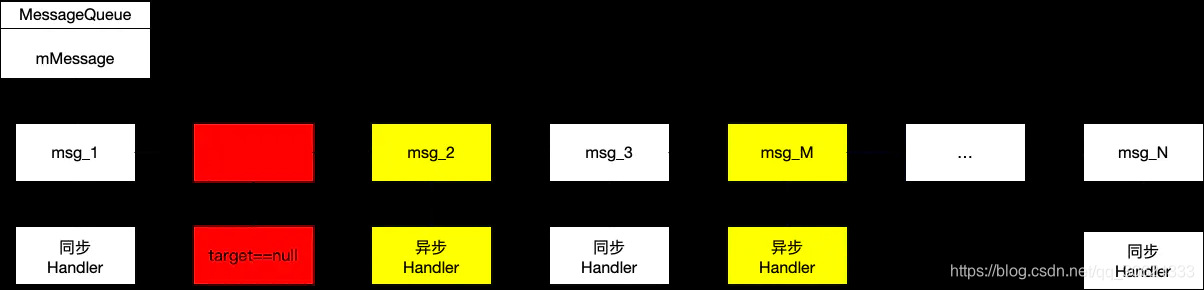
如上图所示,在消息队列中有同步消息和异步消息(黄色部分)以及一道墙----同步屏障(红色部分)。有了同步屏
障的存在,msg_2 和 msg_M 这两个异步消息可以被优先处理,而后面的 msg_3 等同步消息则不会被处理。那么这
些同步消息什么时候可以被处理呢?那就需要先移除这个同步屏障,即调用 removeSyncBarrier() 。
同步消息的应用场景
似乎在日常的应用开发中,很少会用到同步屏障。那么,同步屏障在系统源码中有哪些使用场景呢?Android 系统中
的 UI 更新相关的消息即为异步消息,需要优先处理。
比如,在 View 更新时,draw、requestLayout、invalidate 等很多地方都调用了
ViewRootImpl#scheduleTraversals() ,如下:
//ViewRootImpl.java
void scheduleTraversals() { if (!mTraversalScheduled) { mTraversalScheduled = true; //开启同步屏障 mTraversalBarrier = mHandler.getLooper().getQueue().postSyncBarrier(); //发送异步消息 mChoreographer.postCallback( Choreographer.CALLBACK_TRAVERSAL, mTraversalRunnable, null); if (!mUnbufferedInputDispatch) { scheduleConsumeBatchedInput(); } notifyRendererOfFramePending(); pokeDrawLockIfNeeded(); } }postCallback() 最终走到了 ChoreographerpostCallbackDelayedInternal() :
讯享网private void postCallbackDelayedInternal(int callbackType, Object action, Object token, long delayMillis) { if (DEBUG_FRAMES) { Log.d(TAG, "PostCallback: type=" + callbackType- ", action=" + action + ", token=" + token =" + delayMillis); } synchronized (mLock) { final long now = SystemClock.uptimeMillis(); final long dueTime = now + delayMillis; mCallbackQueues[callbackType].addCallbackLocked(dueTime, action, token); if (dueTime <= now) { scheduleFrameLocked(now); } else { Message msg = mHandler.obtainMessage(MSG_DO_SCHEDULE_CALLBACK, action); msg.arg1 = callbackType; msg.setAsynchronous(true); //异步消息 mHandler.sendMessageAtTime(msg, dueTime); } } }
这里就开启了同步屏障,并发送异步消息,由于 UI 更新相关的消息是优先级最高的,这样系统就会优先处理这些异
步消息。
最后,当要移除同步屏障的时候需要调用 ViewRootImpl#unscheduleTraversals() 。
void unscheduleTraversals() { if (mTraversalScheduled) { mTraversalScheduled = false; //移除同步屏障 mHandler.getLooper().getQueue().removeSyncBarrier(mTraversalBarrier); mChoreographer.removeCallbacks( Choreographer.CALLBACK_TRAVERSAL, mTraversalRunnable, null); } }小结
同步屏障的设置可以方便地处理那些优先级较高的异步消息。当我们调用
Handler.getLooper().getQueue().postSyncBarrier() 并设置消息的 setAsynchronous(true) 时,target 即
为 null ,也就开启了同步屏障。当在消息轮询器 Looper 在 loop() 中循环处理消息时,如若开启了同步屏障,会优
先处理其中的异步消息,而阻碍同步消息。
版权声明:本文内容由互联网用户自发贡献,该文观点仅代表作者本人。本站仅提供信息存储空间服务,不拥有所有权,不承担相关法律责任。如发现本站有涉嫌侵权/违法违规的内容,请联系我们,一经查实,本站将立刻删除。
如需转载请保留出处:https://51itzy.com/kjqy/63292.html