
本项目基于一个流行的日本谜题--"Hashiwokakero"、"Hashi "或 "Bridges"。你需要编写一个程序来解决这个谜题,并简要说明你所使用的算法和数据结构。
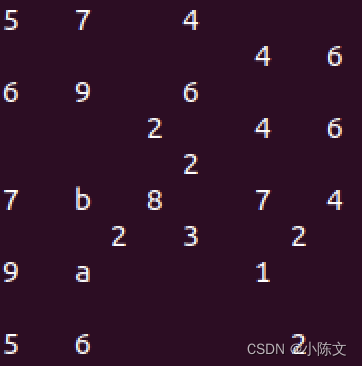
程序的输入将是一个由数字和点组成的矩形数组,例如:
讯享网
每个数字代表一个 "岛屿",而点代表岛屿之间的空隙(水域)。大于 9 的数字用 "a"(10)、"b"(11)或 "c"(12)表示。游戏的目的是用一个桥梁网络连接所有岛屿,同时满足以下规则:
1.所有桥梁必须水平或垂直延伸
2.桥梁不能相互交叉,也不能与其他岛屿交叉
3.连接任何一对岛屿的桥梁不能超过三座
4.连接每个岛屿的桥梁总数必须等于岛上的桥梁数
5.例如,读取上述 10 行输入后,您的程序可能会产生以下输出:

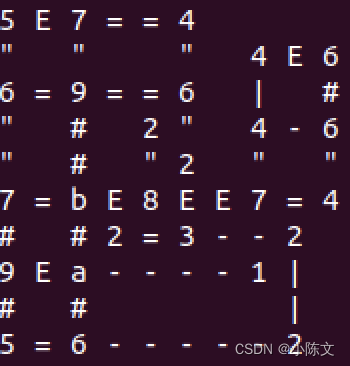
请注意,单座桥梁用字符"-"或"|"表示,成对桥梁用"="或"""表示,三座桥梁用 "E "或"#"表示,
import sys import random direction = [(0, -1), (-1, 0), (0, 1), (1, 0)] max_bridge_num = 3 ch_to_int = [{0: 0, '-': 1, '=': 2, 'E': 3, '|': 0, '"': 0, '#': 0}, {0: 0, '|': 1, '"': 2, '#': 3, '-': 0, '=': 0, 'E': 0}] int_to_ch = [{0: 0, 1: '-', 2: '=', 3: 'E'}, {0: 0, 1: '|', 2: '"', 3: '#'}] def scan_map(): text = [] for line in sys.stdin: row = [] for ch in line: n = ord(ch) if n >= 48 and n <= 57: # between '0' and '9' row.append(n - 48) elif n >= 97 and n <= 122: # between 'a' and 'z' row.append(n - 87) elif ch == '.': row.append(0) text.append(row) return text def get_bridge_code(dir, ch): if isinstance(ch, int) and 0 < ch: return 0 return ch_to_int[dir % 2][ch] def format(ele): if isinstance(ele, int): if ele >= 10: return chr(ord('a') + ele - 10) elif ele == 0: return ' ' return ele def print_map(data): for row in data: # print(' '.join(str(format(cell)) for cell in row)) print(''.join(str(format(cell)) for cell in row)) def map_2_tuple(data): return tuple(tuple(row) for row in data) def is_valid(data, i, j): n = len(data) m = len(data[0]) if i >= 0 and i < n and j >= 0 and j < m: return True return False def get_bridge_num(data, i, j, dir): ni = i + direction[dir][0] nj = j + direction[dir][1] if not is_valid(data, ni, nj): return 0 return get_bridge_code(dir % 2, data[ni][nj]) def search_direction(data, i, j, dir): bnum = get_bridge_num(data, i, j, dir) if bnum >= max_bridge_num: return [0, (-1,-1)] bnch = int_to_ch[dir % 2][bnum] ni = i + direction[dir][0] nj = j + direction[dir][1] while is_valid(data, ni, nj) and data[ni][nj] == bnch: ni = ni + direction[dir][0] nj = nj + direction[dir][1] if not is_valid(data, ni, nj): return [0, (-1,-1)] if isinstance(data[ni][nj], int) and 0 < data[ni][nj]: exsit_bn = 0 for nd in range(0, 4): exsit_bn += get_bridge_num(data, ni, nj, nd) return [min(max_bridge_num - bnum, data[ni][nj] - exsit_bn), (ni,nj)] return [0, (-1,-1)] def potential_bridge_num(data, i, j, dir): return search_direction(data, i, j, dir)[0] def add_bridge(data, i, j, dir, num): if num == 0: return #print("bridge",i,j,dir,num) bnum = get_bridge_num(data, i, j, dir) bnch = int_to_ch[dir % 2][bnum] nbnch = int_to_ch[dir % 2][bnum + num] ni = i + direction[dir][0] nj = j + direction[dir][1] while is_valid(data, ni, nj) and data[ni][nj] == bnch: data[ni][nj] = nbnch ni = ni + direction[dir][0] nj = nj + direction[dir][1] def get_min_comfirmed_bridges(potential, remain_bn): sump = sum(potential) min_bridge_list = [] for p in potential: min_bridge_list.append(max(0, remain_bn - sump + p)) return min_bridge_list def add_comfirmed_and_check(data, ris): n = len(data) m = len(data[0]) correct = True valid = True no_comfirmed_bridge = True for (i, j) in ris: exsit = [] potential = [] for d in range(0, 4): exsit.append(get_bridge_num(data, i, j, d)) potential.append(potential_bridge_num(data, i, j, d)) if sum(potential) + sum(exsit) >= data[i][j]: min_bridge = get_min_comfirmed_bridges(potential, data[i][j] - sum(exsit)) for d in range(0, 4): if min_bridge[d] > 0: no_comfirmed_bridge = False add_bridge(data, i, j, d, min_bridge[d]) exsit[d] += min_bridge[d] potential[d] -= min_bridge[d] else: valid = False if sum(exsit) > data[i][j]: valid = False elif sum(exsit) < data[i][j]: correct = False elif sum(exsit) == data[i][j]: if (i,j) in ris: ris.remove((i,j)) return [correct, valid, no_comfirmed_bridge] def dfs_map(data, i, j, vis2): if (i,j) in vis2.keys(): return 0 vis2[(i,j)] = True ret = data[i][j] for d in range(0, 4): ret -= get_bridge_num(data, i, j, d) [potential, (ni,nj)] = search_direction(data,i,j,d) if potential > 0: ret += dfs_map(data, ni, nj, vis2) if ret < 0: print("error") return ret def check_map_right(data, ris): dfs_vis = {} for (i, j) in ris: numsum = dfs_map(data,i, j,dfs_vis) if numsum % 2 == 1: return False return True def cost_estimation(num, po): if (num,po[0],po[1],po[2],po[3]) in est_mp.keys(): return est_mp[(num,po[0],po[1],po[2],po[3])] if num == 0: return 0 count = 0 for i in range(0,4): for k in range(1, po[i]+1): if num - k >= 0: copied_po = po[:] copied_po[i] -= k count += cost_estimation(num-k, copied_po) + 1 est_mp[(num,po[0],po[1],po[2],po[3])] = count return count def heuristic(data, ris): res = [] for (i, j) in ris: exsit = [] potential = [] for d in range(0, 4): exsit.append(get_bridge_num(data, i, j, d)) potential.append(potential_bridge_num(data, i, j, d)) if sum(exsit) == data[i][j]: continue remain = data[i][j]-sum(exsit) cost = cost_estimation(remain, potential) res.append((i,j,cost)) #random.shuffle(res) #res_xy = [(x[0], x[1]) for x in res] #return res_xy sorted_res = sorted(res, key=lambda x: x[2]) sorted_res_xy = [(x[0], x[1]) for x in sorted_res] return sorted_res_xy def backtrack(data, vis, ris): if map_2_tuple(data) in vis.keys(): return False vis[map_2_tuple(data)] = True while True: [correct, valid, no_comfirmed] = add_comfirmed_and_check(data, ris) if not valid: return False if correct: print_map(data) return True if no_comfirmed: break if not check_map_right(data, ris): return False #print_map(data) #print("--------"+str(len(vis))+"----------") ris = heuristic(data, ris) for (i, j) in ris: dir_list = [0, 1, 2, 3] random.shuffle(dir_list) for d in dir_list: if potential_bridge_num(data, i, j, d) > 0: data_tmp = [row[:] for row in data] ris_tmp = ris[:] add_bridge(data_tmp, i, j, d, 1) if backtrack(data_tmp, vis, ris_tmp): return True return False if __name__ == '__main__': map = scan_map() #print_map(map) #print("------------------------") vis = {} islands = [] est_mp = {} n = len(map) m = len(map[0]) for i in range(0, n): for j in range(0, m): if isinstance(map[i][j], int) and 0 < map[i][j]: islands.append((i,j)) backtrack(map,vis,islands) 讯享网
版权声明:本文内容由互联网用户自发贡献,该文观点仅代表作者本人。本站仅提供信息存储空间服务,不拥有所有权,不承担相关法律责任。如发现本站有涉嫌侵权/违法违规的内容,请联系我们,一经查实,本站将立刻删除。
如需转载请保留出处:https://51itzy.com/kjqy/133833.html