
选自:数据结构java语言描述,罗福强、杨剑、刘英编著
创建邻接矩阵表示的无向图、有向图、有向网。
网:带权的图。
package 图Graph; import java.util.Scanner; public class Graph<T>{
    protected final int MAXSIZE=10; protected final int MAX=999; protected T[] V; //顶点信息 protected int[][] arcs; //邻接矩阵 protected int e; //边数 protected int n; //顶点数  public static int inf=; //用于表示无穷大,即无路径可到达 public Graph( ){
    V =(T[]) new Object[MAXSIZE]; arcs=new int[MAXSIZE][MAXSIZE]; } public void GreateAdj() {
    // 建立邻接矩阵 无向图 时间复杂度O(n^2) int i,j,k; T v1,v2; Scanner sc=new Scanner(System.in); System.out.println("请输入图的顶点数及边数"); System.out.print("顶点数n=");n=sc.nextInt(); System.out.print("边数e=");e=sc.nextInt(); System.out .print ("请输人图的顶点信息: "); String str=sc.next(); for (i=0;i<n;i++) {
    V[i]= (T) (Object)str.charAt(i);//构造顶点信息 } // for(i=0;i<n;i++) // for (j=0;j<n;j++) // arcs[i][j]=0;//初始化邻接矩阵 System.out.println ("请输人图的边的信息: "); for(k=0;k<e;k++) {
    System.out .print ("请输人第"+(k+1)+"条边的两个瑞点: "); str=sc.next();//输人一条边的两个顶点 v1=(T) (Object)str.charAt(0); v2=(T) (Object)str.charAt(1) ; //确定两个顶点在图G中的位置 i=LocateVex (v1);j=LocateVex(v2); //算法 6-1,51行 if(i>=0 && j>=0) {
    //构建无向图 arcs[i][j]=1; arcs[j][i]=1; } // if(i>=0 && j>=0) { //构建有向图 // arcs[i][j]=1; // } } } public void GreateAdjW() {
    // 建立邻接矩阵 有向网 时间复杂度O(n^2) int i,j,k; T v1,v2; Scanner sc=new Scanner(System.in); System.out.println("请输入图的顶点数及边数"); System.out.print("顶点数n=");n=sc.nextInt(); System.out.print("边数e=");e=sc.nextInt(); System.out .print ("请输人图的顶点信息: "); String str=sc.next(); for (i=0;i<n;i++) {
    V[i]= (T) (Object)str.charAt(i);//构造顶点信息 } for(i=0;i<n;i++) //初始化邻接矩阵 for (j=0;j<n;j++) arcs[i][j]=inf; System.out.println ("请输人图的边的信息: "); for(k=0;k<e;k++) {
    int weight; //定义一个权值 System.out .print ("请输人第"+(k+1)+"条边的两个瑞点: "); str=sc.next();//输人一条边的两个顶点 v1=(T) (Object)str.charAt(0); v2=(T) (Object)str.charAt(1) ; System.out.println("权值:"); weight=sc.nextInt(); //确定两个顶点在图G中的位置 i=LocateVex (v1);j=LocateVex(v2); //算法 6-1,51行 if(i>=0 && j>=0) {
    //构建权值为weight的路径 arcs[i][j]=weight; } } } public int LocateVex(T v){
    //在图G中查找顶点  int i; for(i=0;i<n;i++) {
    if(V[i]==v) {
    return i; } } return -1; } public void DisplayAdjMatrix( ){
    //在屏幕上显示图G的邻接矩阵表示 int i,j; System.out.println("图的邻接矩阵表示:"); for(i=0;i<n;i++){
    for(j=0;j<n;j++){
    System.out.print(" "+arcs[i][j]); } System.out.println(); } } public static void main(String[] args) {
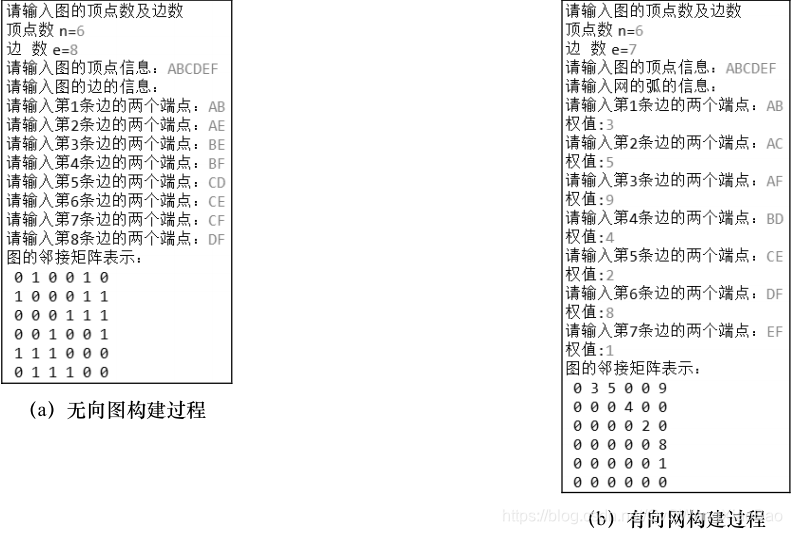
// TODO Auto-generated method stub Graph<Character> G=new Graph<Character>(); G.GreateAdj(); G.DisplayAdjMatrix(); } } 效果图:

创建邻接表表示的无向图、有向图的邻接表、逆邻接表。
讯享网public class ArcNode {
    //边结点的类型定义 int adjVex; //存放邻接的点的序号 ArcNode nextArc; //指向Vi 下一个邻接点的边结点 int weight; //权值 public ArcNode () {
    adjVex=0; weight=0; nextArc=null; } }
public class VNode<T> {
    //顶点结点类型定义 T data; //存储顶点的名称或其相关信息 ArcNode firstArc; //指向 顶点Vi的第一个邻接点的边结点 public VNode() {
data=null; firstArc=null; } } 讯享网import java.util.Scanner; public class ALGraph<T> {
protected final int MAXSIZE=10; protected VNode[] adjList; //顶点结点信息 int n,e;// 图的顶点数和弧数 public ALGraph() {
adjList=new VNode [MAXSIZE] ; } public void CreateLink(){
//创建无向图的邻接表 时间复杂度O(n+e) int i,j, k; T v1, v2; String str; Scanner sc=new Scanner(System.in); System.out.println ("请输人图的顶点数及边数"); System.out.print ("顶点数n=");n=sc.nextInt(); System.out.print("边数e=") ;e=sc.nextInt() ; System.out.println ("请输入图的顶点信息: ") ; str=sc.next(); for(i=0; i<n; i++) {
adjList[i]=new VNode<T> () ; adjList[i].data=str.charAt(i) ; //构造顶点信息 adjList[i].firstArc=null; } System.out.println("请输入图的边的信息: "); for (k=0; k<e; k++) {
System. out.print ("请输入第"+ (k+1) +"条边的两个端点: ") ; str=sc.next() ;//输人一条边的两个顶点 v1=(T) (Object) str.charAt(0) ; v2= (T) (Object) str.charAt(1) ; //确定两个顶点在图G中的位置 i=LocateVex(v1) ;j=LocateVex(v2) ; if (i>=0&&j>=0) {
ArcNode s=new ArcNode(); s.adjVex=j ; s.nextArc=adjList[i].firstArc; adjList[i].firstArc=s; s=new ArcNode () ; s .adjVex=i; s .nextArc=adjList[j].firstArc; adjList[j].firstArc=s; } } } public void CreateLinkY(){
//创建有向图的邻接表 时间复杂度O(n+e) int i,j, k; T v1, v2; String str; Scanner sc=new Scanner(System.in); System.out.println ("请输人图的顶点数及边数"); System.out.print ("顶点数n=");n=sc.nextInt(); System.out.print("边数e=") ;e=sc.nextInt() ; System.out.println ("请输入图的顶点信息: ") ; str=sc.next(); for(i=0; i<n; i++) {
adjList[i]=new VNode<T> () ; adjList[i].data=str.charAt(i) ; //构造顶点信息 adjList[i].firstArc=null; } System.out.println("请输入图的边的信息: "); for (k=0; k<e; k++) {
System. out.print ("请输入第"+ (k+1) +"条边的两个端点: ") ; str=sc.next() ;//输人一条边的两个顶点 v1=(T) (Object) str.charAt(0) ; v2= (T) (Object) str.charAt(1) ; //确定两个顶点在图G中的位置 i=LocateVex(v1) ;j=LocateVex(v2) ; if (i>=0&&j>=0) {
//若要求逆邻接表,只需将下面的i换为j,j换为i ArcNode s=new ArcNode(); s.adjVex=j; s.nextArc=adjList[i].firstArc; adjList[i].firstArc=s; } } } //在图中查找顶点v,找到后返回其在顶点数组中的索引号 public int LocateVex(T v) {
int i; for(i=0; i<n; i++) if (adjList[i] .data==v) return i; return -1 ; } public void DisplayAdjList(){
//在屏幕上显示图的邻接表表示 int i; ArcNode p; System.out.println ("图的邻接表表示: ") ; for (i=0; i<n; i++) {
System.out.print ("\n "+adjList[i] .data) ; p=adjList[i].firstArc; while (p!=null) {
System.out.print ("-->"+p.adjVex) ;p=p. nextArc; } } } public static void main(String[] args) {
// TODO Auto-generated method stub ALGraph<Character> G=new ALGraph<Character> () ; G.CreateLink() ; G.DisplayAdjList() ; } }
效果图:

版权声明:本文内容由互联网用户自发贡献,该文观点仅代表作者本人。本站仅提供信息存储空间服务,不拥有所有权,不承担相关法律责任。如发现本站有涉嫌侵权/违法违规的内容,请联系我们,一经查实,本站将立刻删除。
如需转载请保留出处:https://51itzy.com/kjqy/118952.html