
关节点算法
- 关节点的定义
在连通图当中,对于某个顶点的孩子顶点或其子树中顶点,如果要访问某个顶点的双亲节点或更上级节点,必须经过此顶点,那么此顶点我们称之为关节点。 对于关节点之下的某个子树,这个关节点充当"一夫当关,万夫莫开"的角色。在算法中,关节点可以通过多次深度优先搜或合并的深度优先搜索求得。 - 关节点算法中的基本规则
对于本文中的图,我们抽象出下属几个变量和规则来完成关节点的算法。

对于每个顶点,都具备以下属性:
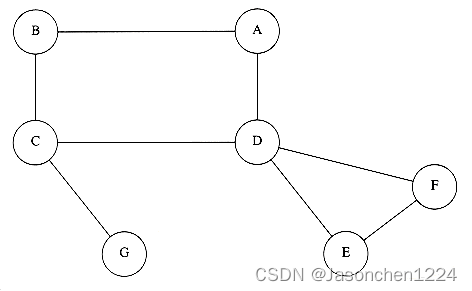
- num[v]: 通过DFS访问某个顶点的次序,为了方便描述我们定义A为0号元素,以此类推,那么从顶点A开始遍历,num[v]的可能数组为num[0]=1, num[3]=1, num[4]=3, num[5]=4,num[2]=5, num[6]=6; num[1]=7;
- visited[v]: 标记元素v是否被访问,未方位标记为0,已访问标记为1
- low[v]数组,对于某个元素的low[v]的值,取决于下列三类值的递归大小
- num[v] - Rule 1
- the lowest num[w] among all back edges(v,w)- Rule 2
- the lowest low[w] among all tree edges(v,w) -Rule 3
对于num[v],代表节点自身访问次序号,它不考虑任何tree edge 或者 back edge,可以采用先序深度遍历实现;对于num[w]只得是v的某个孩子节点或更下的孩子节点有回边到v的父节点之上的顶点(v的直接父节点不考虑);对于low[w]为在孩子节点中不断搜寻最小的值,逐个孩子进行比较,这里涉及到后续遍历处理完成退出递归后的比较处理,在这个过程中可能也涉及到回边的处理。
- 判断为节点的条件,有两种情况可以认定某个顶点为节点
- 如果根节点有两个或两个以上的独立的子树,那么根节点就是关节点,因为如果移除根节点,那么就会形成两棵独立的子树
- 对于非根节点,如果其low(w)>=num(v), 其中w为v的邻接点,这时候,如果w要回达到v以上的祖先节点,那么v就是必经点,此时v为关节点。如果v为根节点,那么此关系总成立,所以需要进行独立判断。
- 代码实现,本代码采用两个DFS进行遍历,其中第一个DFS求出num数组,第二个DFS进行遍历,求出low数组,同时打印出关节点。在第二个DFS遍历过程中,需要判断(v,w)边的类型,可以利用num数组进行判断,对于tree edge(直接遍历边),num[w]>num[v],对于back edge(回边)num[w]<num[v], 通过比较两个顶点大小,便可判断访问边的基本类型。
/* @brief, This function will work out the vertex visiting order via DFS traversal and the order will be kept in the num[s] in the pre-order mode @param G, Adjacent List Graph @param s, Starting Search Point */ void assign_num(ALGraph G,int s) {
    int v; int w; //counter is the global variable to indicate the visiting order //num is also the global varaible shared in different functions //visited[] indicate if the vertex had been visited or not  num[s]=counter++; visited[s]=1; v = s; for(w=FirstAdjVex(G,v);w>=0;w=NextAdjVex(G,v,w)) {
    if(!visited[w]) {
    //parent[] will be used if keep the parent of vertex parent[w]=v; assign_num(G,w); } } }
讯享网 void assign_low(ALGraph G, int s,void (*visit)(VertexType e)) {
int v; int w; v=s; low[v]=num[v]; //Rule 1, taking no edges into account/consideration for(w=FirstAdjVex(G,v);w>=0;w=NextAdjVex(G,v,w)) {
if(num[w]>num[v]) //tree(forward) edge, rule 3 {
assign_low(G,w,visit); if(low[w]>=num[v]) {
visit(G.vertices[v].data); } //select the minimum low[v] from variout w children if(low[v]>low[w]) {
low[v]=low[w]; } } //parent[v]!=w will exclude the v's direct parent //since it had been visited in the recursive call else if(parent[v]!=w) //backward edge rule 2 {
if(low[v]>num[w]) {
low[v]=num[w]; } } } }
//@param s Search start point and will take as the root node void find_articulation_point(ALGraph G, int s, void (*visit)(VertexType e)) {
    int v; int w; v=s; counter =1; memset(visted,0,sizeof(int)*MAX_NUM_VERTEX); visited[s]=1; num[s]=counter++; w=FirstAdjVex(G,v); assign_num(G,w); assign_low(G,w,visit); //if counter is less than the total number of vertex // it indciates root vertex will have more than 1 tree // the root node will be articulation point if(counter<G.vexnum) {
    visit(G.vertices[s].data); while(NextAdjVex(G,v,w)>=0) {
    w=NextAdjVex(G,v,w); if(!visited[w]) {
assign_num(G, w); assign_low(G, w, visit); } } } } - 总结
对于关节点,其关键思想在于探测某个顶点的子树中节点是否存在回边(back edge),如果某个子树中所有顶点都不存在回边,无论其它子树是否存在回边,那么此顶点就是关节点。其程序实现的核心在于利用 先序和后续处理相结合的方式,最终求得图的所有关节点,其算法复杂度都为O(|E|+|V|).
求low[v]过程为,比上(祖先节点)比下(孩子节点)比自己(初始访问次序号或根节点号),最后取最小。
2023-2 上海

Reference book
《Data structure and Algorithm Analysis in C, Second Edition》
by Mark Ellen Weiss
版权声明:本文内容由互联网用户自发贡献,该文观点仅代表作者本人。本站仅提供信息存储空间服务,不拥有所有权,不承担相关法律责任。如发现本站有涉嫌侵权/违法违规的内容,请联系我们,一经查实,本站将立刻删除。
如需转载请保留出处:https://51itzy.com/kjqy/84983.html