
1.介绍
在AAEGan(AAEGan 简介与代码实战)中,图片经过编码端可以被提取出隐变量z,隐变量z通过解码端可以被生成图片,其实这里面就有一种对称美,我们今天的猪脚BiGan也是有对称美。更加详细的内容可以参见论文: ADVERSARIAL FEATURE LEARNING
2.模型结构
整个结构包括三部分:Encode网络,G网络,D网络。
Encode网络,提取原始图片的隐变量
G网络,将噪声生成图片
D网络,判断这个配对(原始图片和隐变量 生成图片和噪声)是来自encoder还是decoder

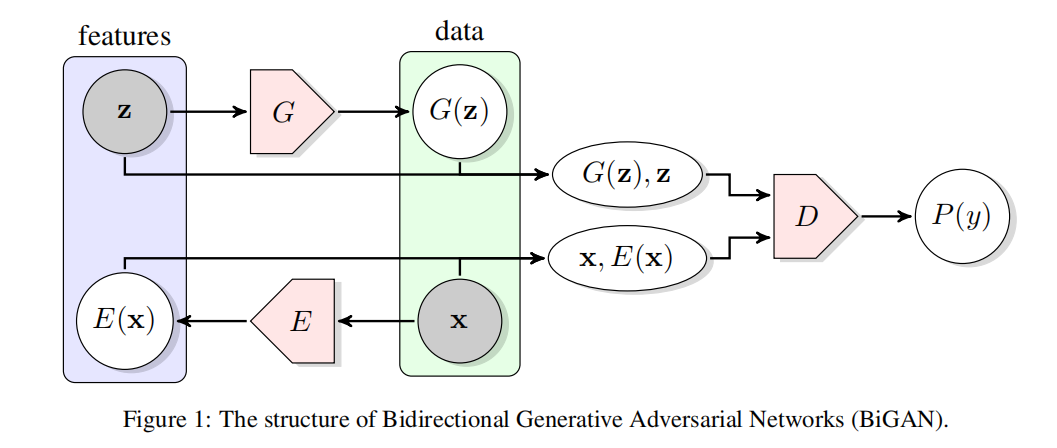
3.模型特点
bigan的全称是Bidirectional GAN,中文翻译是“双向Gan”,对于配对“原始图片和隐变量 ”原始图片是已知的,隐变量 是学习噪声,对于配对“生成图片和噪声”,噪声是已知的,生成图片是学习原始图片,这就是一个双向学习过程。
4.代码实现keras
class BIGAN(): def __init__(self): self.img_rows = 28 self.img_cols = 28 self.channels = 1 self.img_shape = (self.img_rows, self.img_cols, self.channels) self.latent_dim = 100 optimizer = Adam(0.0002, 0.5) # Build and compile the discriminator self.discriminator = self.build_discriminator() self.discriminator.compile(loss=['binary_crossentropy'], optimizer=optimizer, metrics=['accuracy']) # Build the generator self.generator = self.build_generator() # Build the encoder self.encoder = self.build_encoder() # The part of the bigan that trains the discriminator and encoder self.discriminator.trainable = False # Generate image from sampled noise z = Input(shape=(self.latent_dim, )) img_ = self.generator(z) # Encode image img = Input(shape=self.img_shape) z_ = self.encoder(img) # Latent -> img is fake, and img -> latent is valid fake = self.discriminator([z, img_]) valid = self.discriminator([z_, img]) # Set up and compile the combined model # Trains generator to fool the discriminator self.bigan_generator = Model([z, img], [fake, valid]) self.bigan_generator.compile(loss=['binary_crossentropy', 'binary_crossentropy'], optimizer=optimizer) def build_encoder(self): model = Sequential() model.add(Flatten(input_shape=self.img_shape)) model.add(Dense(512)) model.add(LeakyReLU(alpha=0.2)) model.add(BatchNormalization(momentum=0.8)) model.add(Dense(512)) model.add(LeakyReLU(alpha=0.2)) model.add(BatchNormalization(momentum=0.8)) model.add(Dense(self.latent_dim)) model.summary() img = Input(shape=self.img_shape) z = model(img) return Model(img, z) def build_generator(self): model = Sequential() model.add(Dense(512, input_dim=self.latent_dim)) model.add(LeakyReLU(alpha=0.2)) model.add(BatchNormalization(momentum=0.8)) model.add(Dense(512)) model.add(LeakyReLU(alpha=0.2)) model.add(BatchNormalization(momentum=0.8)) model.add(Dense(np.prod(self.img_shape), activation='tanh')) model.add(Reshape(self.img_shape)) model.summary() z = Input(shape=(self.latent_dim,)) gen_img = model(z) return Model(z, gen_img) def build_discriminator(self): z = Input(shape=(self.latent_dim, )) img = Input(shape=self.img_shape) d_in = concatenate([z, Flatten()(img)]) model = Dense(1024)(d_in) model = LeakyReLU(alpha=0.2)(model) model = Dropout(0.5)(model) model = Dense(1024)(model) model = LeakyReLU(alpha=0.2)(model) model = Dropout(0.5)(model) model = Dense(1024)(model) model = LeakyReLU(alpha=0.2)(model) model = Dropout(0.5)(model) validity = Dense(1, activation="sigmoid")(model) return Model([z, img], validity) def train(self, epochs, batch_size=128, sample_interval=50): # Load the dataset (X_train, _), (_, _) = mnist.load_data() # Rescale -1 to 1 X_train = (X_train.astype(np.float32) - 127.5) / 127.5 X_train = np.expand_dims(X_train, axis=3) # Adversarial ground truths valid = np.ones((batch_size, 1)) fake = np.zeros((batch_size, 1)) for epoch in range(epochs): # --------------------- # Train Discriminator # --------------------- # Sample noise and generate img z = np.random.normal(size=(batch_size, self.latent_dim)) imgs_ = self.generator.predict(z) # Select a random batch of images and encode idx = np.random.randint(0, X_train.shape[0], batch_size) imgs = X_train[idx] z_ = self.encoder.predict(imgs) # Train the discriminator (img -> z is valid, z -> img is fake) d_loss_real = self.discriminator.train_on_batch([z_, imgs], valid) d_loss_fake = self.discriminator.train_on_batch([z, imgs_], fake) d_loss = 0.5 * np.add(d_loss_real, d_loss_fake) # --------------------- # Train Generator # --------------------- # Train the generator (z -> img is valid and img -> z is is invalid) g_loss = self.bigan_generator.train_on_batch([z, imgs], [valid, fake]) # Plot the progress print ("%d [D loss: %f, acc: %.2f%%] [G loss: %f]" % (epoch, d_loss[0], 100*d_loss[1], g_loss[0])) # If at save interval => save generated image samples if epoch % sample_interval == 0: self.sample_interval(epoch) def sample_interval(self, epoch): r, c = 5, 5 z = np.random.normal(size=(25, self.latent_dim)) gen_imgs = self.generator.predict(z) gen_imgs = 0.5 * gen_imgs + 0.5 fig, axs = plt.subplots(r, c) cnt = 0 for i in range(r): for j in range(c): axs[i,j].imshow(gen_imgs[cnt, :,:,0], cmap='gray') axs[i,j].axis('off') cnt += 1 fig.savefig("images/mnist_%d.png" % epoch) plt.close()讯享网
版权声明:本文内容由互联网用户自发贡献,该文观点仅代表作者本人。本站仅提供信息存储空间服务,不拥有所有权,不承担相关法律责任。如发现本站有涉嫌侵权/违法违规的内容,请联系我们,一经查实,本站将立刻删除。
如需转载请保留出处:https://51itzy.com/kjqy/84688.html