
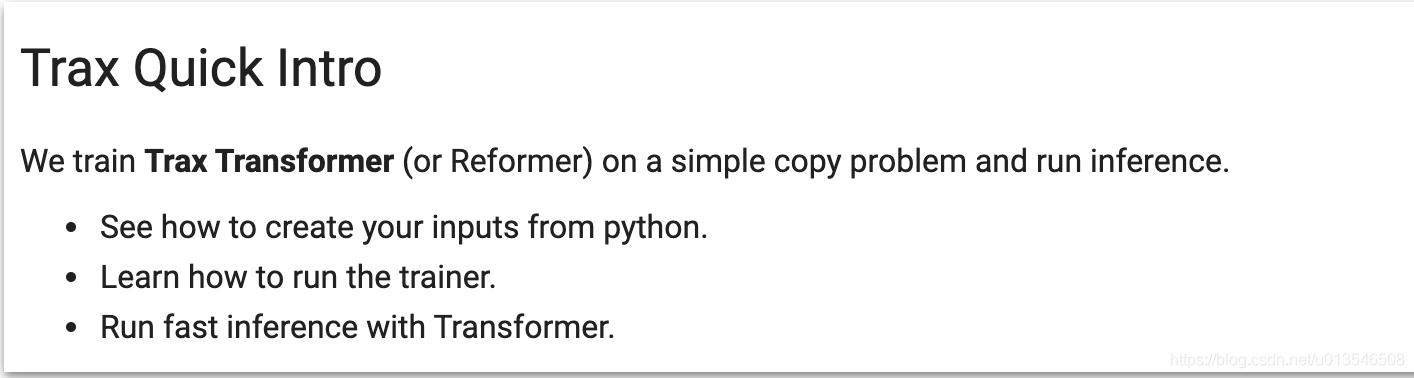
Google 的深度学习库Trax,其简版教程(Trax Quick Intro)需要通过翻墙才能看,这次当个搬运工,这是一个关于transformer训练和预测的简要介绍:
讯享网
导入包:
! pip install -q -U trax ! pip install -q tensorflow import os import numpy as np import trax 讯享网
模拟训练数据:
讯享网# Construct inputs, see one batch def copy_task(batch_size, vocab_size, length): """This task is to copy a random string w, so the input is 0w0w.""" while True: assert length % 2 == 0 w_length = (length // 2) - 1 w = np.random.randint(low=1, high=vocab_size-1, size=(batch_size, w_length)) zero = np.zeros([batch_size, 1], np.int32) loss_weights = np.concatenate([np.zeros((batch_size, w_length+2)), np.ones((batch_size, w_length))], axis=1) x = np.concatenate([zero, w, zero, w], axis=1) yield (x, x, loss_weights) # Here inputs and targets are the same. copy_inputs = trax.supervised.Inputs(lambda _: copy_task(16, 32, 10)) # Peek into the inputs. data_stream = copy_inputs.train_stream(1) inputs, targets, mask = next(data_stream) print("Inputs[0]: %s" % str(inputs[0])) print("Targets[0]: %s" % str(targets[0])) print("Mask[0]: %s" % str(mask[0]))
Inputs[0]: [ 0 6 13 29 22 0 6 13 29 22]
Targets[0]: [ 0 6 13 29 22 0 6 13 29 22]
Mask[0]: [0. 0. 0. 0. 0. 1. 1. 1. 1. 1.]
Transformer训练:
# Transformer LM def tiny_transformer_lm(mode): return trax.models.TransformerLM( # You can try trax_models.ReformerLM too. d_model=32, d_ff=128, n_layers=2, vocab_size=32, mode=mode) # Train tiny model with Trainer. output_dir = os.path.expanduser('~/train_dir/') !rm -f ~/train_dir/model.pkl # Remove old model. trainer = trax.supervised.Trainer( model=tiny_transformer_lm, loss_fn=trax.layers.CrossEntropyLoss(), optimizer=trax.optimizers.Adafactor, # Change optimizer params here. lr_schedule=trax.lr.MultifactorSchedule, # Change lr schedule here. inputs=copy_inputs, output_dir=output_dir) # Because we have loss mask, this API may change. # Train for 3 epochs each consisting of 500 train batches, eval on 2 batches. n_epochs = 3 train_steps = 500 eval_steps = 2 for _ in range(n_epochs): trainer.train_epoch(train_steps, eval_steps) Step 500: Ran 500 train steps in 16.51 secs
Step 500: Evaluation
Step 500: train accuracy | 0.
Step 500: train loss | 1.
Step 500: train neg_log_perplexity | -1.
Step 500: train weights_per_batch_per_core | 80.00000000
Step 500: eval accuracy | 0.
Step 500: eval loss | 1.
Step 500: eval neg_log_perplexity | -1.
Step 500: eval weights_per_batch_per_core | 80.00000000
Step 500: Finished evaluation
Step 1000: Ran 500 train steps in 2.54 secs
Step 1000: Evaluation
Step 1000: train accuracy | 1.00000000
Step 1000: train loss | 0.00
Step 1000: train neg_log_perplexity | -0.00
Step 1000: train weights_per_batch_per_core | 80.00000000
Step 1000: eval accuracy | 1.00000000
Step 1000: eval loss | 0.0
Step 1000: eval neg_log_perplexity | -0.0
Step 1000: eval weights_per_batch_per_core | 80.00000000
Step 1000: Finished evaluation
Step 1500: Ran 500 train steps in 2.46 secs
Step 1500: Evaluation
Step 1500: train accuracy | 1.00000000
Step 1500: train loss | 0.00037777
Step 1500: train neg_log_perplexity | -0.00037777
Step 1500: train weights_per_batch_per_core | 80.00000000
Step 1500: eval accuracy | 1.00000000
Step 1500: eval loss | 0.00037660
Step 1500: eval neg_log_perplexity | -0.00037660
Step 1500: eval weights_per_batch_per_core | 80.00000000
Step 1500: Finished evaluation

模型预测:
讯享网# Initialize model for inference. predict_model = tiny_transformer_lm(mode='predict') predict_signature = trax.shapes.ShapeDtype((1,1), dtype=np.int32) predict_model.init(predict_signature) predict_model.init_from_file(os.path.join(output_dir, "model.pkl"), weights_only=True) # You can also do: predict_model.weights = trainer.model_weights # Run inference prefix = [0, 1, 2, 3, 4, 0] # Change non-0 digits to see if it's copying cur_input = np.array([[0]]) result = [] for i in range(10): logits = predict_model(cur_input) next_input = np.argmax(logits[0, 0, :], axis=-1) if i < len(prefix) - 1: next_input = prefix[i] cur_input = np.array([[next_input]]) result.append(int(next_input)) # Append to the result print(result)
[0, 1, 2, 3, 4, 0, 1, 2, 3, 4]
非常简单的一个事例,Trax库也在不断更新中,代码很清晰,有兴趣的可以关注一下!
后续
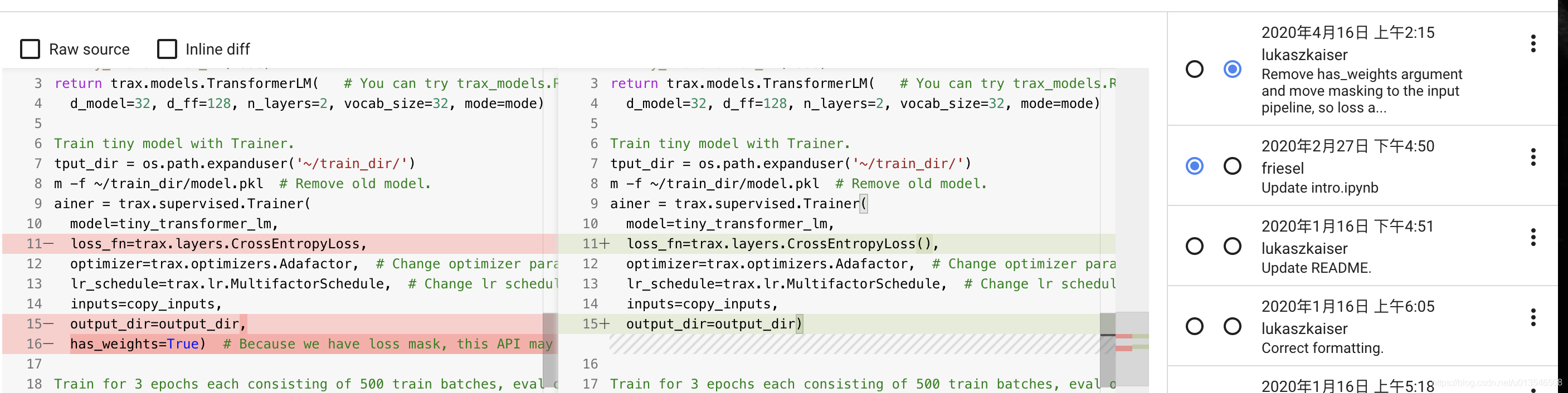
4.16官方更新了一下代码,将模型训练步骤中loss_fn=trax.layers.CrossEntropyLoss,改为loss_fn=trax.layers.CrossEntropyLoss(), 去掉参数has_weights=True,上文代码也已更改
版权声明:本文内容由互联网用户自发贡献,该文观点仅代表作者本人。本站仅提供信息存储空间服务,不拥有所有权,不承担相关法律责任。如发现本站有涉嫌侵权/违法违规的内容,请联系我们,一经查实,本站将立刻删除。
如需转载请保留出处:https://51itzy.com/kjqy/80272.html