
一、NLP 文本分类步骤
第一步:准备数据集,X:句子;Y:类别
第二步:分词,并去除停词(中文理由停词,比如而且,逗号之类;英文的话需要做词的时态转换之类)
第三步:word2idx/word2vec;这里word2vec,可以利用语料库,训练一个单词转为向量的model,这个模型你输入单词,会给你一个向量,并且能计算单词的相似度,相当于提前给词语做了归一化;word2idx就直接用词汇表的id作为向量的元素;
第四步:建模训练
二、代码
1、数据准备➕预处理
我们采用,头条新闻数据集作为本次demo的数据集。 https://github.com/aceimnorstuvwxz/toutiao-text-classfication-dataset讯享网
下载好之后,需要进行预处理,个人习惯转为json字典;并且2/8开分为测试和训练集;
讯享网file = open("./toutiao.txt", 'r') file = file.readlines() print(file[0],len(file)) print(file[0].split("_!_")) data = {"train": [], "test": [], "class_name":{}, "class_info": {}} # shuffle data random.shuffle(file) max_sentence = 0 for i, line in enumerate(file): if i < int(0.8 * len(file)): line = line.split("_!_") if line[1] not in data["class_name"].keys(): data["class_name"][line[1]] = line[2] if line[1] not in data["class_info"].keys(): data["class_info"][line[1]] = 1 else: data["class_info"][line[1]] += 1 data["train"].append({"x": line[3], "y": line[1]}) max_sentence = len(line[3]) if len(line[3]) > max_sentence else max_sentence else: line = line.split("_!_") if line[1] not in data["class_name"].keys(): data["class_name"][line[1]] = line[2] if line[1] not in data["class_info"].keys(): data["class_info"][line[1]] = 1 else: data["class_info"][line[1]] += 1 data["test"].append({"x": line[3], "y": line[1]}) max_sentence = len(line[3]) if len(line[3]) > max_sentence else max_sentence data["max_sentence"] = max_sentence data["num_train"] = len(data["train"]) data["num_test"] = len(data["test"])
import matplotlib.pyplot as plt %matplotlib inline from matplotlib import gridspec fig = plt.figure(figsize=(20, 4.5)) gs = gridspec.GridSpec(1, 2, width_ratios=[1, 2.5]) ax1 = plt.subplot(gs[0]) ax2 = plt.subplot(gs[1]) counts = [data["num_train"], data["num_test"]] colors = ['silver', 'purple'] explode = (0.1, 0) # explode 1st slice labels = ['train','test'] ax1.pie(counts, explode=explode, labels=labels, colors=colors, autopct='%1.1f%%', shadow=True, startangle=140) counts = [] labels = [] for namecode in data["class_name"].keys(): counts.append(data["class_info"][namecode]) labels.append(data["class_name"][namecode]) print(len(counts),len(labels)) print(counts) print(labels) df = pd.DataFrame({"labels": labels, "counts": counts}) ax2.bar(df["labels"], df["counts"]) ax2.set_title("nums") ax2.set_ylabel("% nums") # ax2.set_xticks(rotation=-15) ax2.set_xticklabels(labels = labels, rotation=-15) plt.show()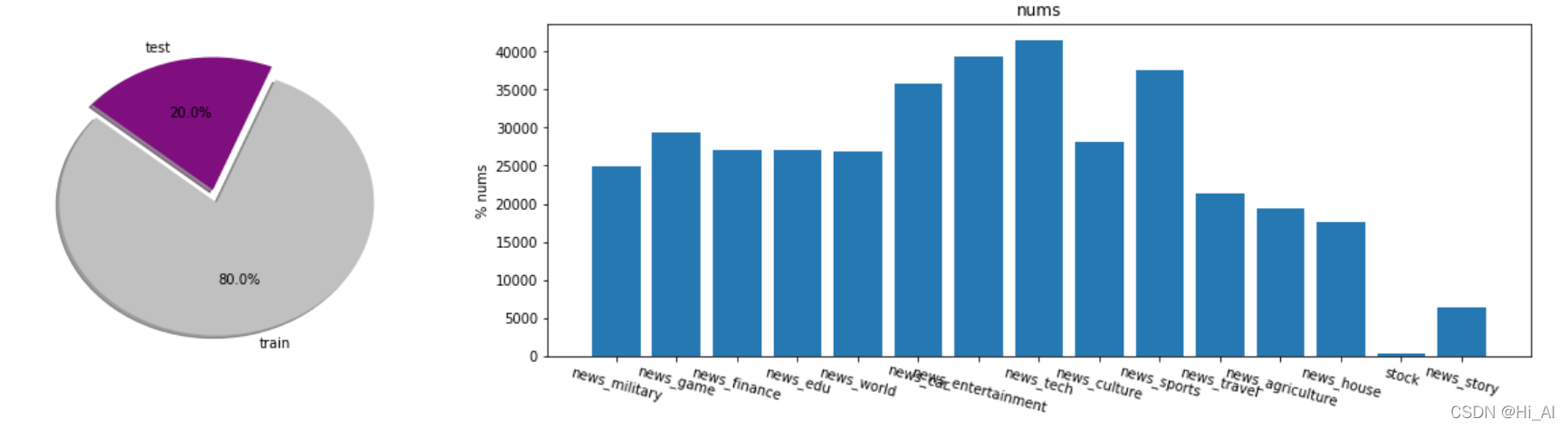
到这里为止,数据分析和预处理就结束了
2、对句子进行分词
讯享网stopwords = [i.strip() for i in open('stop_words.txt').readlines()] def pretty_cut(sentence): cut_list = jieba.lcut(''.join(re.findall('[\u4e00-\u9fa5]', sentence)), cut_all = True) for i in range(len(cut_list)-1, -1, -1): if cut_list[i] in stopwords: del cut_list[i] return cut_list
这里的stop_word.txt 可以在github下载
GitHub - goto456/stopwords: 中文常用停用词表(哈工大停用词表、百度停用词表等)

用“cn_stopwords.txt” 就可以了
效果如下:

3、接下来可以采用多种方式把中文转为向量
方法一:
import logging import sys # import gensim.models as word2vec from gensim.models.word2vec import LineSentence, logger from gensim.models import Word2Vec train_data_wv = [] for sentence in data["train"]: jieba_word = " ".join(pretty_cut(sentence["x"])) train_data_wv.append(jieba_word) sentence["x_jieba"] = jieba_word for sentence in data["test"]: jieba_word = " ".join(pretty_cut(sentence["x"])) train_data_wv.append(jieba_word) sentence["x_jieba"] = jieba_word train_w2v = Word2Vec(train_data_wv, window=5, min_count=0,vector_size=50, workers=10) train_w2v.train(train_data_wv, total_examples=len(train_data_wv), epochs=10)方法二:
讯享网vocabs = {} index_word = 1 for se in train_data_wv: vo = set(se.split(' ')) for word in vo: if word not in vocabs.keys(): vocabs[word]=index_word index_word += 1 def get_pretrain_pad_seq(vocab, sentence, maxlen): transformed_sentence = [] for word in sentence: tran_word = vocab.get(word, None) if tran_word: transformed_sentence.append(tran_word) else: transformed_sentence.append() transformed_sentence += [0 for _ in range(abs(maxlen - len(sentence)))] return np.array(transformed_sentence) max_len = 0 for sentence in train_data_wv: max_len = len(sentence.split(' ')) if len(sentence.split(' ')) > max_len else max_len
采用方法二,通常需要词汇量+1,多的那个用来pad,通常是0;
接下来就是把整个数据集进行整理,转化为训练举证
trainX = [] trainY = [] testX = [] testY = [] for sample in data["train"]: jieba_word = sample["x_jieba"].split(' ') x = get_pretrain_pad_seq(vocabs, jieba_word, max_len) trainX.append(x) trainY.append(int(sample["y"])) for sample in data["test"]: jieba_word = sample["x_jieba"].split(' ') x = get_pretrain_pad_seq(vocabs, jieba_word, max_len) testX.append(x) testY.append(int(sample["y"])) trainX = np.array(trainX) trainY = np.array(trainY) testX = np.array(testX) testY = np.array(testY) import tensorflow as tf trainY = tf.keras.utils.to_categorical(trainY) testY = tf.keras.utils.to_categorical(testY) print(trainX.shape, trainY.shape, testX.shape, testY.shape) 4、 建模训练
讯享网from tensorflow.keras import Model from tensorflow.keras.layers import Embedding, Dense, LSTM class TextRNN(Model): def __init__(self, maxlen, max_features, embedding_dims, class_num=1, last_activation='sigmoid'): super(TextRNN, self).__init__() self.maxlen = maxlen self.max_features = max_features self.embedding_dims = embedding_dims self.class_num = class_num self.last_activation = last_activation self.embedding = Embedding(self.max_features, self.embedding_dims, input_length=self.maxlen) self.rnn = LSTM(128) # LSTM or GRU self.classifier = Dense(self.class_num, activation=self.last_activation) def call(self, inputs): if len(inputs.get_shape()) != 2: raise ValueError('The rank of inputs of TextRNN must be 2, but now is %d' % len(inputs.get_shape())) if inputs.get_shape()[1] != self.maxlen: raise ValueError('The maxlen of inputs of TextRNN must be %d, but now is %d' % (self.maxlen, inputs.get_shape()[1])) embedding = self.embedding(inputs) x = self.rnn(embedding) output = self.classifier(x) return output
上面是模型代码,接下来就是训练代码了:
from tensorflow.keras.callbacks import EarlyStopping from tensorflow.keras.preprocessing import sequence max_features = # 单次数+1 maxlen = 80 batch_size = 32 embedding_dims = 32 epochs = 10 print('Build model...') # 15类,但是编码用的百位数 model = TextRNN(max_len, max_features, embedding_dims, class_num=117, last_activation='softmax') model.compile('adam', 'categorical_crossentropy', metrics=['accuracy']) print('Train...') early_stopping = EarlyStopping(monitor='val_accuracy', patience=3, mode='max') model.fit(trainX, trainY, batch_size=batch_size, epochs=epochs, callbacks=[early_stopping], validation_data=(testX, testY)) print('Test...') result = model.predict(testX) 
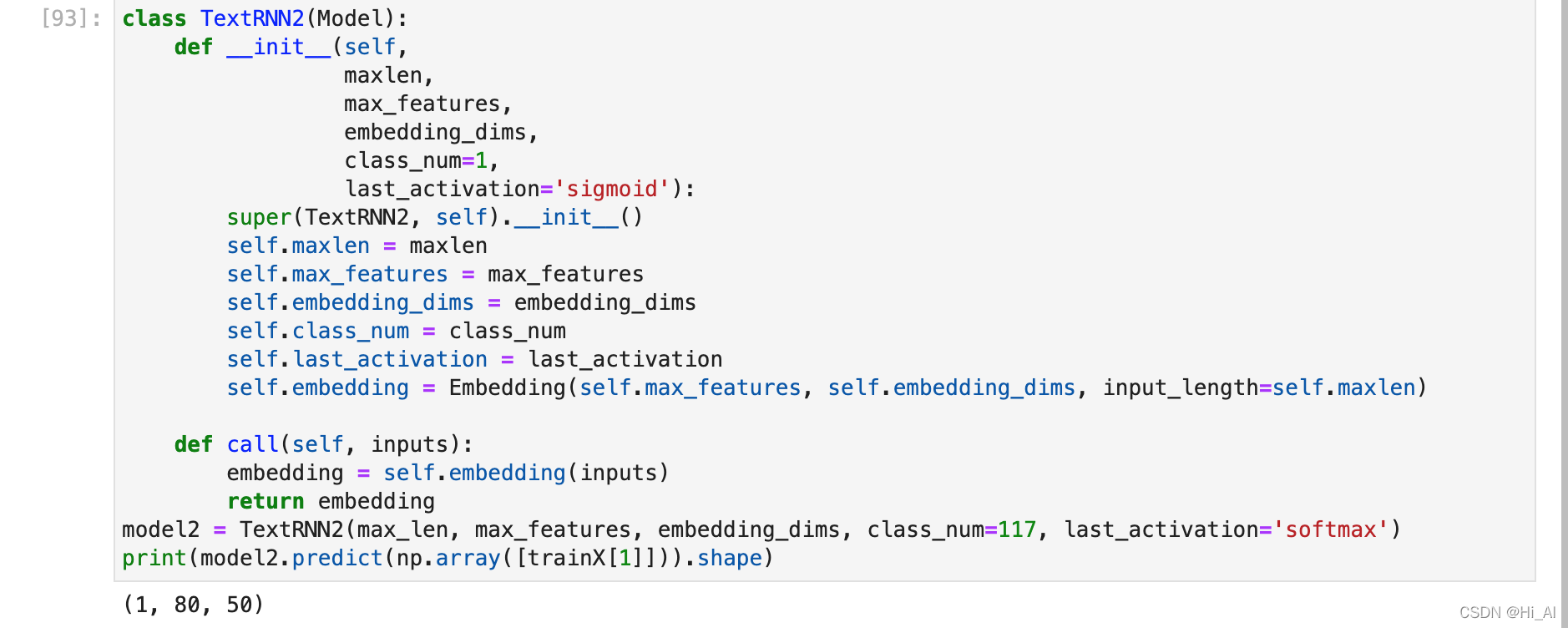
这里会采用embedding层把每个单词原本index转为词向量:
版权声明:本文内容由互联网用户自发贡献,该文观点仅代表作者本人。本站仅提供信息存储空间服务,不拥有所有权,不承担相关法律责任。如发现本站有涉嫌侵权/违法违规的内容,请联系我们,一经查实,本站将立刻删除。
如需转载请保留出处:https://51itzy.com/kjqy/78869.html