
结构汉明距离(Structural Hamming Distance)
python的SHD调用代码为:
cdt.metrics.SHD(target, pred, double_for_anticausal=True)讯享网
其中参数为:
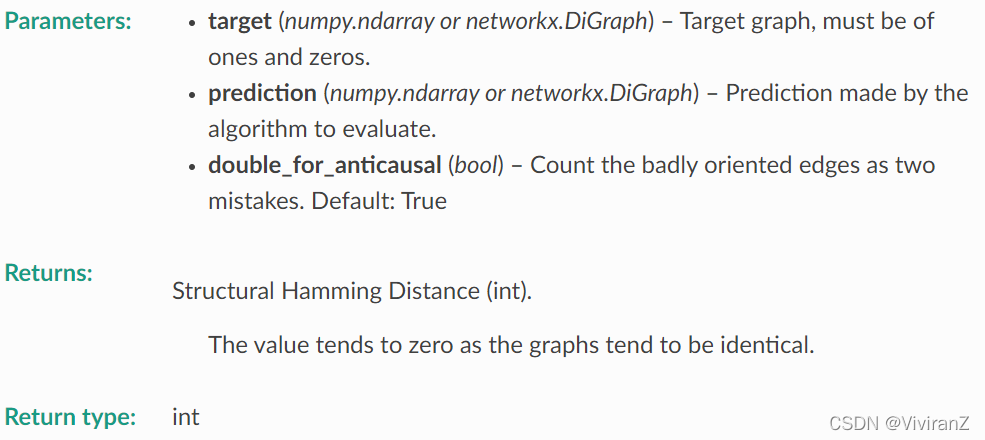
一个例子:
讯享网from cdt.metrics import SHD from numpy.random import randint tar, pred = randint(2, size=(10, 10)), randint(2, size=(10, 10)) SHD(tar, pred, double_for_anticausal=False)
参考:
https://fentechsolutions.github.io/CausalDiscoveryToolbox/html/metrics.html#:~:text=The%20Structural%20Hamming%20Distance%20%28SHD%29%20is%20a%20standard,the%20target%20graph%20is%20counted%20as%20a%20mistake.

误发现率(False Discovery Rate)
误发现率是判断所有discovery中错误的和反向的比例,即:

其中
好复杂,直接存一下NOTEARS里对于几个常见的判断标准的实现过程把
def count_accuracy(B_true, B_est): """Compute various accuracy metrics for B_est. true positive = predicted association exists in condition in correct direction reverse = predicted association exists in condition in opposite direction false positive = predicted association does not exist in condition Args: B_true (np.ndarray): [d, d] ground truth graph, {0, 1} B_est (np.ndarray): [d, d] estimate, {0, 1, -1}, -1 is undirected edge in CPDAG Returns: fdr: (reverse + false positive) / prediction positive tpr: (true positive) / condition positive fpr: (reverse + false positive) / condition negative shd: undirected extra + undirected missing + reverse nnz: prediction positive """ if (B_est == -1).any(): # cpdag if not ((B_est == 0) | (B_est == 1) | (B_est == -1)).all(): raise ValueError('B_est should take value in {0,1,-1}') if ((B_est == -1) & (B_est.T == -1)).any(): raise ValueError('undirected edge should only appear once') else: # dag if not ((B_est == 0) | (B_est == 1)).all(): raise ValueError('B_est should take value in {0,1}') if not is_dag(B_est): raise ValueError('B_est should be a DAG') d = B_true.shape[0] # linear index of nonzeros pred_und = np.flatnonzero(B_est == -1) pred = np.flatnonzero(B_est == 1)#我们获得的矩阵中是父节点的节点的位置(flatten之后的矩阵中) cond = np.flatnonzero(B_true)#真实邻接矩阵中是父节点的节点的位置(flatten之后的矩阵中) cond_reversed = np.flatnonzero(B_true.T)#该函数输入一个矩阵,返回扁平化后矩阵中非零元素的位置 cond_skeleton = np.concatenate([cond, cond_reversed])#能够一次完成多个数组的拼接 # true pos true_pos = np.intersect1d(pred, cond, assume_unique=True)#返回两个输入数组中经过排序的、唯一的值 # treat undirected edge favorably true_pos_und = np.intersect1d(pred_und, cond_skeleton, assume_unique=True) true_pos = np.concatenate([true_pos, true_pos_und]) # false pos false_pos = np.setdiff1d(pred, cond_skeleton, assume_unique=True) false_pos_und = np.setdiff1d(pred_und, cond_skeleton, assume_unique=True) false_pos = np.concatenate([false_pos, false_pos_und]) # reverse extra = np.setdiff1d(pred, cond, assume_unique=True) reverse = np.intersect1d(extra, cond_reversed, assume_unique=True) # compute ratio pred_size = len(pred) + len(pred_und) cond_neg_size = 0.5 * d * (d - 1) - len(cond) fdr = float(len(reverse) + len(false_pos)) / max(pred_size, 1) tpr = float(len(true_pos)) / max(len(cond), 1) fpr = float(len(reverse) + len(false_pos)) / max(cond_neg_size, 1) # structural hamming distance pred_lower = np.flatnonzero(np.tril(B_est + B_est.T)) cond_lower = np.flatnonzero(np.tril(B_true + B_true.T)) extra_lower = np.setdiff1d(pred_lower, cond_lower, assume_unique=True) missing_lower = np.setdiff1d(cond_lower, pred_lower, assume_unique=True) shd = len(extra_lower) + len(missing_lower) + len(reverse) return {'fdr': fdr, 'tpr': tpr, 'fpr': fpr, 'shd': shd, 'nnz': pred_size}
版权声明:本文内容由互联网用户自发贡献,该文观点仅代表作者本人。本站仅提供信息存储空间服务,不拥有所有权,不承担相关法律责任。如发现本站有涉嫌侵权/违法违规的内容,请联系我们,一经查实,本站将立刻删除。
如需转载请保留出处:https://51itzy.com/kjqy/62038.html