
Baseball managers have a crucial job, so as teams increase their quantification of player performance we turn the lens of Sabermetrics to the bench bosses.
棒球经理的工作至关重要,因此,随着球队增加对球员表现的量化,我们将Sabermetrics的视角转向了板凳老板。
Much criticism has been levied onto baseball managers and their inability to see past the archetypal dominate closer who exclusively pitches in Save situations. Writers in the statistical community have observed and critiqued the many flaws which come with the Save statistic and how it’s perceived by fans, managers and baseball decision-makers as far back at least 2008.[1] Accumulating Saves is a function of opportunity and degree of difficulty which is not the best way to get at a relief pitchers ability to get outs. More objective methods Earned Run Average (ERA) and its estimators like Fielding Independent Pitching (FIP) and Skill-Interactive Earned Run Average (SIERA) are better ways to evaluate a pitcher’s talent and Win Probability Added (WPA) is better for measuring a pitcher’s import to winning games for whatever it’s worth. This criticism has definitely been heard in the intervening years by people running ball teams which can be shown by the number of pitchers who are getting Saves on each team and the variance of Save totals for a given team.
人们对棒球管理者提出了很多批评,他们无视过去的原型者占主导地位,而后者仅在“拯救”状态下投球。 统计界的作家已经观察到并批评了Save统计数据所带来的许多缺陷,以及至少在2008年之前球迷,经理和棒球决策者对它的看法。 [1]积累储蓄是机会和程度的函数困难,这不是减轻投手出手能力的**方法。 更加客观的方法赢得平均成绩(ERA)及其估算器(例如,独立外场投球(FIP)和技能互动的平均平均成绩(SIERA))是评估投手天赋的更好方法,而增加的获胜概率(WPA)更适合衡量投手的不论价值多少,均可导入获胜游戏。 在过去的几年中,经营球队的人肯定听到了这种批评,这可以通过每个队获得节省的投手数量以及特定球队的节省总数的变化来表明。
A team with high variance in their Save totals means that there is one player accumulating a lot of Saves and some number who have very few opposed to lower variance representing a more even distribution of Saves among pitchers. This variance metric is heavily negatively correlated (-0.74) with the with the number of pitchers a team has recording a Save in a given season. Which means the more pitchers recording a Save on a team the more likely the distribution is to be equitable and the insistence on using your best pitcher in only a Save situation is lower. Based on this analysis, somewhere between 2008 and 2011 was the peak on the capital “C” Closer in Major League Baseball. A rather precipitous drop off of the closer occurred in 2016 and has continued on a downward trajectory to the point where last year saw the most equitable distribution of saves among teams since 1987, excluding the lockout shorten 1994 season.

一支球队的总扑救差异较大,这意味着有一名球员积累了很多扑救,而有些人则很少反对较低的偏见,这意味着投手之间的扑救分布更为平均。 这个差异指标与球队在给定赛季中记录了扑救的投手数量呈负相关(-0.74)。 这意味着越多的投手在球队上记录下一场扑救,就越有可能获得公平的分配,而仅在扑救情况下使用**投手的坚持性就更低。 根据此分析,2008年至2011年之间是美国职业棒球大联盟首府“ C”赛区的顶峰。 在2016年发生了一次相当大的下滑,并持续下降,直到去年,自1987年以来,各支球队之间的节省量分配最为平均,不包括1994年停摆缩短的赛季。
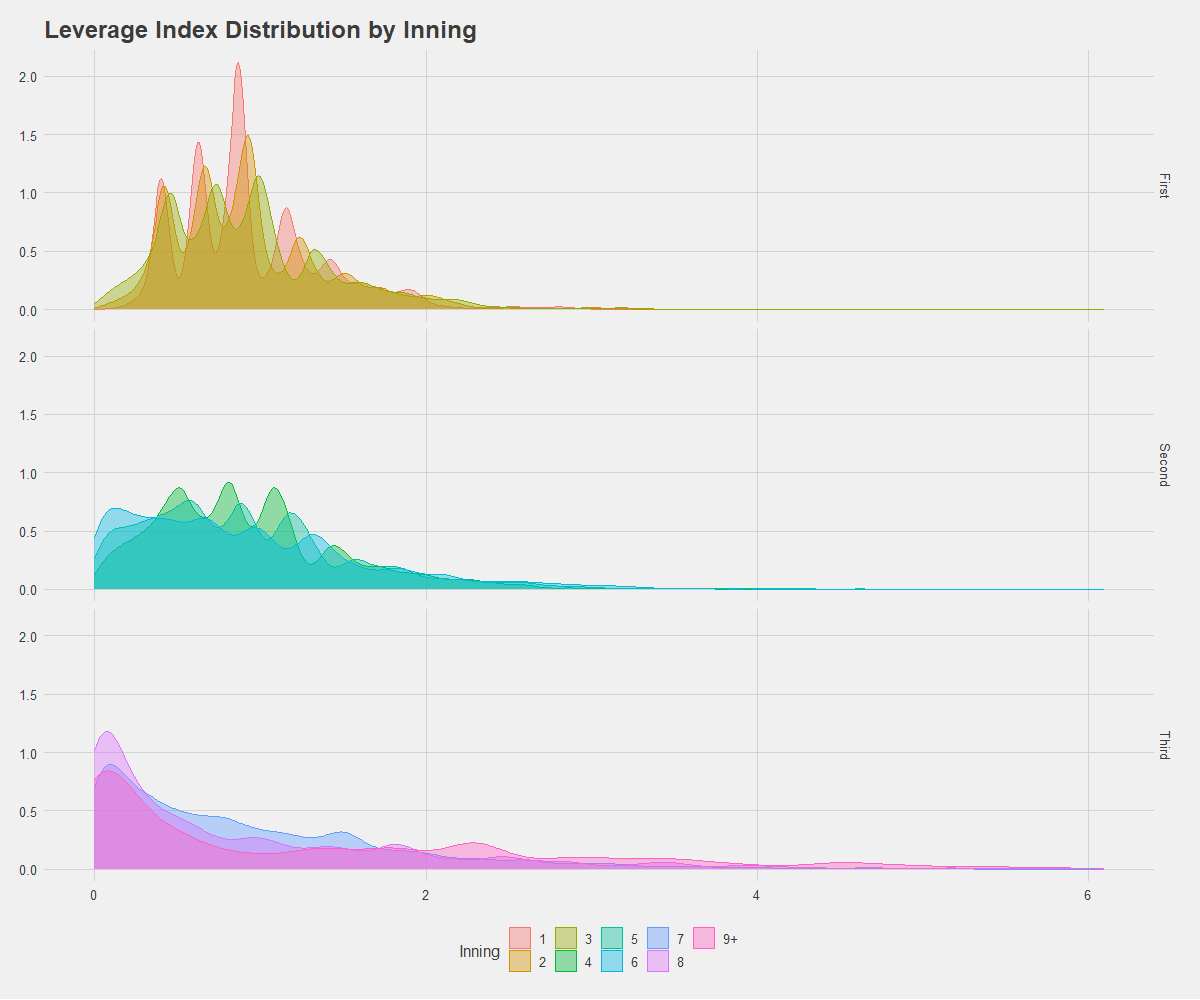
That’s interesting but it doesn’t tell us what managers are doing instead of strictly using their best relief pitcher in Save situations. The analyst critique proposes the superior alternative to managing to the Save would be to use your best relief options in the highest leverage moments of the game regardless of inning. One problem with that is, ordering the highest leverage to lowest leverage moments can only be done after all the decisions have been made. However, it is not completely unpredictable while in the game and managers certainly can come closer to aligning pitcher quality to leverage than merely pitching their closers in the ninth. In order to analyze if managers are indeed following through on this alternative, we must first define leverage and quantify it. Fortunately, Fangraphs has done exactly this and offers the numeric leverage estimate for each plate appearance dating back to 1974.
这很有趣,但是它并没有告诉我们管理人员在做什么,而不是告诉我们在“节省”情况下严格使用他们最好的救济投手。 分析家的批评认为,比起“节省”,更好的选择是在游戏的最高杠杆时间内使用**的缓解选项,而不考虑局数。 这样做的一个问题是,只有在做出所有决定后,才能将最高杠杆率定为最低杠杆矩。 但是,这并不是完全不可预测的,在游戏中,管理者当然可以更接近调整投手的质量以发挥杠杆作用,而不是仅仅在第九个比赛中投靠。 为了分析管理者是否确实遵循了该替代方案,我们必须首先定义杠杆并对其进行量化。 幸运的是,Fangraphs恰好做到了这一点,并提供了可追溯到1974年的每个板块外观的数字杠杆估计。
Leverage is defined in terms of win probability and its potential to fluctuate from the outcome of a given plate appearance. So, if you have a win probability estimate in State A given at least the inning, position of base runners, number of outs and score, you then consider all the possible outcomes of plate appearance (walk, fly out, home run, etc.) and calculate all those win probabilities in those hypothetical State B’s. From there, you calculate the variance of the win probabilities associated with all possible outcomes and that is your leverage. If there is a high variance in the win probabilities a plate appearance can generate then the leverage is high. For example, if the bases are loaded down by one with two outs in the bottom of the ninth inning, a plate appearance could either win the game (100% win probability), lose the game (0% win probability) or tie (approximately 50% win probability) which would be very high variance as compared to a plate appearance in a blowout where no matter what happens the game will still likely end in the same way. Using this definition of leverage, choosing the ninth inning of a close game as a proxy for high leverage isn’t bad.
杠杆率是根据获胜概率及其可能因给定板块外观的结果而波动的能力来定义的。 因此,如果您至少在状态A下获得了获胜概率估计值,至少给出了局限,基本跑垒员的位置,出局次数和得分,那么您可以考虑所有可能出现的盘面结果(步行,飞出,本垒打等)。 )并计算那些在假设B状态下的所有获胜概率。 在这里,您可以计算与所有可能的结果相关的获胜概率的方差,这就是您的杠杆率。 如果获胜概率有很大差异,那么牌面可能会产生,那么杠杆就很高。 例如,如果在第九局的底部将底数减一,两个出局,则盘面出现可能会赢得比赛(获胜概率为100%),比赛输掉(胜出概率为0%)或并列(大约) 50%的获胜概率),与井喷中的盘面情况相比,差异非常大,无论发生什么情况,游戏仍然可能以相同的方式结束。 使用这种对杠杆的定义,选择封闭游戏的第九局作为高杠杆的代理并不错。
版权声明:本文内容由互联网用户自发贡献,该文观点仅代表作者本人。本站仅提供信息存储空间服务,不拥有所有权,不承担相关法律责任。如发现本站有涉嫌侵权/违法违规的内容,请联系我们,一经查实,本站将立刻删除。
如需转载请保留出处:https://51itzy.com/kjqy/57874.html