
之前的系列文章:介绍了 RLHF 里用到 Reward Model、PPO 算法。
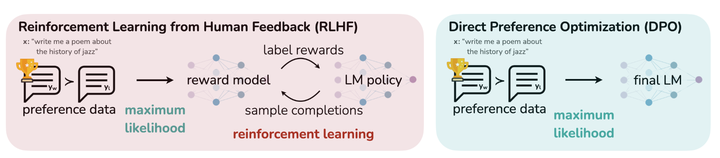
但是这种传统的 RLHF 算法存在以下问题:流程复杂,需要多个中间模型对超参数很敏感,导致模型训练的结果不稳定。
斯坦福大学提出了 DPO 算法,尝试解决上面的问题,DPO 算法的思想也被后面 RLAIF(AI反馈强化学习)的算法借鉴,这个系列会从 DPO 开始,介绍 SPIN、self-reward model 算法。
而 DPO 本身是一种不需要强化学习的算法,简化了整个 RLHF 流程,训练起来会更简单。
原理
讯享网
传统的 RLHF 步骤一般是:训练一个 reward model 对 prompt 的 response 进行打分,训练完之后借助 PPO 算法,使得 SFT 的模型和人类偏好对齐,这个过程我们需要初始化四个基本结构一致的 transformer 模型。DPO 算法,提供了一种更为简单的 loss function,而这个就是 DPO 的核心思想:针对奖励函数的 loss 函数被转换成针对策略的 loss 函数,而针对策略的 loss 函数又暗含对奖励的表示,即人类偏好的回答会暗含一个更高的奖励。
L D P O ( π θ ; π r e f ) = − E ( x , y w , y l ) ∼ D [ log σ ( β log π θ ( y w ∣ x ) π r e f ( y w ∣ x ) − β log π θ ( y l ∣ x ) π r e f ( y l ∣ x ) ) ] \mathcal{L}_{\mathrm{DPO}}\left(\pi_\theta ; \pi_{\mathrm{ref}}\right)=-\mathbb{E}_{\left(x, y_w, y_l\right) \sim \mathcal{D}}\left[\log \sigma\left(\beta \log \frac{\pi_\theta\left(y_w \mid x\right)}{\pi_{\mathrm{ref}}\left(y_w \mid x\right)}-\beta \log \frac{\pi_\theta\left(y_l \mid x\right)}{\pi_{\mathrm{ref}}\left(y_l \mid x\right)}\right)\right] LDPO(πθ;πref)=−E(x,yw,yl)∼D[logσ(βlogπref(yw∣x)πθ(yw∣x)−βlogπref(yl∣x)πθ(yl∣x))]
这个函数唯一的超参数是 β \beta β,决定了不同策略获得的奖励之间的 margin。
可以看出 DPO 虽然说是没有用强化学习,但是还是有强化学习的影子,相当于 beta 是一个固定的 reward,通过人类偏好数据,可以让这个奖励的期望最大化,本至上来说 dpo 算法也算是一种策略迭代。
对 loss function 求导,可得如下表达式:

∇ θ L D P O ( π θ ; π r e f ) = − β E ( x , y w , y l ) ∼ D [ σ ( r ^ θ ( x , y l ) − r ^ θ ( x , y w ) ) ⏟ higher weight when reward estimate is wrong [ ∇ θ log π ( y w ∣ x ) ⏟ increase likelihood of y w − ∇ θ log π ( y l ∣ x ) ⏟ decrease likelihood of y l ] ] \begin{aligned} & \nabla_\theta \mathcal{L}_{\mathrm{DPO}}\left(\pi_\theta ; \pi_{\mathrm{ref}}\right)= \\ & -\beta \mathbb{E}_{\left(x, y_w, y_l\right) \sim \mathcal{D}}[\underbrace{\sigma\left(\hat{r}_\theta\left(x, y_l\right)-\hat{r}_\theta\left(x, y_w\right)\right)}_{\text {higher weight when reward estimate is wrong }}[\underbrace{\nabla_\theta \log \pi\left(y_w \mid x\right)}_{\text {increase likelihood of } y_w}-\underbrace{\nabla_\theta \log \pi\left(y_l \mid x\right)}_{\text {decrease likelihood of } y_l}]] \end{aligned} ∇θLDPO(πθ;πref)=−βE(x,yw,yl)∼D[higher weight when reward estimate is wrong σ(r^θ(x,yl)−r^θ(x,yw))[increase likelihood of yw ∇θlogπ(yw∣x)−decrease likelihood of yl ∇θlogπ(yl∣x)]]
其中 r ^ θ ( x , y ) = β log π θ ( y ∣ x ) π ref ( y ∣ x ) \hat{r}_\theta(x, y)=\beta \log \frac{\pi_\theta(y \mid x)}{\pi_{\text {ref }}(y \mid x)} r^θ(x,y)=βlogπref (y∣x)πθ(y∣x) 。
不得不佩服作者构思的巧妙,通过求导,作者捕捉到了”暗含“的 reward —— σ ( r ^ θ ( x , y l ) − r ^ θ ( x , y w ) ) \sigma\left(\hat{r}_\theta\left(x, y_l\right)-\hat{r}_\theta\left(x, y_w\right)\right) σ(r^θ(x,yl)−r^θ(x,yw)),作者在论文里说到,当我们在让 loss 降低的过程中,这个 reward 也会变小(可以用来做 rejected_rewards)。因而在下面的代码实现里,chosen_rewards 和 rejected_rewards 就来自这个想法。
代码实现
我们来看下 trl 是如何实现 dpo loss 的,可以看到 dpo 和 ppo 相比,实现确实更为简单,而且从开源社区的反应来看,dpo 的效果也很不错,现在 dpo 已经成为偏好对齐最主流的算法之一。
def dpo_loss( self, policy_chosen_logps: torch.FloatTensor, policy_rejected_logps: torch.FloatTensor, reference_chosen_logps: torch.FloatTensor, reference_rejected_logps: torch.FloatTensor, ) -> Tuple[torch.FloatTensor, torch.FloatTensor, torch.FloatTensor]: """Compute the DPO loss for a batch of policy and reference model log probabilities. Args: policy_chosen_logps: Log probabilities of the policy model for the chosen responses. Shape: (batch_size,) policy_rejected_logps: Log probabilities of the policy model for the rejected responses. Shape: (batch_size,) reference_chosen_logps: Log probabilities of the reference model for the chosen responses. Shape: (batch_size,) reference_rejected_logps: Log probabilities of the reference model for the rejected responses. Shape: (batch_size,) Returns: A tuple of three tensors: (losses, chosen_rewards, rejected_rewards). The losses tensor contains the DPO loss for each example in the batch. The chosen_rewards and rejected_rewards tensors contain the rewards for the chosen and rejected responses, respectively. """ pi_logratios = policy_chosen_logps - policy_rejected_logps if self.reference_free: ref_logratios = torch.tensor([0], dtype=pi_logratios.dtype, device=pi_logratios.device) else: ref_logratios = reference_chosen_logps - reference_rejected_logps pi_logratios = pi_logratios.to(self.accelerator.device) ref_logratios = ref_logratios.to(self.accelerator.device) logits = pi_logratios - ref_logratios # The beta is a temperature parameter for the DPO loss, typically something in the range of 0.1 to 0.5. # We ignore the reference model as beta -> 0. The label_smoothing parameter encodes our uncertainty about the labels and # calculates a conservative DPO loss. losses = ( -F.logsigmoid(self.beta * logits) * (1 - self.label_smoothing) - F.logsigmoid(-self.beta * logits) * self.label_smoothing ) chosen_rewards = ( self.beta * ( policy_chosen_logps.to(self.accelerator.device) - reference_chosen_logps.to(self.accelerator.device) ).detach() ) rejected_rewards = ( self.beta * ( policy_rejected_logps.to(self.accelerator.device) - reference_rejected_logps.to(self.accelerator.device) ).detach() ) return losses, chosen_rewards, rejected_rewards 讯享网
改进
在 Preference Tuning LLMs with Direct Preference Optimization Methods (huggingface.co) 一文中提到,dpo 也存在一些不足:
dpo 算法很容易在数据集上过拟合dpo 训练依赖成对的偏好数据集,这种数据集的构造和标注都很耗费时间。
一些研究者也根据这些问题提出了新的算法:
针对 1,deepmind 提出了 Identity Preference Optimisation (IPO),给 DPO 的 loss 加了一个正则项,避免训练快速过拟合
针对 2,ContextualAI 提出了 Kahneman-Tversky Optimisation (KTO),KTO 算法的数据集,不再是成对的偏好数据集,而是给每条数据集 “good” 或者 “bad” 的标签进行偏好对齐。
这些算法的相关内容会在介绍完 SPIN 和 self-reward model 之后进行补充,欢迎关注,感谢阅读。
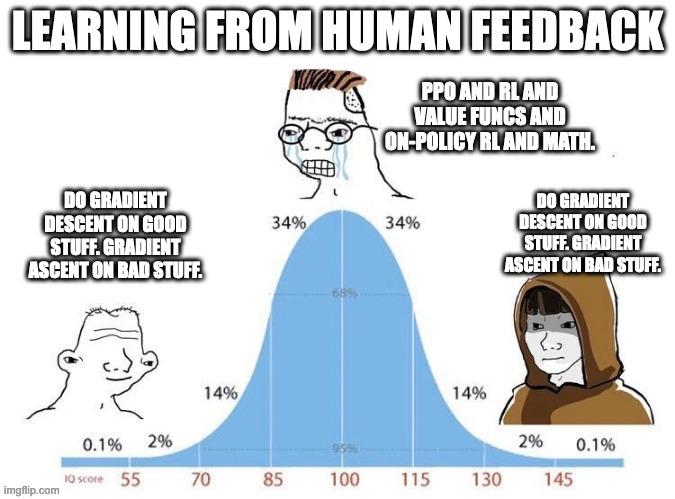
最后说点题外话,通过 DPO,我们可以看出深度学习还是一门实验的学科,如果光看 DPO 算法本身,很难相信这样一个简单的算法,会这么有效。所以多动手写代码,多实验,也许有一天我们也可以发现很 work 的算法,共勉。
参考
- Direct Preference Optimization: Your Language Model is Secretly a Reward Model
- Aligning LLMs with Direct Preference Optimization (youtube.com)
- huggingface/trl: Train transformer language models with reinforcement learning. (github.com)
- Preference Tuning LLMs with Direct Preference Optimization Methods (huggingface.co)
版权声明:本文内容由互联网用户自发贡献,该文观点仅代表作者本人。本站仅提供信息存储空间服务,不拥有所有权,不承担相关法律责任。如发现本站有涉嫌侵权/违法违规的内容,请联系我们,一经查实,本站将立刻删除。
如需转载请保留出处:https://51itzy.com/kjqy/52358.html