
双三次插值(BiCubic插值 )
双三次插值又称立方卷积插值。三次卷积插值是一种更加复杂的插值方式。该算法利用待采样点周围16个点的灰度值作三次插值,不仅考虑到4 个直接相邻点的灰度影响,而且考虑到各邻点间灰度值变化率的影响。三次运算可以得到更接近高分辨率图像的放大效果,但也导致了运算量的急剧增加。这种算法需要选取插值基函数来拟合数据,其最常用的插值基函数如图1所示,本次实验采用如图所示函数作为基函数。
图像放大并进行BiCubic插值 Matlab/C++代码点击打开链接
假设源图像A大小为m*n,缩放K倍后的目标图像B的大小为M*N,即K=M/m。A的每一个像素点是已知的,B是未知的,我们想要求出目标图像B中每一像素点(X,Y)的值,必须先找出像素(X,Y)在源图像A中对应的像素(x,y),再根据源图像A距离像素(x,y)最近的16个像素点作为计算目标图像B(X,Y)处像素值的参数,利用BiCubic基函数求出16个像素点的权重,图B像素(x,y)的值就等于16个像素点的加权叠加。
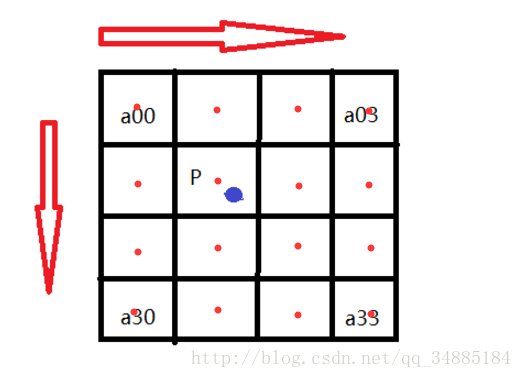
根据比例关系x/X=m/M=1/K,我们可以得到B(X,Y)在A上的对应坐标为A(x,y)=A(X*(m/M),Y*(n/N))=A(X/K,Y/K)。如图所示P点就是目标图像B在(X,Y)处对应于源图像A中的位置,P的坐标位置会出现小数部分,所以我们假设 P的坐标为P(x+u,y+v),其中x,y分别表示整数部分,u,v分别表示小数部分(蓝点到a11方格中红点的距离)。那么我们就可以得到如图所示的最近16个像素的位置,在这里用a(i,j)(i,j=0,1,2,3)来表示,如上图。
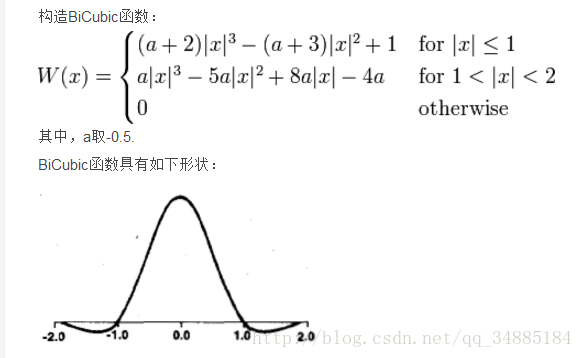
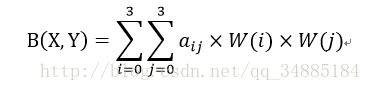
我们要做的就是求出BiCubic函数中的参数x,从而获得上面所说的16个像素所对应的权重W(x)。BiCubic基函数是一维的,而像素是二维的,所以我们将像素点的行与列分开计算。BiCubic函数中的参数x表示该像素点到P点的距离,例如a00距离P(x+u,y+v)的距离为(1+u,1+v),因此a00的横坐标权重i_0=W(1+u),纵坐标权重j_0=W(1+v),a00对B(X,Y)的贡献值为:(a00像素值)* i_0* j_0。因此,a0X的横坐标权重分别为W(1+u),W(u),W(1-u),W(2-u);ay0的纵坐标权重分别为W(1+v),W(v),W(1-v),W(2-v);B(X,Y)像素值为:

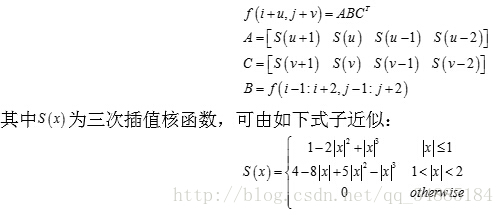
上述可以用矩阵形式表示,下面图片来源:点击打开链接
加权算法(a可以不取-0.5):
Matlab代码:
%双三次插值具体实现 clc,clear; fff=imread('E:\Documents\BUPT\DIP\图片\lena.bmp'); ff =rgb2gray(fff);%转化为灰度图像 [mm,nn]=size(ff); %将图像隔行隔列抽取元素,得到缩小的图像f m=mm/2; n=nn/2; f =zeros(m,n); for i=1:m for j=1:n f(i,j)=ff(2*i,2*j); end end k=5; %设置放大倍数 bijiao1 =imresize(f,k,'bilinear');%双线性插值结果比较 bijiao =uint8(bijiao1); a=f(1,:); c=f(m,:); %将待插值图像矩阵前后各扩展两行两列,共扩展四行四列 b=[f(1,1),f(1,1),f(:,1)',f(m,1),f(m,1)]; d=[f(1,n),f(1,n),f(:,n)',f(m,n),f(m,n)]; a1=[a;a;f;c;c]; b1=[b;b;a1';d;d]; ffff=b1'; f1=double(ffff); g1 =zeros(k*m,k*n); fori=1:k*m %利用双三次插值公式对新图象所有像素赋值 u=rem(i,k)/k; i1=floor(i/k)+2; A=[sw(1+u) sw(u) sw(1-u) sw(2-u)]; for j=1:k*n v=rem(j,k)/k; j1=floor(j/k)+2; C=[sw(1+v);sw(v);sw(1-v);sw(2-v)]; B=[f1(i1-1,j1-1) f1(i1-1,j1) f1(i1-1,j1+1)f1(i1-1,j1+2) f1(i1,j1-1) f1(i1,j1) f1(i1,j1+1) f1(i1,j1+2) f1(i1+1,j1-1) f1(i1+1,j1) f1(i1+1,j1+1) f1(i1+1,j1+2) f1(i1+2,j1-1) f1(i1+2,j1) f1(i1+2,j1+1)f1(i1+2,j1+2)]; g1(i,j)=(A*B*C); end end g=uint8(g1); imshow(uint8(f));title('缩小的图像'); %显示缩小的图像 figure,imshow(ff);title('原图'); %显示原图像 figure,imshow(g);title('双三次插值放大的图像'); %显示插值后的图像 figure,imshow(bijiao);title('双线性插值放大结果'); %显示插值后的图像 mse=0; ff=double(ff); g=double(g); ff2=fftshift(fft2(ff)); %计算原图像和插值图像的傅立叶幅度谱 g2=fftshift(fft2(g)); figure,subplot(1,2,1),imshow(log(abs(ff2)),[8,10]);title('原图像的傅立叶幅度谱'); subplot(1,2,2),imshow(log(abs(g2)),[8,10]);title('双三次插值图像的傅立叶幅度谱'); 基函数代码: functionA=sw(w1) w=abs(w1); ifw<1&&w>=0 A=1-2*w^2+w^3; elseifw>=1&&w<2 A=4-8*w+5*w^2-w^3; else A=0; end讯享网
C++代码:
讯享网 #include "opencv2/imgproc/imgproc.hpp" #include "opencv2/highgui/highgui.hpp" #include <iostream> #include <cmath> #include <fstream> using namespace cv; using namespace std; #define PI 3. float BiCubicPoly(float x); void MyScaleBiCubicInter(Mat& src, Mat& dst, float TransMat[3][3]); / * @function main */ int main( int argc, char argv ) { // load image char* imageName = "images/Lenna_256.png"; Mat image; image = imread(imageName,1); if(!image.data) { cout << "No image data" << endl; return -1; } // show image namedWindow("image", CV_WINDOW_AUTOSIZE); imshow("image", image); Mat dst; float transMat[3][3] = { {2.0, 0, 0}, {0, 2.0, 0}, {0, 0, 1} }; MyScaleBiCubicInter(image, dst, transMat); namedWindow("out_image", CV_WINDOW_AUTOSIZE); imshow("out_image", dst); imwrite("Lenna_scale_biCubic2.jpg", dst); waitKey(0); return 0; } float BiCubicPoly(float x) { float abs_x = abs(x); float a = -0.5; if( abs_x <= 1.0 ) { return (a+2)*pow(abs_x,3) - (a+3)*pow(abs_x,2) + 1; } else if( abs_x < 2.0 ) { return a*pow(abs_x,3) - 5*a*pow(abs_x,2) + 8*a*abs_x - 4*a; } else return 0.0; } void MyScaleBiCubicInter(Mat& src, Mat& dst, float TransMat[3][3]) { CV_Assert(src.data); CV_Assert(src.depth() != sizeof(uchar)); // calculate margin point of dst image float left = 0; float right = 0; float top = 0; float down = 0; float x = src.cols * 1.0f; float y = 0.0f; float u1 = x * TransMat[0][0] + y * TransMat[0][1]; float v1 = x * TransMat[1][0] + y * TransMat[1][1]; x = src.cols * 1.0f; y = src.rows * 1.0f; float u2 = x * TransMat[0][0] + y * TransMat[0][1]; float v2 = x * TransMat[1][0] + y * TransMat[1][1]; x = 0.0f; y = src.rows * 1.0f; float u3 = x * TransMat[0][0] + y * TransMat[0][1]; float v3 = x * TransMat[1][0] + y * TransMat[1][1]; left = min( min( min(0.0f,u1), u2 ), u3); right = max( max( max(0.0f,u1), u2 ), u3); top = min( min( min(0.0f,v1), v2 ), v3); down = max( max( max(0.0f,v1), v2 ), v3); // create dst image dst.create(int(abs(right-left)), int(abs(down-top)), src.type()); CV_Assert( dst.channels() == src.channels() ); int channels = dst.channels(); int i,j; uchar* p; uchar* q0; uchar* q1; uchar* q2; uchar* q3; for( i = 0; i < dst.rows; ++i) { p = dst.ptr<uchar>(i); for ( j = 0; j < dst.cols; ++j) { // x = (j+left)/TransMat[0][0] ; y = (i+top)/TransMat[1][1] ; int x0 = int(x) - 1; int y0 = int(y) - 1; int x1 = int(x); int y1 = int(y); int x2 = int(x) + 1; int y2 = int(y) + 1; int x3 = int(x) + 2; int y3 = int(y) + 2; if( (x0 >= 0) && (x3 < src.cols) && (y0 >= 0) && (y3 < src.rows) ) { q0 = src.ptr<uchar>(y0); q1 = src.ptr<uchar>(y1); q2 = src.ptr<uchar>(y2); q3 = src.ptr<uchar>(y3); float dist_x0 = BiCubicPoly(x-x0); float dist_x1 = BiCubicPoly(x-x1); float dist_x2 = BiCubicPoly(x-x2); float dist_x3 = BiCubicPoly(x-x3); float dist_y0 = BiCubicPoly(y-y0); float dist_y1 = BiCubicPoly(y-y1); float dist_y2 = BiCubicPoly(y-y2); float dist_y3 = BiCubicPoly(y-y3); float dist_x0y0 = dist_x0 * dist_y0; float dist_x0y1 = dist_x0 * dist_y1; float dist_x0y2 = dist_x0 * dist_y2; float dist_x0y3 = dist_x0 * dist_y3; float dist_x1y0 = dist_x1 * dist_y0; float dist_x1y1 = dist_x1 * dist_y1; float dist_x1y2 = dist_x1 * dist_y2; float dist_x1y3 = dist_x1 * dist_y3; float dist_x2y0 = dist_x2 * dist_y0; float dist_x2y1 = dist_x2 * dist_y1; float dist_x2y2 = dist_x2 * dist_y2; float dist_x2y3 = dist_x2 * dist_y3; float dist_x3y0 = dist_x3 * dist_y0; float dist_x3y1 = dist_x3 * dist_y1; float dist_x3y2 = dist_x3 * dist_y2; float dist_x3y3 = dist_x3 * dist_y3; switch(channels) { case 1: { break; } case 3: { p[3*j] = (uchar)(q0[3*x0] * dist_x0y0 + q1[3*x0] * dist_x0y1 + q2[3*x0] * dist_x0y2 + q3[3*x0] * dist_x0y3 + q0[3*x1] * dist_x1y0 + q1[3*x1] * dist_x1y1 + q2[3*x1] * dist_x1y2 + q3[3*x1] * dist_x1y3 + q0[3*x2] * dist_x2y0 + q1[3*x2] * dist_x2y1 + q2[3*x2] * dist_x2y2 + q3[3*x2] * dist_x2y3 + q0[3*x3] * dist_x3y0 + q1[3*x3] * dist_x3y1 + q2[3*x3] * dist_x3y2 + q3[3*x3] * dist_x3y3 ) ; p[3*j+1] = (uchar)(q0[3*x0+1] * dist_x0y0 + q1[3*x0+1] * dist_x0y1 + q2[3*x0+1] * dist_x0y2 + q3[3*x0+1] * dist_x0y3 + q0[3*x1+1] * dist_x1y0 + q1[3*x1+1] * dist_x1y1 + q2[3*x1+1] * dist_x1y2 + q3[3*x1+1] * dist_x1y3 + q0[3*x2+1] * dist_x2y0 + q1[3*x2+1] * dist_x2y1 + q2[3*x2+1] * dist_x2y2 + q3[3*x2+1] * dist_x2y3 + q0[3*x3+1] * dist_x3y0 + q1[3*x3+1] * dist_x3y1 + q2[3*x3+1] * dist_x3y2 + q3[3*x3+1] * dist_x3y3 ) ; p[3*j+2] = (uchar)(q0[3*x0+2] * dist_x0y0 + q1[3*x0+2] * dist_x0y1 + q2[3*x0+2] * dist_x0y2 + q3[3*x0+2] * dist_x0y3 + q0[3*x1+2] * dist_x1y0 + q1[3*x1+2] * dist_x1y1 + q2[3*x1+2] * dist_x1y2 + q3[3*x1+2] * dist_x1y3 + q0[3*x2+2] * dist_x2y0 + q1[3*x2+2] * dist_x2y1 + q2[3*x2+2] * dist_x2y2 + q3[3*x2+2] * dist_x2y3 + q0[3*x3+2] * dist_x3y0 + q1[3*x3+2] * dist_x3y1 + q2[3*x3+2] * dist_x3y2 + q3[3*x3+2] * dist_x3y3 ) ; float thre = 198.0f; if( (abs(p[3*j]-q1[3*x1]) > thre) || (abs(p[3*j+1]-q1[3*x1+1]) > thre) || (abs(p[3*j+2]-q1[3*x1+2]) > thre) ) { p[3*j] = q1[3*x1]; p[3*j+1] = q1[3*x1+1]; p[3*j+2] = q1[3*x1+2]; } break; } } } } } }
【转载】https://blog.csdn.net/_/article/details/
https://blog.csdn.net/u0/article/details/
版权声明:本文内容由互联网用户自发贡献,该文观点仅代表作者本人。本站仅提供信息存储空间服务,不拥有所有权,不承担相关法律责任。如发现本站有涉嫌侵权/违法违规的内容,请联系我们,一经查实,本站将立刻删除。
如需转载请保留出处:https://51itzy.com/kjqy/28406.html