
0.主题
对昨天的 k \textit{k} k-NN分类器进行的一些补充。
1.程序
1. 重新实现computeNearests
computeNearests,即求 k \textit{k} k 个最近邻,结合插入排序,可以用一次扫描实现这个功能。具体的,我们需要维护两个个能存储 k \textit{k} k 个元素的数组,一个用于存储距离,一个用于存储数据点的下标,程序的执行逻辑如下:
- 求训练集中的一个数据点与当前测试数据点间的距离
- 当数组未存满 k \textit{k} k 个元素,或者当前两点距离小于数组中第 k \textit{k} k 大值的时候,用插入排序将该距离放入距离数组,始终维持距离数组中的元素保持升序。同步调整数据点数组中的值。
- 跳转至第1步,至训练集中所有元素均被扫描则终止。
具体实现如下:
 / * Compute the nearest k neighbors. * * @param paraCurrent current instance. We are comparing it with all others. * @return the indices of the nearest instances. */ public int[] computeNearests( int paraCurrent ) {
    int[] resultNearests = new int[ numNeighbors ]; double[] resultDistances = new double[ numNeighbors ]; int index = 0; double[] tempDistances = new double[ dataset.numInstances( ) ]; for ( int i = 0; i < tempDistances.length; i++ ) {
    if ( i == paraCurrent ) {
    continue; } // Of if tempDistances[ i ] = distance( paraCurrent, i ); int tempPos; if ( index < numNeighbors ) {
    tempPos = index; index++; } else if ( resultDistances[ numNeighbors - 1 ] > tempDistances[ i ] ) {
    tempPos = numNeighbors - 1; } else {
    continue; } // Of if while ( tempPos > 0 ) {
    if ( resultDistances[ tempPos - 1 ] > tempDistances[ i ] ) {
    resultDistances[ tempPos ] = resultDistances[ tempPos - 1 ]; resultNearests[ tempPos ] = resultNearests[ tempPos - 1 ]; } else {
    resultDistances[ tempPos ] = tempDistances[ i ]; resultNearests[ tempPos ] = i; break; } // Of if tempPos--; } // Of while if ( tempPos == 0 ) {
    resultDistances[ tempPos ] = tempDistances[ i ]; resultNearests[ tempPos ] = i; } // Of if } //Of for i System.out.println("The nearest of " + paraCurrent + " are: " + Arrays.toString(resultNearests)); return resultNearests; } // Of computeNearests
讯享网
2. setDistanceMeasure() 方法
增加了该方法,可以自由的在曼哈顿距离和欧氏距离之间切换了。当修改的距离度量非法时,distance方法会给出提升,因此这里就不再考虑非法情况。
讯享网 / * * Chose the type of distance. * * @param paraDistance The given distance measure. * */ public void setDistanceMeasure( int paraDistance ) {
    distanceMeasure = paraDistance; } // Of setDistanceMeasure
3. setNumNeighors() 方法
增加该方法后,可以自由的选择 k \textit{k} k 值了,当选择的 k \textit{k} k 非法时,程序给出提示,并使用默认的 k \textit{k} k 值。

 / * * Chose the number of neighbor. * * @param paraK The given number. * */ public void setNumNeighors( int paraK ) {
    if ( ( paraK <= 0 ) || ( paraK > trainingSet.length) ) {
    System.out.println("The number of neighbor is illegal, We'll use the default values!"); return; } numNeighbors = paraK; } // Of setNumNeighors
4. weightedVoting() 方法
该方法考虑了 k \textit{k} k 个最近邻中,不同远近邻居的权重。具体的策略为,最近的数据点可以投 k \textit{k} k 票,第二近的数据点投 k − 1 \textit{k} - 1 k−1 票,以此类推,最远的(即第 k \textit{k} k 远的邻居) 投 1 \text{1} 1票。
可以描述为,第 i \textit{i} i 近的邻居投票数为 k − i + 1 \textit{k} - \textit{i} + 1 k−i+1 。这就保证了距离越近的邻居话语权越大,越远的话语权越小。由于在今天重新实现的computeNearests方法中,我们始终维护长度为 k \textit{k} k 的按距离升序的数组,因此在这里区分 k \textit{k} k 个邻居的远近也就是很容易的事情了。
讯享网 / * weightedVoting using the instances. * * @param paraNeighbors The indices of the neighbors. * @return The predicted label. */ public int weightedVoting( int[] paraNeighbors ) {
    int[] tempVotes = new int[ dataset.numClasses( ) ]; for ( int i = 0; i < paraNeighbors.length; i++ ) {
    tempVotes[ ( int ) dataset.instance( paraNeighbors[ i ] ).classValue( ) ] += numNeighbors - i + 1; } // Of for i int tempMaximalVotingIndex = 0; int tempMaximalVoting = 0; for ( int i = 0; i < dataset.numClasses( ); i++ ) {
    if ( tempVotes[ i ] > tempMaximalVoting ) {
    tempMaximalVoting = tempVotes[ i ]; tempMaximalVotingIndex = i; } // Of if } // Of for i return tempMaximalVotingIndex; } // Of weightedVoting
5. 测试
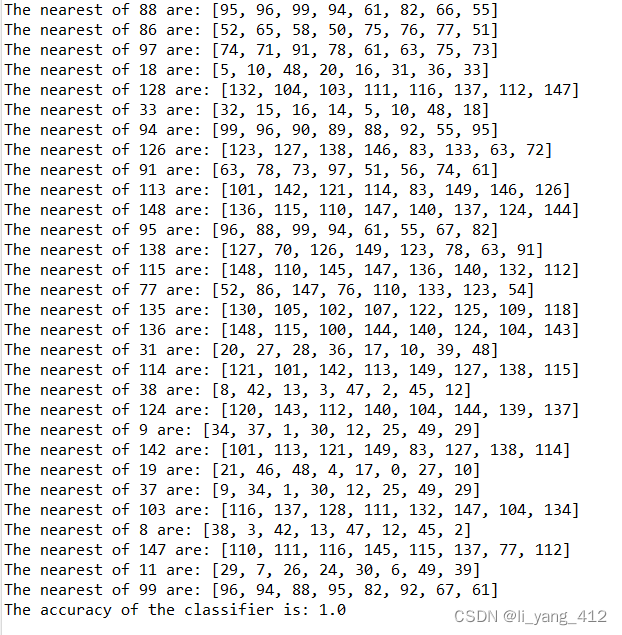
测试选择距离度量为欧氏距离, k \textit{k} k 为 8 \text{8} 8,投票方式为带权重的投票,测试代码如下:
 / * * The entrance of the program. * * @param args Not used now. * */ public static void main( String args[ ] ) {
    KnnClassification tempClassifier = new KnnClassification("G:/Program Files/Weka-3-8-6/data/iris.arff"); tempClassifier.setDistanceMeasure( 1 ); tempClassifier.splitTrainingTesting( 0.8 ); tempClassifier.setNumNeighors( 8 ); tempClassifier.predict( ); System.out.println("The accuracy of the classifier is: " + tempClassifier.getAccuracy()); } // Of main
程序执行结果如下:
2. leave-one-out测试
所谓 leave-one-out,就是说,每次选择一个数据点来测试,而其余的数据点全部用于训练,每一个数据点都会被选来测试一次。
本来想把 leave-one-out 写成一个方法,但是各个方法之间的依赖挺多的,要进行 leave-one-out 需要对很多方法进行修改,所以干脆重新弄了个类,在之前的基础上进行简单的修改来进行leave-one-out测试。
代码如下:
讯享网package machinelearning.knn; import java.io.FileReader; import java.util.Arrays; import weka.core.*; public class KnnLeaveOneOut {
    / * Manhattan distance. */ public static final int MANHATTAN = 0; / * Euclidean distance. */ public static final int EUCLIDEAN = 1; / * The distance measure. */ public int distanceMeasure = EUCLIDEAN; / * The number of neighbors. */ int numNeighbors = 7; / * The whole dataset. */ Instances dataset; / * The predictions. */ int[] predictions; / * * The first constructor. * * @param paraFilename The arff filename. * */ public KnnLeaveOneOut( String paraFilename ) {
    try {
    FileReader fileReader = new FileReader( paraFilename ); dataset = new Instances( fileReader ); dataset.setClassIndex( dataset.numAttributes( ) - 1 ); fileReader.close( ); } catch ( Exception ee ) {
    System.out.println("Error occurred while trying to read \'" + paraFilename + "\' in KnnClassification constructor.\r\n" + ee); System.exit( 0 ); } // Of try } // Of the first constructor / * * Predict for the whole data set. The results are stored in predictions. * #see predictions. * */ public void predict( ) {
    predictions = new int[ dataset.numInstances( ) ]; for ( int i = 0; i < predictions.length; i++ ) {
    predictions[ i ] = predict( i ); } // Of for i } // Of predict / * * Predict for given instance. * * @return The prediction. * */ public int predict( int paraIndex ) {
    int[] tempNeighbors = computeNearests( paraIndex ); int resultPrediction = weightedVoting( tempNeighbors ); return resultPrediction; } // Of predict / * * Chose the type of distance. * * @param paraDistance The given distance measure. * */ public void setDistanceMeasure( int paraDistance ) {
    distanceMeasure = paraDistance; } // Of setDistanceMeasure / * * The distance between two instances. * * @param paraI The index of the first instance. * @param paraJ The index of the second instance. * @return The distance. * */ public double distance( int paraI, int paraJ ) {
    double resultDistance = 0; double tempDifference; switch ( distanceMeasure ) {
    case MANHATTAN: for ( int i = 0; i < dataset.numAttributes( ) - 1; i++ ) {
    tempDifference = dataset.instance( paraI ).value( i ) - dataset.instance( paraJ ).value( i ); if ( tempDifference < 0 ) {
    resultDistance -= tempDifference; } else {
    resultDistance += tempDifference; } // Of if } // Of for i break; case EUCLIDEAN: for ( int i = 0; i < dataset.numAttributes( ) - 1; i++ ) {
    tempDifference = dataset.instance( paraI ).value( i ) - dataset.instance( paraJ ).value( i ); resultDistance += tempDifference * tempDifference; } // Of for i break; default: System.out.println("Unsupported distance measure: " + distanceMeasure); } // Of switch return resultDistance; } // Of distance / * * Get the accuracy of the classifier. * * @return The accuracy. * */ public double getAccuracy( ) {
    // A double divides an int gets another double. double tempCorrect = 0; for ( int i = 0; i < predictions.length; i++ ) {
    if ( predictions[ i ] == dataset.instance( i ).classValue( ) ) {
    tempCorrect++; } // Of if } // Of for i return tempCorrect / predictions.length; } // Of getAccuracy / * Compute the nearest k neighbors. * * @param paraCurrent current instance. We are comparing it with all others. * @return the indices of the nearest instances. */ public int[] computeNearests( int paraCurrent ) {
    int[] resultNearests = new int[ numNeighbors ]; double[] resultDistances = new double[ numNeighbors ]; int index = 0; double[] tempDistances = new double[ dataset.numInstances( ) ]; for ( int i = 0; i < tempDistances.length; i++ ) {
    if ( i == paraCurrent ) {
    continue; } // Of if tempDistances[ i ] = distance( paraCurrent, i ); int tempPos; if ( index < numNeighbors ) {
    tempPos = index; index++; } else if ( resultDistances[ numNeighbors - 1 ] > tempDistances[ i ] ) {
    tempPos = numNeighbors - 1; } else {
    continue; } // Of if while ( tempPos > 0 ) {
    if ( resultDistances[ tempPos - 1 ] > tempDistances[ i ] ) {
    resultDistances[ tempPos ] = resultDistances[ tempPos - 1 ]; resultNearests[ tempPos ] = resultNearests[ tempPos - 1 ]; } else {
    resultDistances[ tempPos ] = tempDistances[ i ]; resultNearests[ tempPos ] = i; break; } // Of if tempPos--; } // Of while if ( tempPos == 0 ) {
    resultDistances[ tempPos ] = tempDistances[ i ]; resultNearests[ tempPos ] = i; } // Of if } //Of for i System.out.println("The nearest of " + paraCurrent + " are: " + Arrays.toString(resultNearests)); return resultNearests; } // Of computeNearests / * Voting using the instances. * * @param paraNeighbors The indices of the neighbors. * @return The predicted label. */ public int simpleVoting(int[] paraNeighbors) {
    int[] tempVotes = new int[ dataset.numClasses( ) ]; for ( int i = 0; i < paraNeighbors.length; i++ ) {
    tempVotes[ ( int ) dataset.instance( paraNeighbors[ i ] ).classValue( ) ]++; } // Of for i int tempMaximalVotingIndex = 0; int tempMaximalVoting = 0; for ( int i = 0; i < dataset.numClasses( ); i++ ) {
    if ( tempVotes[ i ] > tempMaximalVoting ) {
    tempMaximalVoting = tempVotes[ i ]; tempMaximalVotingIndex = i; } // Of if } // Of for i return tempMaximalVotingIndex; } // Of simpleVoting / * weightedVoting using the instances. * * @param paraNeighbors The indices of the neighbors. * @return The predicted label. */ public int weightedVoting( int[] paraNeighbors ) {
    int[] tempVotes = new int[ dataset.numClasses( ) ]; for ( int i = 0; i < paraNeighbors.length; i++ ) {
    tempVotes[ ( int ) dataset.instance( paraNeighbors[ i ] ).classValue( ) ] += numNeighbors - i + 1; } // Of for i int tempMaximalVotingIndex = 0; int tempMaximalVoting = 0; for ( int i = 0; i < dataset.numClasses( ); i++ ) {
    if ( tempVotes[ i ] > tempMaximalVoting ) {
    tempMaximalVoting = tempVotes[ i ]; tempMaximalVotingIndex = i; } // Of if } // Of for i return tempMaximalVotingIndex; } // Of weightedVoting / * * Chose the number of neighbor. * * @param paraK The given number. * */ public void setNumNeighors( int paraK ) {
    if ( ( paraK <= 0 ) || ( paraK >= dataset.numInstances( ) ) ) {
    System.out.println("The number of neighbor is illegal, We'll use the default values!"); return; } numNeighbors = paraK; } // Of setNumNeighors / * * The entrance of the program. * * @param args Not used now. * */ public static void main( String args[ ] ) {
    KnnLeaveOneOut tempClassifier = new KnnLeaveOneOut("G:/Program Files/Weka-3-8-6/data/iris.arff"); tempClassifier.setDistanceMeasure( 1 ); tempClassifier.setNumNeighors( 9 ); tempClassifier.predict( ); System.out.println("The accuracy of the classifier is: " + tempClassifier.getAccuracy()); } // Of main } // Of class KnnLeaveOneOut
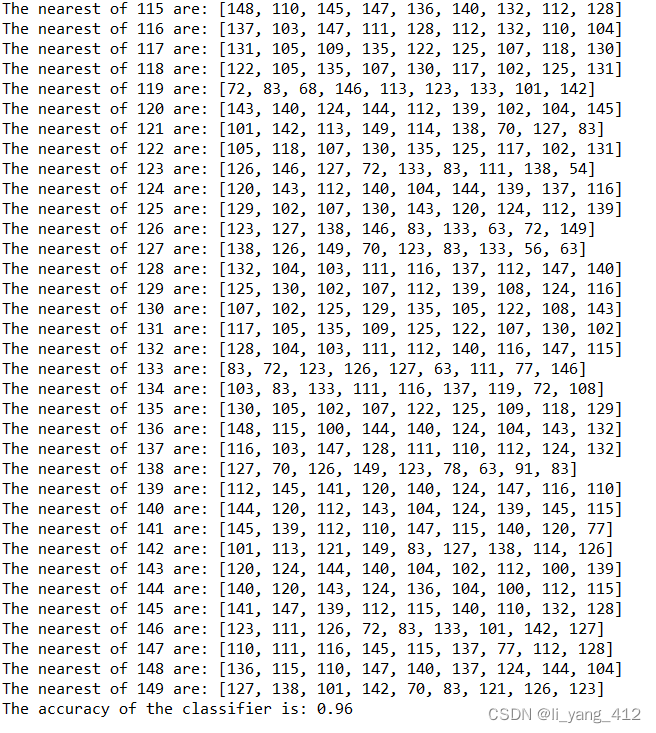
在该测试中,距离度量选择欧氏距离, k \textit{k} k 值选择为 9 9 9,投票方式为带权重的投票。
程序执行结果如下:
3. 体会
- 影响 k \textit{k} k-NN结果的因素有距离度量,投票方式, k \textit{k} k 值选择。今天增加的几个方法就是用于灵活的调节这几个因素。
- leave-one-out可以看做把数据集划分为训练集和大小为1的测试集,每个数据点都要做一次测试集。也就是说leave-one-out需要的计算要更多,一般时间复杂度太高的就不太适合用leave-one-out了。另一方面,当数据集足够大的时候,选择按比例将数据集划分为训练集和测试集比较合理,这样时间成本更低些,数据集比较小的时候,就可以考虑leave-one-out,因为可以将数据充分的利用起来。
版权声明:本文内容由互联网用户自发贡献,该文观点仅代表作者本人。本站仅提供信息存储空间服务,不拥有所有权,不承担相关法律责任。如发现本站有涉嫌侵权/违法违规的内容,请联系我们,一经查实,本站将立刻删除。
如需转载请保留出处:https://51itzy.com/kjqy/134852.html