
数据质量提升
Author Vlad Rișcuția is joined for this article by co-authors Wayne Yim and Ayyappan Balasubramanian.
作者 Vlad Rișcuția 和合著者 Wayne Yim 和 Ayyappan Balasubramanian 共同撰写了这篇文章 。
为什么要数据质量? (Why data quality?)
Data quality is a critical aspect of ensuring high quality business decisions. An estimate of the yearly cost of poor data quality is $3.1 trillion per year for the United States alone, equating to approximately 16.5 percent of GDP.¹ For a business such as Microsoft, where data-driven decisions are ingrained within the fabric of the company, ensuring high data quality is paramount. Not only is data used to drive, steer, and grow the Microsoft business from a tactical and strategic perspective, but there are also regulatory obligations to produce accurate data for quarterly financial reporting.
数据质量是确保高质量业务决策的关键方面。 据估计,仅在美国,不良数据质量的年成本就高达每年3.1万亿美元,约占GDP的16.5%。¹对于像Microsoft这样的企业,数据驱动型决策根深蒂固,确保高数据质量至关重要。 从战术和战略角度来看,不仅使用数据来驱动,指导和发展Microsoft业务,而且还存在监管义务,要求为季度财务报告生成准确的数据。
DataCop的历史 (History of DataCop)
In the Experiences and Devices (E+D) division at Microsoft, a central data team called IDEAs (Insights Data Engineering and Analytics) generates key business metrics that are used to grow and steer the business. As one of its first undertakings, the team created the Office 365 Commercial Monthly Active User (MAU) measure to track the usage and growth of Office 365. This was a complicated endeavor due to the sheer scale of data, the number of Office products and services involved, and the heterogenous nature of the data pipelines across different products and services. In addition, many other business metrics, tracking the growth and usage of all Office products and services, also needed to be created.
在Microsoft的“体验和设备”(E + D)部门中,一个名为IDEA(Insights数据工程和分析)的中央数据团队生成了用于发展和指导业务的关键业务指标。 作为其首批任务之一,该团队创建了Office 365商业月度活动用户(MAU)措施来跟踪Office 365的使用和增长。由于数据规模巨大,Office产品和服务的数量庞大,这是一项复杂的工作。涉及的服务以及跨不同产品和服务的数据管道的异构性质。 此外,还需要创建许多其他业务指标,以跟踪所有Office产品和服务的增长和使用情况。
In the process of creating these critical business metrics, it was clear that generating them at scale and in a reliable way with high data quality was of the utmost importance, as key tactical and strategic business decisions would be based on them. In addition, because of the team’s charge to generate key metrics for release with quarterly earnings, producing high quality data was also a regulatory requirement.
在创建这些关键业务指标的过程中,很明显,以关键的战术和战略业务决策将基于它们,以高质量的数据大规模可靠地生成它们至关重要。 另外,由于团队负责生成关键指标以按季度收入发布,因此生成高质量数据也是监管要求。
The IDEAs team formed as a data quality team consisting of program management, engineering, and data science representatives, and set out to investigate internal and external data quality solutions. The team examined internal data quality systems and researched public whitepapers from other companies that worked with huge amounts of data. Members of the team also spent a considerable amount of time with LinkedIn, learning about their data quality system called “Data Sentinel”² to potentially leverage what they had built, as they had already spent a considerable amount of time developing Data Sentinel and are also part of Microsoft.
IDEA团队组成了一个由程序管理,工程和数据科学代表组成的数据质量团队,并着手研究内部和外部数据质量解决方案。 该团队检查了内部数据质量系统,并研究了处理大量数据的其他公司的公开白皮书。 团队成员还花了很多时间在LinkedIn上,了解他们称为“ Data Sentinel”²的数据质量系统,以潜在地利用他们所构建的内容,因为他们已经花费了大量时间来开发Data Sentinel,并且微软的一部分。

The vision for a data quality platform in IDEAs was that it would be extensible, scalable, able to work with the multiple data fabrics involved, and be leveraged by the wider data science community at Microsoft. For example, data scientists and data analysts should be able to write data quality checks in languages familiar to them such as Python, R, and Scala, among others, and have these data quality checks operate reliably at scale.
IDEA中的数据质量平台的愿景是,它是可扩展的,可伸缩的,能够与所涉及的多个数据结构配合使用,并被Microsoft的更广泛的数据科学社区所利用。 例如,数据科学家和数据分析人员应该能够用他们熟悉的语言(例如Python,R和Scala等)编写数据质量检查,并使这些数据质量检查可靠地大规模运行。
Another key requirement was to have the data quality platform function as a DaaS, or “Data as a Service,” resulting in the need to apply the same “service rigor” in engineering, operations, and processes that were used to create and operate Office 365, the largest SaaS in the world. This meant having very high engineering standards around change management, monitoring, security controls, and auditability, and tightly integrating with Microsoft incident management systems to ensure that systems operate with high availability, efficiency, and security.
另一个关键要求是使数据质量平台具有DaaS或“数据即服务”的功能,因此需要在用于创建和操作Office的工程,操作和流程中应用相同的“服务严格性” 365,世界上最大的SaaS。 这意味着在变更管理,监视,安全控制和可审核性方面具有很高的工程标准,并与Microsoft事件管理系统紧密集成,以确保系统以高可用性,效率和安全性运行。
In the end, the team decided to build its own extensible data quality system from scratch in order for it to function with the scale and reliability of a DaaS and for it to interface with other internal Microsoft data systems. The initial functional specification was written in late 2018, and by early 2019 DataCop was born. Today, DataCop is part of the DataHub platform that also consists of Data Build and Data Catalog. Data Build generates the datasets required by the business in a compliant and scalable way and Data Catalog is a search store for all assets and surfaces with metadata such as data quality scores from DataCop, as well as access and privacy information. Future articles will describe how Data Catalog and Data Build are used to generate the metrics and insights that drive, steer, and grow the E+D business and serve as critical components of the data quality journey.
最后,团队决定从头开始构建自己的可扩展数据质量系统,以使其能够与DaaS的规模和可靠性一起运行,并与其他内部Microsoft数据系统进行交互。 最初的功能规范写于2018年底,到2019年初DataCop诞生了。 今天,DataCop已成为DataHub平台的一部分,该平台还包括数据构建和数据目录。 Data Build以合规且可扩展的方式生成企业所需的数据集,Data Catalog是具有元数据(例如来自DataCop的数据质量得分以及访问和隐私信息)的所有资产和表面的搜索存储。 未来的文章将描述如何使用“数据目录”和“数据构建”来生成度量标准和见解,以推动,指导和发展E + D业务,并充当数据质量之旅的关键组成部分。
建筑 (Architecture)
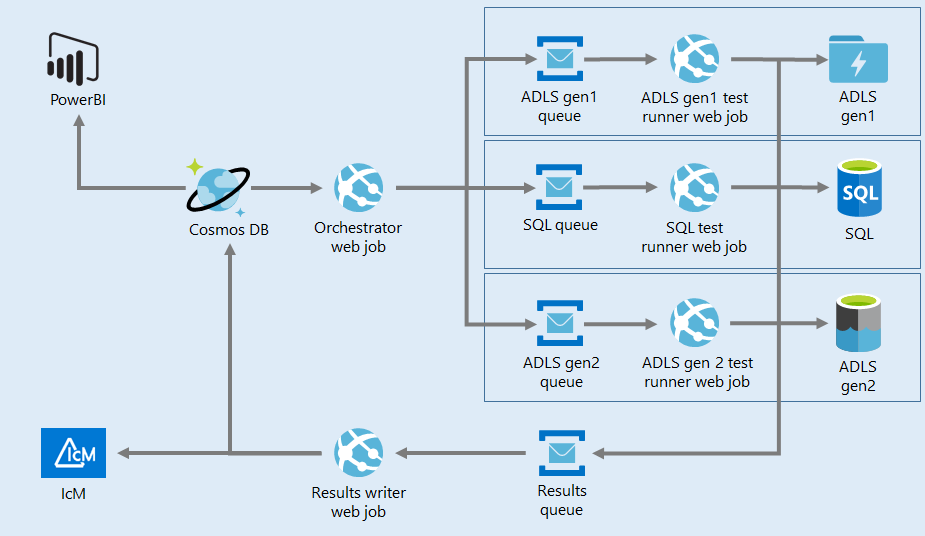
DataCop is designed with a mindset that no one team can solve this challenge on its own. The data ecosystem at Microsoft consists of multiple data fabrics, with data arriving in minutes to a month later. The system must be flexible and simple enough for other developers across Microsoft to add plugins and workers for adding to the data fabric or quality checks they want to build on. As a result, DataCop was built as a distributed message broker based on Azure Service Bus with quality check results stored on Cosmos DB.
DataCop的设计思想是,任何团队都无法独自解决这一挑战。 Microsoft的数据生态系统由多个数据结构组成,数据在数分钟至一个月后到达。 该系统必须足够灵活和简单,以使Microsoft的其他开发人员可以添加插件和工作程序,以添加到他们想要建立的数据结构或质量检查中。 结果,DataCop被构建为基于Azure Service Bus的分布式消息代理,质量检查结果存储在Cosmos DB中 。
Messages in the message broker must be self-contained and allow workers to work on them exclusively. This would allow messages from Orchestrator to run scheduled checks or from an Azure Data Factory (ADF) pipeline itself. Every time a data check or new fabric needs to be added, the developer can simply implement an override and develop their own worker process without affecting the rest of the system. The Azure team leveraged this to build on it quickly, as described below.
消息代理中的消息必须是独立的,并允许工作人员专门处理它们。 这将允许来自Orchestrator的消息运行计划的检查,或者来自Azure数据工厂 (ADF)管道本身的消息。 每次需要添加数据检查或新结构时,开发人员都可以简单地实现覆盖并开发自己的工作进程,而不会影响系统的其余部分。 如下所述,Azure团队利用它来快速构建它。
版权声明:本文内容由互联网用户自发贡献,该文观点仅代表作者本人。本站仅提供信息存储空间服务,不拥有所有权,不承担相关法律责任。如发现本站有涉嫌侵权/违法违规的内容,请联系我们,一经查实,本站将立刻删除。
如需转载请保留出处:https://51itzy.com/kjqy/134377.html