
O.Sativa选用MSU或者RAPDB这两个数据库的genome和gtf文件,介绍一下MSU的ID,RAPDB的同理。The Rice Annotation Project (RAP)(https://rapdb.dna.affrc.go.jp/index.html)和Rice Genome Annotation Project (RGAP7,MSU)(http://rice.plantbiology.msu.edu/index.shtml)RAP格式为“Os-Chr-g-number”,MSU格式为“LOC_Os-Chr-g-number”。
1 AGRIGO2 http://systemsbiology.cau.edu.cn/agriGOv2/ 支持多种ID,包括MSU
2 RIGW http://rice.hzau.edu.cn/cgi-bin/rice2/enrichment 只支持水稻的转录本ID,可做KEGG
3 PlantGSEA http://structuralbiology.cau.edu.cn/PlantGSEA/analysis.php 只支持MSU ID
4 PANTHER http://www.pantherdb.org/ 可视化漂亮。支持Uniprot ID。MSU ID转换为 Uniprot ID(PlantGSEA)
5 CARMO:http://bioinfo.sibs.ac.cn/carmo/result.php?job_id=0 只更新到 2015年,支持 LOC ID
- 将MSU ID(LOC)转换为 Uniprot ID,
PlantGSEA - 将Uniprot ID粘贴到
PANTHER中

讯享网 - 出图, select ontology,包括GO分析,蛋白功能注释,Pathway分析
- 显著性分析,statistical overrepresentation test, Use default settings
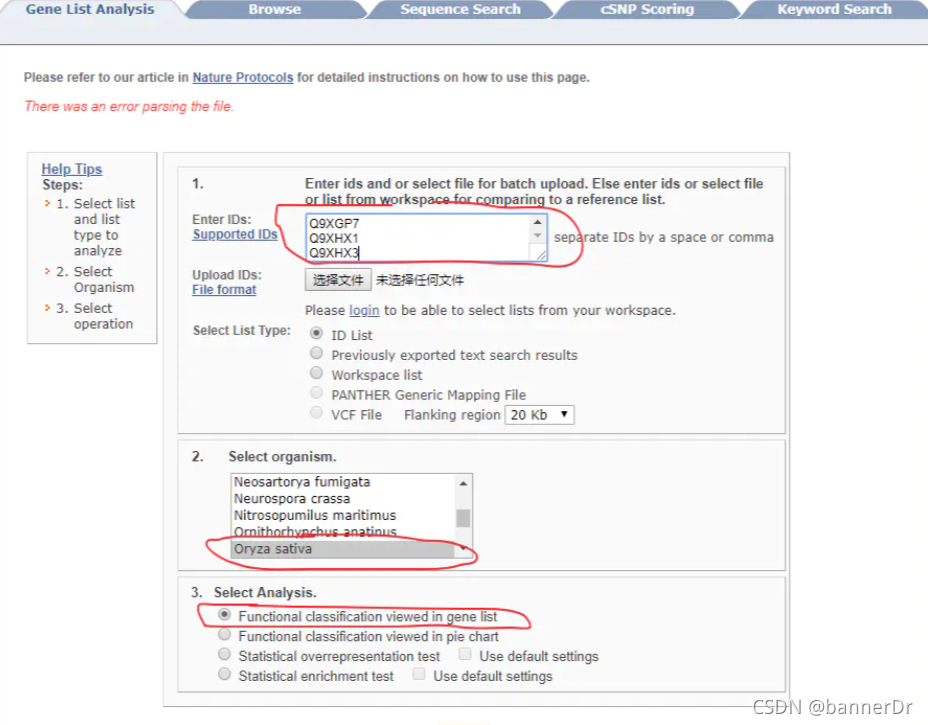
ID转化
- 水稻的基因号大致分为两类,RAP格式为“Os-Chr-g-number”,MSU格式为“LOC_Os-Chr-g-number”。各种分析输入的基因号有指定要求,ID转换至关重要。
- RAP《-》MSU:(OryzaExpress,RAP-DB,PlantGSEA)
OryzaExpress:http://bioinf.mind.meiji.ac.jp/OryzaExpress/ID_converter.phpRAP-DB:https://rapdb.dna.affrc.go.jp/tools/converter/runPlantGSEA:http://structuralbiology.cau.edu.cn/PlantGSEA/- Ensemble Plants(http://plants.ensembl.org/index.html),
- RIGW(http://rice.hzau.edu.cn/rice/)
biomaRt RAP转entrezgene_id(NCBI)- MSU转RAP转entrezid,MSU转uniprot(plantGSEA)转entrezid(david)
biomaRt
#1.Installation BiocManager::install("biomaRt") library(biomaRt) 讯享网
讯享网#2.Data Import a <- read.csv('testgene.txt',sep = '\t')
#3.getBM做ID转换 #getBM函数,四个参数。 getBM函数唯一用处,做各种ID转换。 #1.filter来控制根据什么东西来过滤,可是不同数据库的ID,也可以是染色体定位系统坐标。 #2.Attributes来控制我们想获得什么,一般是不同数据库的ID。 #3.Values是我们用来检索的关键词向量。 #4.Mart是我们前面选择好的数据库。 #3.1建立与ensemble数据库的链接 #在ensemble plants上能看到所有已提交的物种信息 ensembl = useMart(biomart = "plants_mart",host = "http://plants.ensembl.org") #查看ensemble plants都有哪些物种信息,并设置为该物种信息。 dataset <- listDatasets(mart = ensembl) head(dataset) ensembl = useMart(biomart = "plants_mart",host = "http://plants.ensembl.org",dataset="osativa_eg_gene") #查看该dataset上都有哪些属性,方便后面做添加 attributes <- listAttributes(ensembl) 讯享网supplement <- getBM(attributes =c("ensembl_gene_id",'external_gene_name',"description"),filters = "ensembl_gene_id",values = a,mart = ensembl)
转换成GO ID并附上GO描述
supplements <- getBM(attributes =c("ensembl_gene_id",'go_id','goslim_goa_description'), filters = "ensembl_gene_id",values = a,mart = ensembl) 转换成NCBI ID
讯享网supplements <- getBM(attributes =c("ensembl_gene_id",'entrezgene_id'), filters = "ensembl_gene_id",values = a,mart = ensembl)
ClusterProfile
- GO数据库?以及BP,MF,CC的分类系统?超几何分布检验?不同的阈值过滤?筛选指标?
- 超几何分布是统计学上一种离散概率分布。它描述了从有限N个物件(其中包含M个指定种类的物件)中抽出n个物件,成功抽出该指定种类的物件的次数(不放回)。
- 拿不到结果?这个时候可以设置: pvalueCutoff = 0.9, qvalueCutoff =0.9 甚至为1,来不做筛选。而且基因集的大小也是被限制了。
enrichGO(); dotplot() - 多组基因集的KEGG数据库富集
compareCluster,在线获取KEGG数据库最新信息,考验网速: - 制作一个 DEG 数据框,其中有两列ENTREZID,是基因id,和new是分组信息
xx.formula <- compareCluster(ENTREZID~new, data=DEG, fun=‘enrichKEGG’)
dotplot(xx.formula, x=~GeneRatio) + facet_grid(~new) - 多组基因集走GO数据库富集
构建一个数据框,list_de_gene_clusters, 含有两列信息:

list_de_gene_clusters <- split(de_gene_clusters$ENTREZID, de_gene_clusters$cluster) # Run full GO enrichment test formula_res <- compareCluster( ENTREZID~cluster, data=de_gene_clusters, fun="enrichGO", OrgDb="org.Mm.eg.db", ont = "BP", pAdjustMethod = "BH", pvalueCutoff = 0.01, qvalueCutoff = 0.05 ) # Run GO enrichment test and merge terms # that are close to each other to remove result redundancy lineage1_ego <- simplify( formula_res, cutoff=0.5, by="p.adjust", select_fun=min )
版权声明:本文内容由互联网用户自发贡献,该文观点仅代表作者本人。本站仅提供信息存储空间服务,不拥有所有权,不承担相关法律责任。如发现本站有涉嫌侵权/违法违规的内容,请联系我们,一经查实,本站将立刻删除。
如需转载请保留出处:https://51itzy.com/kjqy/133601.html