
上一篇我们通过WireShark抓包获取到了RTSP通信的流程,本篇文章通过代码去分析每个流程的工作原理。
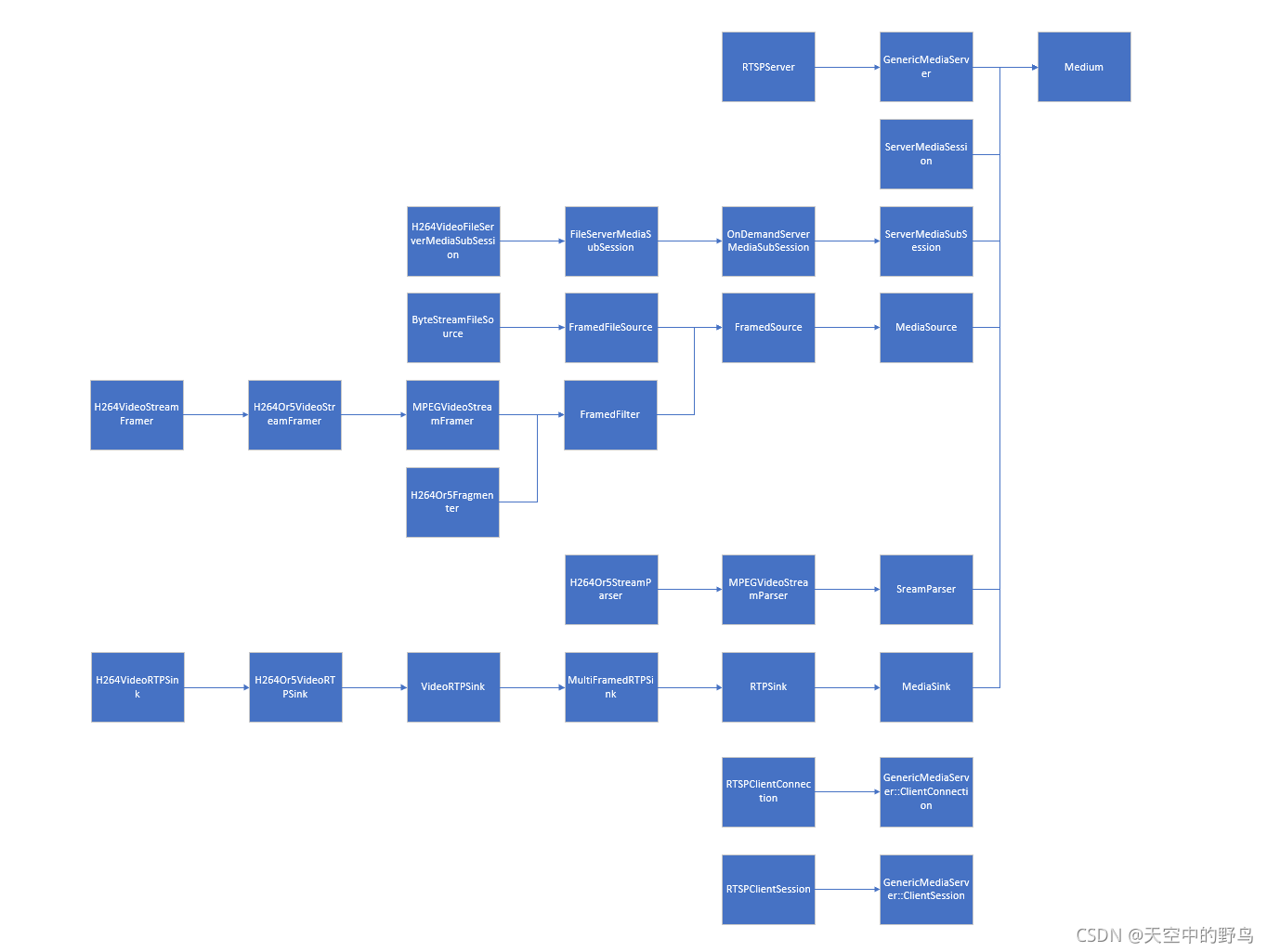
live555的继承关系太过复杂,所以做了个图简单记录一下与h264文件传输相关的类继承关系
讯享网
一、OPTION
OPTION比较简单,就是客户端向服务端请求可用的方法。服务端收到客户端发来的OPTION指令后,调用函数handleCmd_OPTIONS进行处理
void RTSPServer::RTSPClientConnection::handleCmd_OPTIONS() {
    snprintf((char*)fResponseBuffer, sizeof fResponseBuffer, "RTSP/1.0 200 OK\r\nCSeq: %s\r\n%sPublic: %s\r\n\r\n", fCurrentCSeq, dateHeader(), fOurRTSPServer.allowedCommandNames()); }
讯享网
讯享网char const* RTSPServer::allowedCommandNames() {
    return "OPTIONS, DESCRIBE, SETUP, TEARDOWN, PLAY, PAUSE, GET_PARAMETER, SET_PARAMETER"; }
二、DESCRIBE
live555很多类的关键变量命名是一样的,所以做了个图简单记录下在模拟h264RTP时的关键变量的实际类型。后面分析代码时觉得乱时可以回头看看这张图。
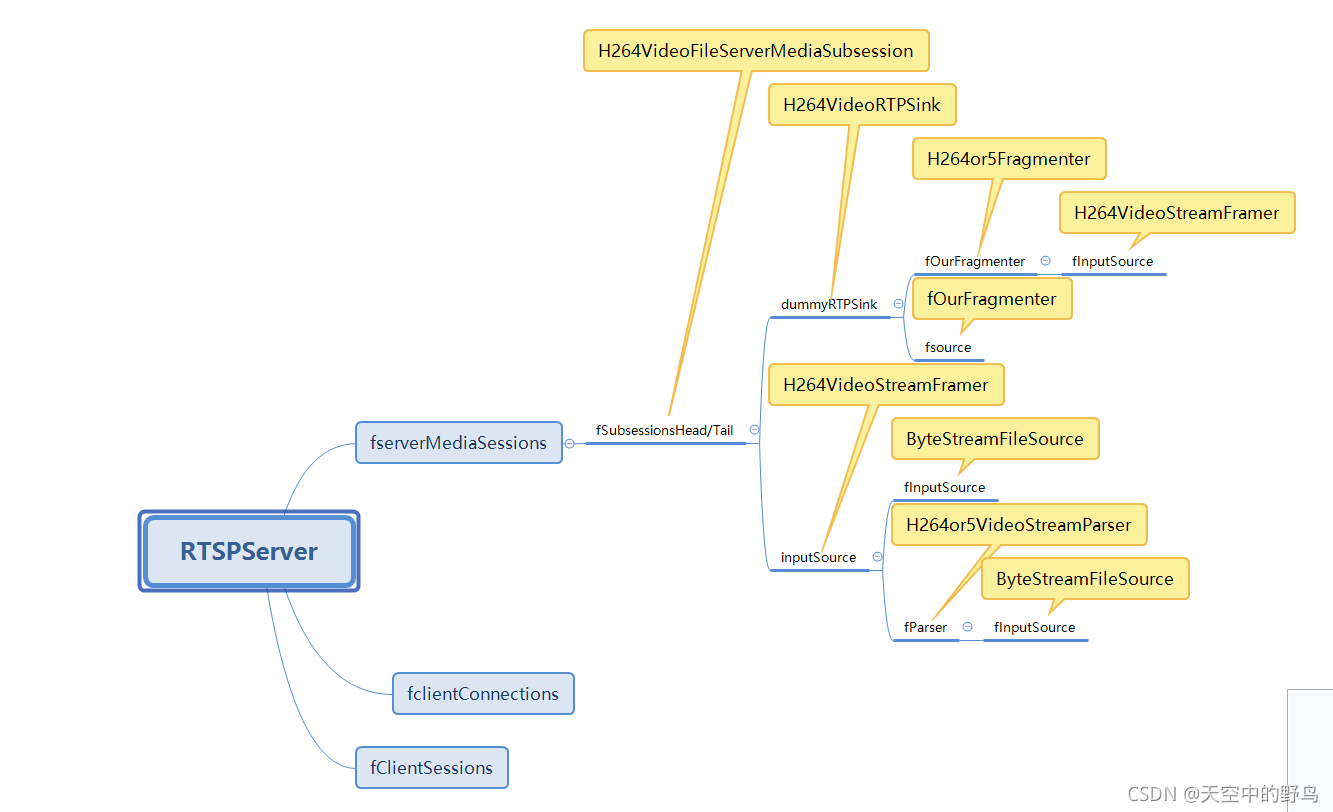
DESCRIBE的过程是客户端向服务端请求媒体描述文件,服务端向客户端回复sdp信息。
1.处理DESCRIBE命令
void RTSPServer::RTSPClientConnection ::handleCmd_DESCRIBE(char const* urlPreSuffix, char const* urlSuffix, char const* fullRequestStr) {
    char urlTotalSuffix[2*RTSP_PARAM_STRING_MAX]; // enough space for urlPreSuffix/urlSuffix'\0' urlTotalSuffix[0] = '\0'; if (urlPreSuffix[0] != '\0') {
    strcat(urlTotalSuffix, urlPreSuffix); strcat(urlTotalSuffix, "/"); } strcat(urlTotalSuffix, urlSuffix); if (!authenticationOK("DESCRIBE", urlTotalSuffix, fullRequestStr)) return; // We should really check that the request contains an "Accept:"  // for "application/sdp", because that's what we're sending back  // Begin by looking up the "ServerMediaSession" object for the specified "urlTotalSuffix": fOurServer.lookupServerMediaSession(urlTotalSuffix, DESCRIBELookupCompletionFunction, this); }
可以看到,服务端的handleCmd_DESCRIBE函数。首先是通过urlTotalSuffix找到对应的MediaSession,找到后调用ESCRIBELookupCompletionFunction函数。
讯享网void RTSPServer::RTSPClientConnection ::DESCRIBELookupCompletionFunction(void* clientData, ServerMediaSession* sessionLookedUp) {
    RTSPServer::RTSPClientConnection* connection = (RTSPServer::RTSPClientConnection*)clientData; connection->handleCmd_DESCRIBE_afterLookup(sessionLookedUp); } void RTSPServer::RTSPClientConnection ::handleCmd_DESCRIBE_afterLookup(ServerMediaSession* session) {
    char* sdpDescription = NULL; char* rtspURL = NULL; do {
    if (session == NULL) {
    handleCmd_notFound(); break; } // Increment the "ServerMediaSession" object's reference count, in case someone removes it // while we're using it: session->incrementReferenceCount(); // Then, assemble a SDP description for this session: sdpDescription = session->generateSDPDescription(fAddressFamily); if (sdpDescription == NULL) {
    // This usually means that a file name that was specified for a // "ServerMediaSubsession" does not exist. setRTSPResponse("404 File Not Found, Or In Incorrect Format"); break; } unsigned sdpDescriptionSize = strlen(sdpDescription); // Also, generate our RTSP URL, for the "Content-Base:" header // (which is necessary to ensure that the correct URL gets used in subsequent "SETUP" requests). rtspURL = fOurRTSPServer.rtspURL(session, fClientInputSocket); snprintf((char*)fResponseBuffer, sizeof fResponseBuffer, "RTSP/1.0 200 OK\r\nCSeq: %s\r\n" "%s" "Content-Base: %s/\r\n" "Content-Type: application/sdp\r\n" "Content-Length: %d\r\n\r\n" "%s", fCurrentCSeq, dateHeader(), rtspURL, sdpDescriptionSize, sdpDescription); } while (0); if (session != NULL) {
    // Decrement its reference count, now that we're done using it: session->decrementReferenceCount(); if (session->referenceCount() == 0 && session->deleteWhenUnreferenced()) {
    fOurServer.removeServerMediaSession(session); } } delete[] sdpDescription; delete[] rtspURL; }
2.生成SDP信息
找到session后,让这个session生成SDP描述信息。调用generateSDPDescription函数
 for (subsession = fSubsessionsHead; subsession != NULL; subsession = subsession->fNext) {
    char const* sdpLines = subsession->sdpLines(addressFamily); if (sdpLines == NULL) continue; // the media's not available sdpLength += strlen(sdpLines); }
在generateSDPDescription时,查找session的subsession,添加每个subsession的sdp信息。
我们这个例子中只有一个subsession,就是H264VideoFileServerMediaSubsession。
而H264VideoFileServerMediaSubsession继承于OnDemandServerMediaSubsession。所以接下来会调用OnDemandServerMediaSubsession的sdpLines来生成sdp信息。
3.获取subsession的sdp信息
讯享网char const* OnDemandServerMediaSubsession::sdpLines(int addressFamily) {
    if (fSDPLines == NULL) {
    // We need to construct a set of SDP lines that describe this // subsession (as a unicast stream). To do so, we first create // dummy (unused) source and "RTPSink" objects, // whose parameters we use for the SDP lines: unsigned estBitrate; FramedSource* inputSource = createNewStreamSource(0, estBitrate); if (inputSource == NULL) return NULL; // file not found Groupsock* dummyGroupsock = createGroupsock(nullAddress(addressFamily), 0); unsigned char rtpPayloadType = 96 + trackNumber()-1; // if dynamic RTPSink* dummyRTPSink = createNewRTPSink(dummyGroupsock, rtpPayloadType, inputSource); if (dummyRTPSink != NULL && dummyRTPSink->estimatedBitrate() > 0) estBitrate = dummyRTPSink->estimatedBitrate(); setSDPLinesFromRTPSink(dummyRTPSink, inputSource, estBitrate); Medium::close(dummyRTPSink); delete dummyGroupsock; closeStreamSource(inputSource); } return fSDPLines; }
由于初始化时我们不知道H264VideoFileServerMediaSubsession的sps和pps等信息,所以live555通过模拟发送RTP流的方式,先读取H264文件并解析来获取sps和pps信息。
首先是创建一个输入源;
然后创建一个模拟的Groupsock,这个模拟的Groupsock是个空的地址,端口也设置的是0;
然后利用这个Groupsock和输入源创建一个RTP消费者,由于这个RTPSink的IP端口都是假的,所以就不会真正的发送RTP流。
最后通过setSDPLinesFromRTPSink获取到这个subsession的SDP信息。
由于这个过程只是为了获取SDP信息,所以获取到SDP信息以后就把创建的这些模拟的媒体资源全部释放掉了。
4.创建媒体输入源
这个Subsession是H264VideoFileServerMediaSubsession类型的,所以会调用H264VideoFileServerMediaSubsession的createNewStreamSource。
FramedSource* H264VideoFileServerMediaSubsession::createNewStreamSource(unsigned /*clientSessionId*/, unsigned& estBitrate) {
estBitrate = 500; // kbps, estimate // Create the video source: ByteStreamFileSource* fileSource = ByteStreamFileSource::createNew(envir(), fFileName); if (fileSource == NULL) return NULL; fFileSize = fileSource->fileSize(); // Create a framer for the Video Elementary Stream: return H264VideoStreamFramer::createNew(envir(), fileSource); } 讯享网H264VideoStreamFramer ::H264VideoStreamFramer(UsageEnvironment& env, FramedSource* inputSource, Boolean createParser, Boolean includeStartCodeInOutput, Boolean insertAccessUnitDelimiters) : H264or5VideoStreamFramer(264, env, inputSource, createParser, includeStartCodeInOutput, insertAccessUnitDelimiters) {
}
H264VideoStreamFramer继承于H264or5VideoStreamFramer。
H264or5VideoStreamFramer ::H264or5VideoStreamFramer(int hNumber, UsageEnvironment& env, FramedSource* inputSource, Boolean createParser, Boolean includeStartCodeInOutput, Boolean insertAccessUnitDelimiters) : MPEGVideoStreamFramer(env, inputSource), fHNumber(hNumber), fIncludeStartCodeInOutput(includeStartCodeInOutput), fInsertAccessUnitDelimiters(insertAccessUnitDelimiters), fLastSeenVPS(NULL), fLastSeenVPSSize(0), fLastSeenSPS(NULL), fLastSeenSPSSize(0), fLastSeenPPS(NULL), fLastSeenPPSSize(0) {
    fParser = createParser ? new H264or5VideoStreamParser(hNumber, this, inputSource, includeStartCodeInOutput) : NULL; fFrameRate = 30.0; // We assume a frame rate of 30 fps, unless we learn otherwise (from parsing a VPS or SPS NAL unit) }
在这里面会创建一个解析器,来解析h264的文件。

5.获取SDPLine
讯享网void OnDemandServerMediaSubsession ::setSDPLinesFromRTPSink(RTPSink* rtpSink, FramedSource* inputSource, unsigned estBitrate) {
    if (rtpSink == NULL) return; char const* mediaType = rtpSink->sdpMediaType(); unsigned char rtpPayloadType = rtpSink->rtpPayloadType(); struct sockaddr_storage const& addressForSDP = rtpSink->groupsockBeingUsed().groupAddress(); portNumBits portNumForSDP = ntohs(rtpSink->groupsockBeingUsed().port().num()); AddressString ipAddressStr(addressForSDP); char* rtpmapLine = rtpSink->rtpmapLine(); char const* rtcpmuxLine = fMultiplexRTCPWithRTP ? "a=rtcp-mux\r\n" : ""; char const* rangeLine = rangeSDPLine(); char const* auxSDPLine = getAuxSDPLine(rtpSink, inputSource); if (auxSDPLine == NULL) auxSDPLine = ""; char const* const sdpFmt = "m=%s %u RTP/AVP %d\r\n" "c=IN %s %s\r\n" "b=AS:%u\r\n" "%s" "%s" "%s" "%s" "a=control:%s\r\n"; unsigned sdpFmtSize = strlen(sdpFmt) + strlen(mediaType) + 5 /* max short len */ + 3 /* max char len */ + 3/*IP4 or IP6*/ + strlen(ipAddressStr.val()) + 20 /* max int len */ + strlen(rtpmapLine) + strlen(rtcpmuxLine) + strlen(rangeLine) + strlen(auxSDPLine) + strlen(trackId()); char* sdpLines = new char[sdpFmtSize]; sprintf(sdpLines, sdpFmt, mediaType, // m= <media> portNumForSDP, // m= <port> rtpPayloadType, // m= <fmt list> addressForSDP.ss_family == AF_INET ? "IP4" : "IP6", ipAddressStr.val(), // c= address estBitrate, // b=AS:<bandwidth> rtpmapLine, // a=rtpmap:... (if present) rtcpmuxLine, // a=rtcp-mux:... (if present) rangeLine, // a=range:... (if present) auxSDPLine, // optional extra SDP line trackId()); // a=control:<track-id> delete[] (char*)rangeLine; delete[] rtpmapLine; delete[] fSDPLines; fSDPLines = strDup(sdpLines); delete[] sdpLines; }
以此生成sdp媒体类型、负载类型、IP地址等等信息。
重点在getAuxSDPLine函数,这个函数会去生成h264文件相关的Sdp信息。
由于我们是H264VideoFileServerMediaSubsession,所以回去调用H264VideoFileServerMediaSubsession的getAuxSDPLine函数。
char const* H264VideoFileServerMediaSubsession::getAuxSDPLine(RTPSink* rtpSink, FramedSource* inputSource) {
    if (fAuxSDPLine != NULL) return fAuxSDPLine; // it's already been set up (for a previous client) if (fDummyRTPSink == NULL) {
// we're not already setting it up for another, concurrent stream // Note: For H264 video files, the 'config' information ("profile-level-id" and "sprop-parameter-sets") isn't known // until we start reading the file. This means that "rtpSink"s "auxSDPLine()" will be NULL initially, // and we need to start reading data from our file until this changes. fDummyRTPSink = rtpSink; // Start reading the file: fDummyRTPSink->startPlaying(*inputSource, afterPlayingDummy, this); // Check whether the sink's 'auxSDPLine()' is ready: checkForAuxSDPLine(this); } envir().taskScheduler().doEventLoop(&fDoneFlag); return fAuxSDPLine; } 讯享网void H264VideoFileServerMediaSubsession::checkForAuxSDPLine1() {
nextTask() = NULL; char const* dasl; if (fAuxSDPLine != NULL) {
// Signal the event loop that we're done: setDoneFlag(); } else if (fDummyRTPSink != NULL && (dasl = fDummyRTPSink->auxSDPLine()) != NULL) {
fAuxSDPLine = strDup(dasl); fDummyRTPSink = NULL; // Signal the event loop that we're done: setDoneFlag(); } else if (!fDoneFlag) {
// try again after a brief delay: int uSecsToDelay = ; // 100 ms nextTask() = envir().taskScheduler().scheduleDelayedTask(uSecsToDelay, (TaskFunc*)checkForAuxSDPLine, this); } }
可以看到,这个函数就是一直循环检测SDPLine或者模拟RTPSink的SDPLine是否生成,如果没生成就过100ms继续检测,直到生成后就把fDoneFlag置位,这时任务调度器就会停止工作。
char const* H264VideoRTPSink::auxSDPLine() {
    // Generate a new "a=fmtp:" line each time, using our SPS and PPS (if we have them), // otherwise parameters from our framer source (in case they've changed since the last time that // we were called): H264or5VideoStreamFramer* framerSource = NULL; u_int8_t* vpsDummy = NULL; unsigned vpsDummySize = 0; u_int8_t* sps = fSPS; unsigned spsSize = fSPSSize; u_int8_t* pps = fPPS; unsigned ppsSize = fPPSSize; if (sps == NULL || pps == NULL) {
    // We need to get SPS and PPS from our framer source: if (fOurFragmenter == NULL) return NULL; // we don't yet have a fragmenter (and therefore not a source) framerSource = (H264or5VideoStreamFramer*)(fOurFragmenter->inputSource()); if (framerSource == NULL) return NULL; // we don't yet have a source framerSource->getVPSandSPSandPPS(vpsDummy, vpsDummySize, sps, spsSize, pps, ppsSize); if (sps == NULL || pps == NULL) return NULL; // our source isn't ready } // Set up the "a=fmtp:" SDP line for this stream: u_int8_t* spsWEB = new u_int8_t[spsSize]; // "WEB" means "Without Emulation Bytes" unsigned spsWEBSize = removeH264or5EmulationBytes(spsWEB, spsSize, sps, spsSize); if (spsWEBSize < 4) {
    // Bad SPS size => assume our source isn't ready delete[] spsWEB; return NULL; } u_int32_t profileLevelId = (spsWEB[1]<<16) | (spsWEB[2]<<8) | spsWEB[3]; delete[] spsWEB; char* sps_base64 = base64Encode((char*)sps, spsSize); char* pps_base64 = base64Encode((char*)pps, ppsSize); char const* fmtpFmt = "a=fmtp:%d packetization-mode=1" ";profile-level-id=%06X" ";sprop-parameter-sets=%s,%s\r\n"; unsigned fmtpFmtSize = strlen(fmtpFmt) + 3 /* max char len */ + 6 /* 3 bytes in hex */ + strlen(sps_base64) + strlen(pps_base64); char* fmtp = new char[fmtpFmtSize]; sprintf(fmtp, fmtpFmt, rtpPayloadType(), profileLevelId, sps_base64, pps_base64); delete[] sps_base64; delete[] pps_base64; delete[] fFmtpSDPLine; fFmtpSDPLine = fmtp; return fFmtpSDPLine; }
6.启动RTPSink
讯享网Boolean MediaSink::startPlaying(MediaSource& source, afterPlayingFunc* afterFunc, void* afterClientData) {
    // Make sure we're not already being played: if (fSource != NULL) {
    envir().setResultMsg("This sink is already being played"); return False; } // Make sure our source is compatible: if (!sourceIsCompatibleWithUs(source)) {
    envir().setResultMsg("MediaSink::startPlaying(): source is not compatible!"); return False; } fSource = (FramedSource*)&source; fAfterFunc = afterFunc; fAfterClientData = afterClientData; return continuePlaying(); }
开始播放后会去调用虚函数continuePlaying。我们的RTPSink是H264or5VideoRTPSink类型的,所以就去调用H264or5VideoRTPSink的continuePlaying
Boolean H264or5VideoRTPSink::continuePlaying() {
    // First, check whether we have a 'fragmenter' class set up yet. // If not, create it now: if (fOurFragmenter == NULL) {
    fOurFragmenter = new H264or5Fragmenter(fHNumber, envir(), fSource, OutPacketBuffer::maxSize, ourMaxPacketSize() - 12/*RTP hdr size*/); } else {
    fOurFragmenter->reassignInputSource(fSource); } fSource = fOurFragmenter; // Then call the parent class's implementation: return MultiFramedRTPSink::continuePlaying(); }
这里面创建了一个H264或H265的分片管理器。然后调用父类MultiFramedRTPSink::continuePlaying;
讯享网Boolean MultiFramedRTPSink::continuePlaying() {
    // Send the first packet. // (This will also schedule any future sends.) buildAndSendPacket(True); return True; } ... void MultiFramedRTPSink::buildAndSendPacket(Boolean isFirstPacket) {
    nextTask() = NULL; fIsFirstPacket = isFirstPacket; // Set up the RTP header: unsigned rtpHdr = 0x; // RTP version 2; marker ('M') bit not set (by default; it can be set later) rtpHdr |= (fRTPPayloadType<<16); rtpHdr |= fSeqNo; // sequence number fOutBuf->enqueueWord(rtpHdr); // Note where the RTP timestamp will go. // (We can't fill this in until we start packing payload frames.) fTimestampPosition = fOutBuf->curPacketSize(); fOutBuf->skipBytes(4); // leave a hole for the timestamp fOutBuf->enqueueWord(SSRC()); // Allow for a special, payload-format-specific header following the // RTP header: fSpecialHeaderPosition = fOutBuf->curPacketSize(); fSpecialHeaderSize = specialHeaderSize(); fOutBuf->skipBytes(fSpecialHeaderSize); // Begin packing as many (complete) frames into the packet as we can: fTotalFrameSpecificHeaderSizes = 0; fNoFramesLeft = False; fNumFramesUsedSoFar = 0; packFrame(); } void MultiFramedRTPSink::packFrame() {
    // Get the next frame. // First, skip over the space we'll use for any frame-specific header: fCurFrameSpecificHeaderPosition = fOutBuf->curPacketSize(); fCurFrameSpecificHeaderSize = frameSpecificHeaderSize(); fOutBuf->skipBytes(fCurFrameSpecificHeaderSize); fTotalFrameSpecificHeaderSizes += fCurFrameSpecificHeaderSize; // See if we have an overflow frame that was too big for the last pkt if (fOutBuf->haveOverflowData()) {
    // Use this frame before reading a new one from the source unsigned frameSize = fOutBuf->overflowDataSize(); struct timeval presentationTime = fOutBuf->overflowPresentationTime(); unsigned durationInMicroseconds = fOutBuf->overflowDurationInMicroseconds(); fOutBuf->useOverflowData(); afterGettingFrame1(frameSize, 0, presentationTime, durationInMicroseconds); } else {
    // Normal case: we need to read a new frame from the source if (fSource == NULL) return; fSource->getNextFrame(fOutBuf->curPtr(), fOutBuf->totalBytesAvailable(), afterGettingFrame, this, ourHandleClosure, this); } }
continuePlaying以此调用到了packFrame函数,这个函数中检测到数据不足时会调用fSource->getNextFrame。要记得这个fSource就是之前创建的片段管理器,类型是H264or5Fragmenter。
getNextFrame函数都会去调用虚函数doGetNextFrame,doGetNextFrame是每个子类自己实现的。
所以这里会调用到H264or5Fragmenter的doGetNextFrame函数。
 if (fNumValidDataBytes == 1) {
    // We have no NAL unit data currently in the buffer. Read a new one: fInputSource->getNextFrame(&fInputBuffer[1], fInputBufferSize - 1, afterGettingFrame, this, FramedSource::handleClosure, this); }
H264or5Fragmenter的doGetNextFrame又会去调用InputSource->getNextFrame。
而这个InputSource的类型是H264VideoStreamFramer,可以回去看关键变量类型图。
所以就调用到H264VideoStreamFramer::doGetNextFrame。它继承自H264or5VideoStreamFramer,自身没有重写虚函数,所以调用H264or5VideoStreamFramer::doGetNextFrame.
讯享网 else {
    // Do the normal delivery of a NAL unit from the parser: MPEGVideoStreamFramer::doGetNextFrame(); }
它又去调用MPEGVideoStreamFramer::doGetNextFrame()
void MPEGVideoStreamFramer::doGetNextFrame() {
    fParser->registerReadInterest(fTo, fMaxSize); continueReadProcessing(); }
continueReadProcessing又去调用解析器的解析函数。
讯享网unsigned acquiredFrameSize = fParser->parse();
usingSource()->saveCopyOfSPS(fStartOfFrame + fOutputStartCodeSize, curFrameSize() - fOutputStartCodeSize); ... usingSource()->saveCopyOfPPS(fStartOfFrame + fOutputStartCodeSize, curFrameSize() - fOutputStartCodeSize); 得到SPS和PPS信息后,结合之前H264VideoRTPSink::auxSDPLine()函数,就能生成对应的SDPLine信息了。从而生成了SDP信息并发送给客户端。完成DESCRIBE的整个流程。
版权声明:本文内容由互联网用户自发贡献,该文观点仅代表作者本人。本站仅提供信息存储空间服务,不拥有所有权,不承担相关法律责任。如发现本站有涉嫌侵权/违法违规的内容,请联系我们,一经查实,本站将立刻删除。
如需转载请保留出处:https://51itzy.com/kjqy/121242.html