
本文参考自:https://www.codeproject.com/Articles//Polyline-Simplification
前言
在计算几何中,经常我们会碰到需要简化输入Polyline的场景。多段线(Polyline)简化算法可以帮助我们减少Polyline的点数,从而降低输入规模。对多段线简化算法,通常的做法是在一定的近似精度下,删除一些点或者边。在计算机图形学中,当多段线分辨率高于显示分辨率时,多个顶点和边很可能映射到单个像素上,这意味着计算机将花费一些额外的资源去绘制不可见的顶点。在绘制之前,可以通过多段线简化算法减少点数,从而轻松地避免这种计算资源的浪费。
实践中,根据不同场景的需要,有下面几种简化算法通常比较有用:
- 临近点简化(Radial Distance)
- 垂直距离简化(Perpendicular Distance)
- Douglas-Peucker算法
临近点简化
该算法是一个简单的O(n)复杂度的暴力算法。对某个顶点,接下来连续的顶点与该点(key)的距离如果都在给定的误差范围内,那么将移除这些点。过程如下图:
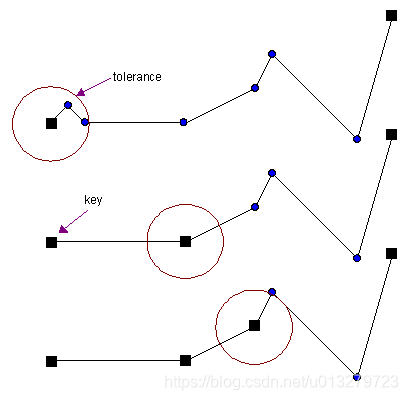
我们通常保留Polyline的起始点和终止点作为结果的一部分。首先将起始点标记为Key,然后沿着Polyline前进,与Key相邻的连续顶点到Key的距离如果小于给定误差就移除,遇到的第一个超过误差的点标记为下一个Key;从这个新的key开始重复上面的过程,知道到达之后一个顶点。
垂直距离简化
临近点算法将点-点距离作为误差判据,而垂直距离简化则是将点-线段的距离作为误差判据。对于每个顶点Vi,需要计算它与线段[Vi-1, Vi+1]的垂直距离,距离比给定误差小的点都将被移除。过程如下图所示:
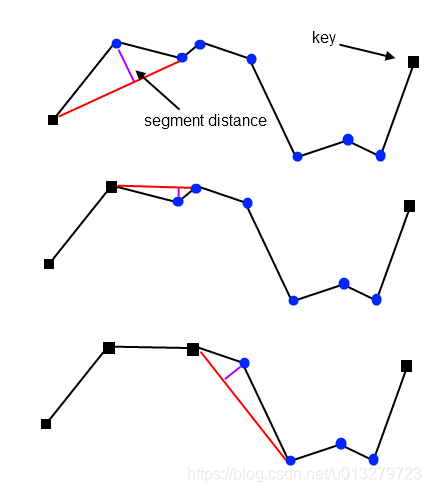

如上图,首先,对前三个顶点进行处理,计算第二个顶点的垂直距离,将这个距离与容差进行比较,大于设定的误差,所以第二个顶点作为Key保留(简化结果的一部分)。然后算法开始处理接下来的三个顶点。这一次,计算的距离低于公差,因此中间顶点被删除。如此重复,直到处理完所有顶点。
Note:对于每个被移除的顶点Vi,下一个可能被移除的候选顶点是Vi+2。这意味着原始多段线的点数最多只能减少50%。为了获得更高的顶点减少率,需要多次遍历。
Douglas-Peucker算法
Douglas-Peucker算法使用点-边距离作为误差衡量标准。该算法从连接原始Polyline的第一个和最后一个顶点的边开始,计算所有中间顶点到边的距离,距离该边最远的顶点,如果其距离大于指定的公差,将被标记为Key并添加到简化结果中。这个过程将对当前简化中的每条边进行递归,直到原始Polyline的所有顶点与当前考察的边的距离都在允许误差范围内。该过程如下图所示:
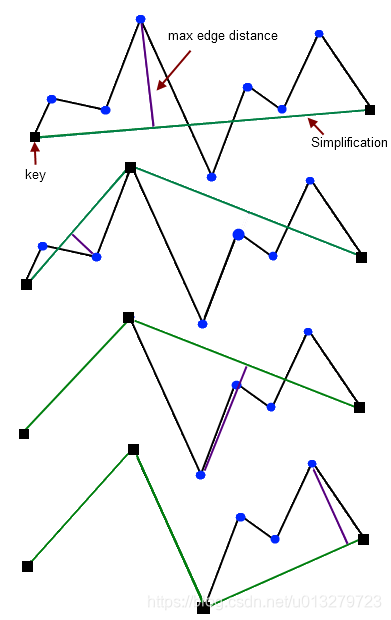
初始时,简化结果只有一条边(起点-终点)。第一步中,将第四个顶点标记为一个Key,并相应地加入到简化结果中;第二步,处理当前结果中的第一条边,到该边的最大顶点距离低于容差,因此不添加任何点;在第三步中,当前简化的第二个边找到了一个Key(点到边的距离大于容差)。这条边在这个Key处被分割,这个新的Key添加到简化结果中。这个过程一直继续下去,直到找不到新的Key为止。注意,在每个步骤中,只处理当前简化结果的一条边。
这个算法的最坏时间复杂度是O(nm), 平均时间复杂度 O(n log m),其中m是简化后的Polyline的点数。因此,该算法是Output-sensitive的。当m很小时,该算法会很快。
该算法在实践中有很好的近似效果,且效率很高,下面给出DP算法的实现:
// Assume that classes are already given for the objects: // Point and Vector with // coordinates {float x, y, z;} // as many as are needed // operators for: // == to test equality // != to test inequality // (Vector)0 = (0,0,0) (null vector) // Point = Point ± Vector // Vector = Point - Point // Vector = Vector ± Vector // Vector = Scalar * Vector (scalar product) // Vector = Vector * Vector (cross product) // Segment with defining endpoints {Point P0, P1;} //=================================================================== // dot product (3D) which allows vector operations in arguments #define dot(u,v) ((u).x * (v).x + (u).y * (v).y + (u).z * (v).z) #define norm2(v) dot(v,v) // norm2 = squared length of vector #define norm(v) sqrt(norm2(v)) // norm = length of vector #define d2(u,v) norm2(u-v) // distance squared = norm2 of difference #define d(u,v) norm(u-v) // distance = norm of difference // poly_decimate(): - remove vertices to get a smaller approximate polygon // Input: tol = approximation tolerance // V[] = polyline array of vertex points // n = the number of points in V[] // Output: sV[]= reduced polyline vertexes (max is n) // Return: m = the number of points in sV[] int poly_decimate( float tol, Point* V, int n, Point* sV ) { int i, k, m, pv; // misc counters float tol2 = tol * tol; // tolerance squared Point* vt = new Point[n]; // vertex buffer int* mk = new int[n] = {0}; // marker buffer // STAGE 1. Vertex Reduction within tolerance of prior vertex cluster vt[0] = V[0]; // start at the beginning for (i=k=1, pv=0; i<n; i++) { if (d2(V[i], V[pv]) < tol2) continue; vt[k++] = V[i]; pv = i; } if (pv < n-1) vt[k++] = V[n-1]; // finish at the end // STAGE 2. Douglas-Peucker polyline reduction mk[0] = mk[k-1] = 1; // mark the first and last vertexes poly_decimateDP( tol, vt, 0, k-1, mk ); // copy marked vertices to the reduced polyline for (i=m=0; i<k; i++) { if (mk[i]) sV[m++] = vt[i]; } delete vt; delete mk; return m; // m vertices in reduced polyline } // poly_decimateDP(): // This is the Douglas-Peucker recursive reduction routine // It marks vertexes that are part of the reduced polyline // for approximating the polyline subchain v[j] to v[k]. // Input: tol = approximation tolerance // v[] = polyline array of vertex points // j,k = indices for the subchain v[j] to v[k] // Output: mk[] = array of markers matching vertex array v[] void poly_decimateDP( float tol, Point* v, int j, int k, int* mk ) { if (k <= j+1) // there is nothing to decimate return; // check for adequate approximation by segment S from v[j] to v[k] int maxi = j; // index of vertex farthest from S float maxd2 = 0; // distance squared of farthest vertex float tol2 = tol * tol; // tolerance squared Segment S = {v[j], v[k]}; // segment from v[j] to v[k] Vector u = S.P1 - S.P0; // segment direction vector double cu = dot(u,u); // segment length squared // test each vertex v[i] for max distance from S // compute using the Algorithm dist_Point_to_Segment() // Note: this works in any dimension (2D, 3D, ...) Vector w; Point Pb; // base of perpendicular from v[i] to S double b, cw, dv2; // dv2 = distance v[i] to S squared for (int i=j+1; i<k; i++) { // compute distance squared w = v[i] - S.P0; cw = dot(w,u); if ( cw <= 0 ) dv2 =d2(v[i], S.P0); else if ( cu <= cw ) dv2 =d2(v[i], S.P1); else { b = cw / cu; Pb = S.P0 + b * u; dv2 =d2(v[i], Pb); } // test with current max distance squared if (dv2 <= maxd2) continue; // v[i] is a new max vertex maxi = i; maxd2 = dv2; } if (maxd2 > tol2) // error is worse than the tolerance { // split the polyline at the farthest vertex from S mk[maxi] = 1; // mark v[maxi] for the reduced polyline // recursively decimate the two subpolylines at v[maxi] poly_decimateDP( tol, v, j, maxi, mk ); // polyline v[j] to v[maxi] poly_decimateDP( tol, v, maxi, k, mk ); // polyline v[maxi] to v[k] } // else the approximation is OK, so ignore intermediate vertexes return; } //=================================================================== 讯享网
版权声明:本文内容由互联网用户自发贡献,该文观点仅代表作者本人。本站仅提供信息存储空间服务,不拥有所有权,不承担相关法律责任。如发现本站有涉嫌侵权/违法违规的内容,请联系我们,一经查实,本站将立刻删除。
如需转载请保留出处:https://51itzy.com/kjqy/111362.html