
DCGAN理论讲解:
论文地址:https://arxiv.org/abs/1511.06434
DCGAN就是将CNN和原始地GAN结合到一起,生成模型和判别模型都运用了深度卷积神经网络的生成对抗网络。DCGAN将CNN和GAN结合,奠定了之后几乎所有GAN的基本网络架构。 总之,DCGAN极大地提升了原始GAN训练地稳定性和生成结果质量。
DCGAN的改进之处:
1. DCGAN的生成器和判别器都舍弃了CNN的池化层,判别器保留CNN的整体架构,生成器则是将卷积层替换成了反卷积层(ConvTranspose2d)。
2. 在判别器和生成器中使用了Batch Normalization(BN)层,这有助于处理初始化不良导致的训练问题,加速模型训练,提升了训练的稳定性。
3. 在生成器中除输出层使用Tanh()激活函数,其余层全部使用ReLu激活函数。而在判别器中,除输出层外所有层都使用LeakyReLu激活函数,防止梯度稀疏。这一点我们已在基础GAN中使用。
DCGAN整体架构:
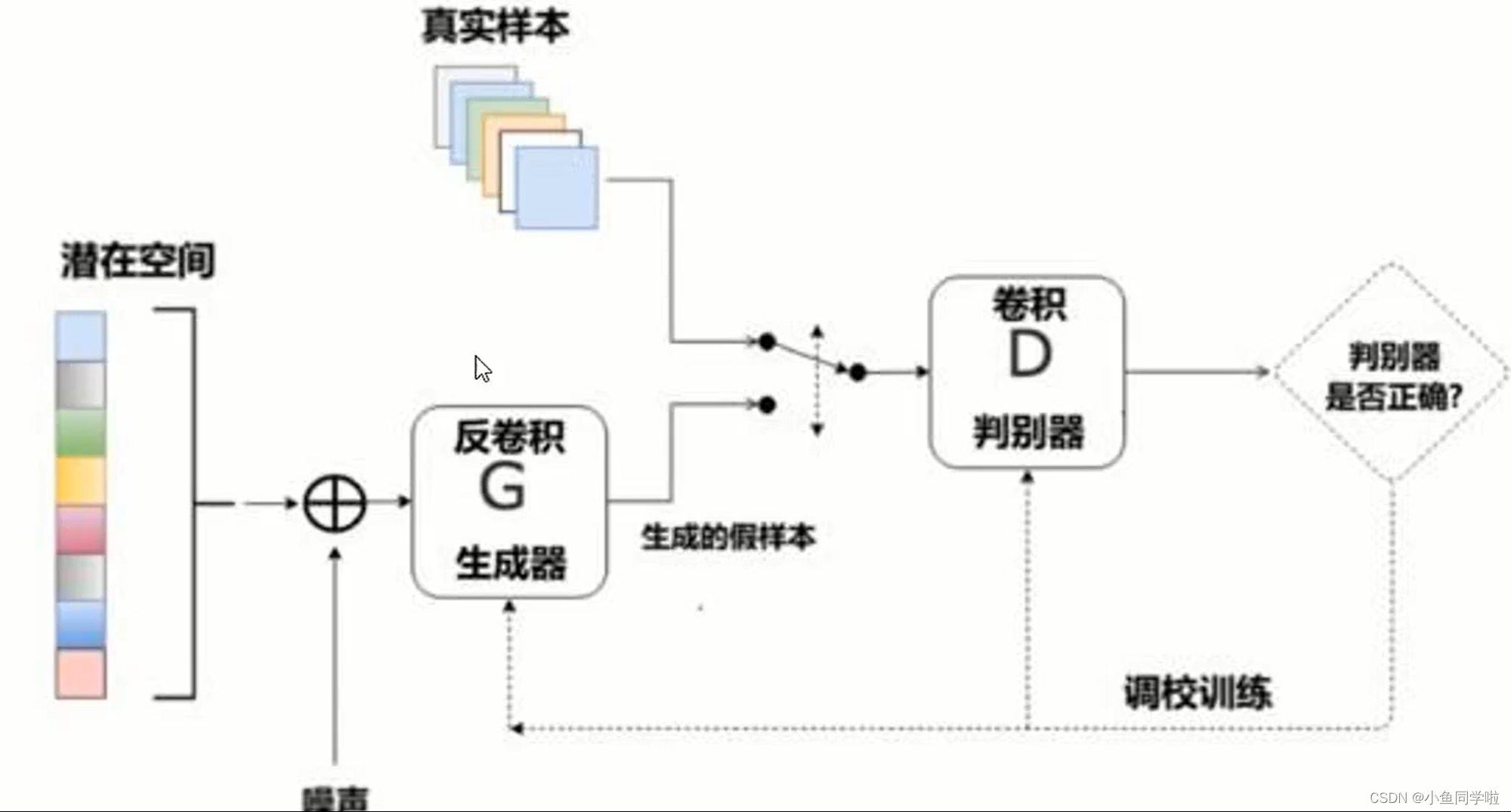
DCGAN的设计技巧:
1. 取消所有pooling层,G网络中使用转置卷积(transposed convolutional layer)进行上采样,D网络中加入stride的卷积(为防止梯度稀疏)代替pooling。
2. 去掉FC层(全连接),使网络变成全卷积网络。

3. G网络中使用Relu作为激活函数,最后一层用Tanh。
4. D网络中使用LeakyRelu激活函数。
5. 在generator和discriminator上都使用batchnorm,解决初始化差的问题,帮助梯度传播到每一层,防止generator把所有的样本都收敛到同一点。直接将BN应用到所有层会导致样本震荡和模型不稳定,因此在生成器的输出层和判别器的输入层不使用BN层,可以防止这种现象。
6. 使用Adam优化器。
7.参数参考论文: LeakyRelu的斜率是0.2 Learing rate = 0.0002 batch size是128。
运行结果:

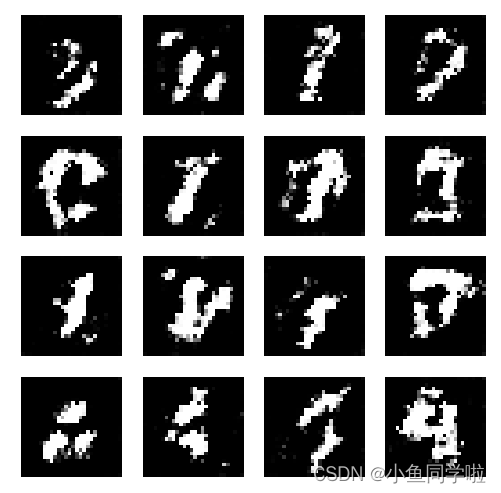
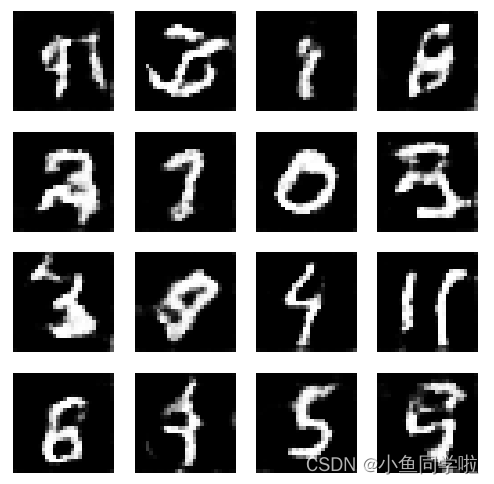
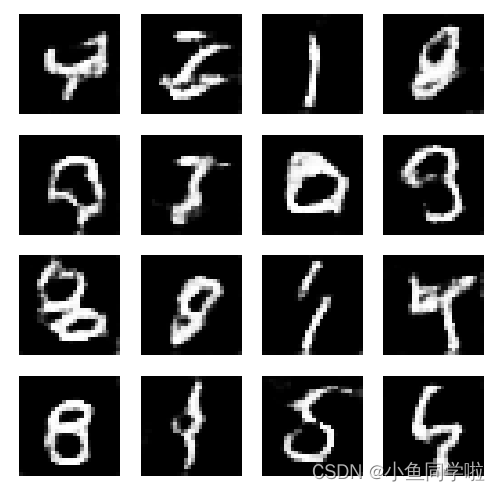
epoch=0 epoch=5 epoch=10
可以看到虽然只训练了10轮但是效果比原始GAN模型好很多,基本可以肉眼看出具体的数字了。
导入的库:
import torch import torch.nn as nn import torch.nn.functional as F import torch.optim as optim import numpy as np import matplotlib.pyplot as plt import torchvision from torchvision import transforms from torch.utils.data import DataLoader讯享网
数据准备(这里我们用的是手写数据集MNIST):
讯享网# 数据准备 transform = transforms.Compose([ transforms.ToTensor(), transforms.Normalize(0.5, 0.5) ]) train_ds = torchvision.datasets.MNIST('data', train=True, transform=transform, download=True) train_dl = DataLoader(train_ds, batch_size=4, shuffle=True)
定义生成器(Generator):
# 生成器的初始化部分 # PS:1.输出层要用Tanh激活函数 2.使用batchnorm,解决初始化差的问题,帮助梯度传播到每一层,防止生成器包所有的样本都收敛到同一个点 class Generator(nn.Module): def __init__(self): super(Generator, self).__init__() self.linear1 = nn.Linear(100, 256 * 7 * 7) self.bn1 = nn.BatchNorm1d(256 * 7 * 7) # 这里是反卷积,stride=2即让图像放大2倍,padding=2即往里缩小两格。 self.decon1 = nn.ConvTranspose2d(in_channels=256, out_channels=128, kernel_size=(3, 3), stride=1, padding=1) # (128, 7, 7) self.bn2 = nn.BatchNorm2d(128) self.decon2 = nn.ConvTranspose2d(128, 64, kernel_size=(4, 4), stride=2, padding=1) # (64, 14, 14) self.bn3 = nn.BatchNorm2d(64) self.decon3 = nn.ConvTranspose2d(64, 1, kernel_size=(4, 4), stride=2, padding=1) # (1, 28, 28) def forward(self, x): x = F.relu(self.linear1(x)) x = self.bn1(x) x = x.view(-1, 256, 7, 7) x = F.relu(self.decon1(x)) x = self.bn2(x) x = F.relu(self.decon2(x)) x = self.bn3(x) x = torch.tanh(self.decon3(x)) return x定义判别器(Discriminator):
讯享网# 判别器的初始化部分 # PS:1.输入层不能用BN 2.用LeakyReLU激活函数 3.为了防止判别器过强而一边倒,用dropout降低其学习效果 class Discriminator(nn.Module): def __init__(self): super(Discriminator, self).__init__() self.conv1 = nn.Conv2d(in_channels=1, out_channels=64, kernel_size=3, stride=2) self.conv2 = nn.Conv2d(in_channels=64, out_channels=128, kernel_size=3, stride=2) self.bn = nn.BatchNorm2d(128) self.fc = nn.Linear(128 * 6 * 6, 1) def forward(self, x): x = F.dropout2d(F.leaky_relu_(self.conv1(x))) # nn.LeakyReLU() 更适合作为模型的一部分使用,因为它会返回一个新的张量,而不会修改原始数据 x = F.dropout2d(F.leaky_relu_(self.conv2(x))) x = self.bn(x) x = x.view(-1, 128 * 6 * 6) x = self.fc(x) return x
初始化模型,定义优化器,损失函数:
# 初始化模型,定义优化器,损失函数 device = 'cuda' if torch.cuda.is_available() else 'cpu' gen = Generator().to(device) dis = Discriminator().to(device) g_optim = optim.Adam(gen.parameters(), lr=1e-4) d_optim = optim.Adam(dis.parameters(), lr=1e-5) # PS:将判别器的学习率设置小一点可以减小其学习速度,防止一边倒 loss_fun = torch.nn.MSELoss()定义绘图函数:
讯享网# 定义绘图函数 test_input = torch.randn(16, 100, device=device) def gen_img_plot(model, test_input): prediction = np.squeeze(model(test_input).detach().cpu().numpy()) plt.figure(figsize=(4, 4)) for i in range(16): plt.subplot(4, 4, i + 1) plt.imshow((prediction[i] + 1) / 2, cmap="gray") plt.axis("off") plt.show()
训练GAN:
# 训练GAN G_loss = [] D_loss = [] for epoch in range(20): g_epoch_loss = 0 d_epoch_loss = 0 count = len(train_dl) for step, (img, _) in enumerate(train_dl): img = img.to(device) size = img.size(0) random_noise = torch.randn(size, 100, device=device) # 优化判别器 d_optim.zero_grad() # 优化真实图片 real_output = dis(img) real_loss = loss_fun(real_output, torch.ones_like(real_output, device=device)) real_loss.backward() # 优化生成图片 gen_img = gen(random_noise) fake_output = dis(gen_img.detach()) fake_loss = loss_fun(fake_output, torch.zeros_like(fake_output, device=device)) fake_loss.backward() d_loss = real_loss + fake_loss d_optim.step() # 优化生成器 g_optim.zero_grad() fake_output = dis(gen_img) g_loss = loss_fun(fake_output, torch.ones_like(fake_output, device=device)) g_loss.backward() g_optim.step() with torch.no_grad(): d_epoch_loss += d_loss.item() g_epoch_loss += g_loss.item() with torch.no_grad(): d_epoch_loss /= count g_epoch_loss /= count D_loss.append(d_epoch_loss) G_loss.append(g_epoch_loss) print("Epoch:", epoch) gen_img_plot(gen, test_input) plt.plot(D_loss, label="D_loss") plt.plot(G_loss, label="G_loss") plt.legend() plt.show()完整代码:
讯享网# 训练GAN G_loss = [] D_loss = [] for epoch in range(20): g_epoch_loss = 0 d_epoch_loss = 0 count = len(train_dl) for step, (img, _) in enumerate(train_dl): img = img.to(device) size = img.size(0) random_noise = torch.randn(size, 100, device=device) # 优化判别器 d_optim.zero_grad() # 优化真实图片 real_output = dis(img) real_loss = loss_fun(real_output, torch.ones_like(real_output, device=device)) real_loss.backward() # 优化生成图片 gen_img = gen(random_noise) fake_output = dis(gen_img.detach()) fake_loss = loss_fun(fake_output, torch.zeros_like(fake_output, device=device)) fake_loss.backward() d_loss = real_loss + fake_loss d_optim.step() # 优化生成器 g_optim.zero_grad() fake_output = dis(gen_img) g_loss = loss_fun(fake_output, torch.ones_like(fake_output, device=device)) g_loss.backward() g_optim.step() with torch.no_grad(): d_epoch_loss += d_loss.item() g_epoch_loss += g_loss.item() with torch.no_grad(): d_epoch_loss /= count g_epoch_loss /= count D_loss.append(d_epoch_loss) G_loss.append(g_epoch_loss) print("Epoch:", epoch) gen_img_plot(gen, test_input) plt.plot(D_loss, label="D_loss") plt.plot(G_loss, label="G_loss") plt.legend() plt.show()
版权声明:本文内容由互联网用户自发贡献,该文观点仅代表作者本人。本站仅提供信息存储空间服务,不拥有所有权,不承担相关法律责任。如发现本站有涉嫌侵权/违法违规的内容,请联系我们,一经查实,本站将立刻删除。
如需转载请保留出处:https://51itzy.com/kjqy/108261.html