
DialEval-1 consists of two subtasks: Nugget Detection (ND) and Dialogue Quality (DQ). They aim to evaluate customer-helpdesk dialogues automatically. The ND subtask is to classify whether a customer or helpdesk turn is a nugget, where being a nugget means that the turn helps towards problem solving; and the DQ subtask is to assign quality scores to each dialogue in terms of three criteria: task accomplishment, customer satisfaction, and efficiency. The official evaluation results of 18 runs are received from 7 teams. IMTKU (Dept. of Information Management, Tamkang University, Taiwan) and I, on behalf of ZEALS, by utilizing XLM-RoBERTa via HuggingFace Transformers, fastai, and blurr, achieve top-1 or top-2 in terms of various evaluation metrics for both ND and DQ.
DialEval-1包含两个子任务:金块检测(ND)和对话质量(DQ)。 他们旨在自动评估客户服务台的对话。 ND子任务是对客户转弯或服务台转弯进行分类,其中,转弯表示转弯有助于解决问题; DQ子任务是根据三个标准为每个对话分配质量得分:任务完成,客户满意度和效率。 来自7个团队的18轮测试的官方评估结果。 IMTKU(台湾淡江大学信息管理系)和我代表ZEALS ,通过HuggingFace Transformers , fastai和blurr利用XLM-RoBERTa ,在各种评估指标上均达到前1名或前2名ND和DQ。
NTCIR? DialEval? ND? DQ? (NTCIR? DialEval? ND? DQ?)
NII (National Institute of Informatics) Testbeds and Community for Information Access Research, a.k.a. NTCIR, is a series of evaluation workshops designed to enhance research in information access technologies, including information retrieval, question answering, text summarization, extraction, etc. It can be seen as an Asia-Pacific counterpart of TREC (Text REtrieval Conference; America), CLEF (Conference and Labs of the Evaluation Forum; Europe), and FIRE (Forum for Information Retrieval Evaluation; Southern Asia).
ñII(国立信息学研究所)笔estbeds和C ommunity为我载文信息访问R esearch,又名NTCIR ,是一个系列评测研讨会旨在加强在信息接入技术,包括信息检索,问题解答,文本摘要,提取研究,可以将其视为TREC (文本检索会议;美国), CLEF (评估论坛的会议和实验室;欧洲)和FIRE (信息检索评估论坛;南亚)的亚太地区对口单位。
DialEval-1 is one of the initiatives, e.g., DSTC (Dialog System Technology Challenges), that study the complexity of the dialogue phenomenon and various dialogue-related problems. Unlike typical tasks of DSTC, however, DialEval-1 focuses on reducing the cost of corpus curation and data analytics. Although WOZ (Wizard-of-Oz), a common approach nowadays, can distribute the workloads of data collection, annotation, and evaluation to crowd-sourcing, the time spent on reaching an agreement for annotation/evaluation standard is nonetheless linear, if not worse. In other words, human annotation and evaluation have two types of issues:
DialEval-1是一项举措,例如DSTC (对话系统技术挑战),它研究了对话现象和各种与对话有关的问题的复杂性。 与DSTC的典型任务不同,DialEval-1专注于降低语料库管理和数据分析的成本。 尽管当今流行的WOZ(Wizard-of-Oz)可以将数据收集,注释和评估的工作量分配给众包,但达成注释/评估标准协议所花费的时间仍然是线性的,即使不是更差。 换句话说,人类注释和评估有两种类型的问题:
- Scalability: costly and hard to decentralize; 可扩展性:成本高且难以分散;
- Measurability: likely unrepeatable/inconsistent even for the same system. 可测量性:即使对于同一系统,也可能不可重复/不一致。

To overcome the issues, DialEval-1 proposes to assess dialogues automatically. Given a customer-helpdesk dialogue (Figure 1), for example, can a system predict which turn of the dialogue is helpful, and by how much?
为了克服这些问题,DialEval-1建议自动评估对话。 例如,给定一个客户服务台对话(图1),系统能否预测对话的哪个回合是有帮助的?
Therefore, DialEval-1 continues ND and DQ subtasks of Short Text Conversation (STC-3) at NTCIR-14 [1], and further constructs a new test collection, such that the performance evaluation would be fair and realistic.
因此,DialEval-1继续在NTCIR-14 [1]上执行短文本对话(STC-3)的ND和DQ子任务,并进一步构建了一个新的测试集合,这样性能评估将是公平和现实的。
究竟要预测什么? (What to predict, exactly?)
Allow me to briefly describe what the expected outcomes are, and how to evaluate them. There will be no math formulae. If the reader is interested in rigorous definitions, please kindly refer to the overview papers [1][2].
请允许我简要描述预期的结果以及如何评估它们。 没有数学公式。 如果读者对严格的定义感兴趣,请参阅概述文件[1] [2]。
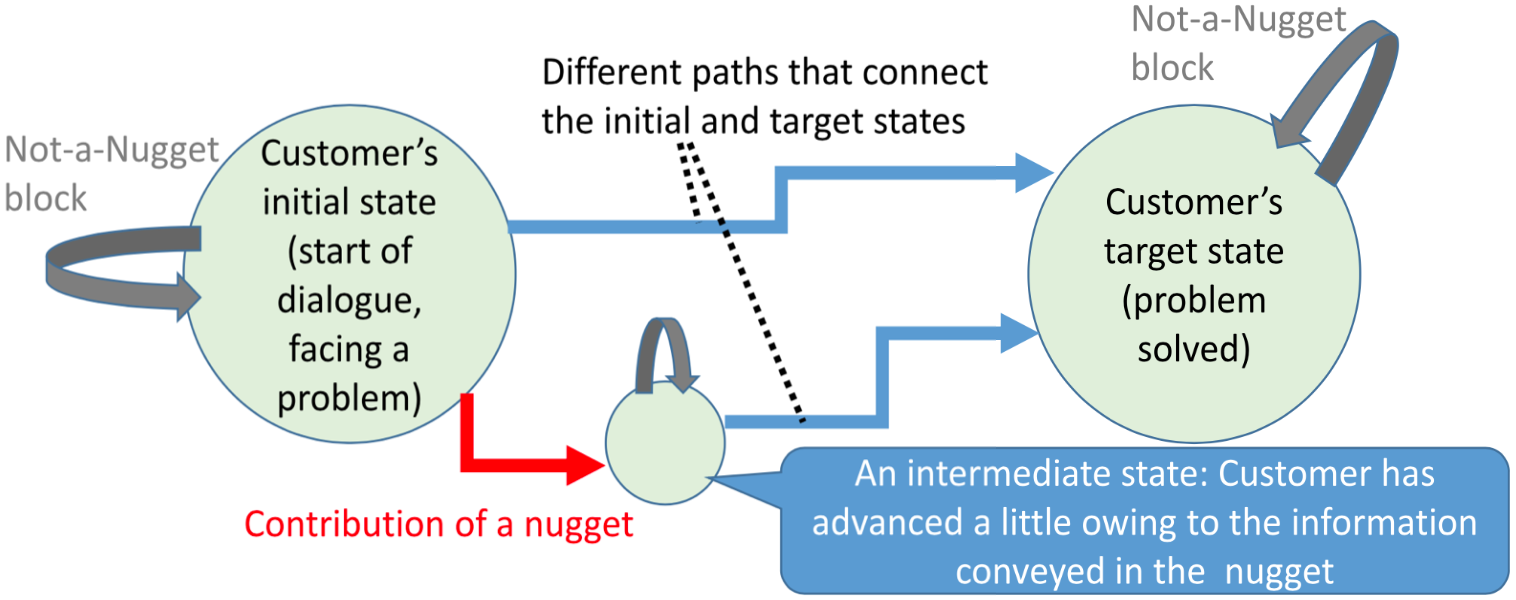
块金检测 (Nugget Detection)
版权声明:本文内容由互联网用户自发贡献,该文观点仅代表作者本人。本站仅提供信息存储空间服务,不拥有所有权,不承担相关法律责任。如发现本站有涉嫌侵权/违法违规的内容,请联系我们,一经查实,本站将立刻删除。
如需转载请保留出处:https://51itzy.com/kjqy/107545.html