
矩阵和线性变换之切变
1. 什么是切变?
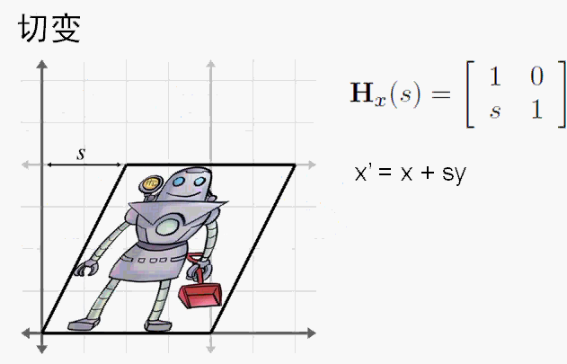
我们来看一幅图片。下面的图片,随着y增大,x的偏移会越来越大。这种类型的变换就叫切换。我们可以得到下图的公式x’ = x + sy。该公式转换成矩阵就得到了切变矩阵。
讯享网

2. 切变效果的矩阵是怎样的?
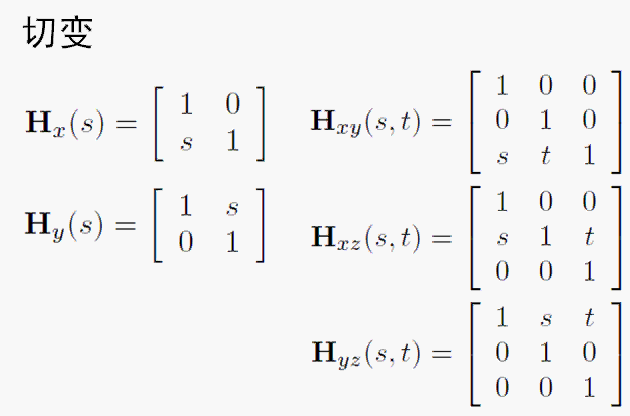
在3D中,同样的道理,有如下右边三个矩阵,分别是随着z增大,x和y发生切变。随着y增大,x和z发生切变。随着z增大,x和y发生切变。
3. 切变矩阵示例代码
void Matrix3X3::setShear(E_Axis axis, float s, float t) { switch(axis) { case Axis_x: { m11 = 1; m12 = s; m13 = t; m21 = 0; m22 = 1; m23 = 0; m31 = 0; m32 = 0; m33 = 1; break; } case Axis_y: { m11 = 1; m12 = 0; m13 = 0; m21 = s; m22 = 1; m23 = t; m31 = 0; m32 = 0; m33 = 1; break; } case Axis_z: { m11 = 1; m12 = 0; m13 = 0; m21 = 0; m22 = 1; m23 = 0; m31 = s; m32 = t; m33 = 1; break; } } }讯享网
- 1
- 2
- 3
- 4
- 5
- 6
- 7
- 8
- 9
- 10
- 11
- 12
- 13
- 14
- 15
- 16
- 17
- 18
- 19
- 20
- 21
- 22
- 23
- 24
- 25
- 26
- 27
4. 切变矩阵程序完整示例代码
讯享网//MathUtil.h #pragma once #include <math.h> enum E_Axis{Axis_x,Axis_y,Axis_z}; const float Pi = 3.14159f;
- 1
- 2
- 3
- 4
- 5
- 6
- 7
- 8
- 9
//Vector3.h #pragma once class Vector3{ public: Vector3(); Vector3(float X,float Y,float Z); //变为零向量 void Zero(); //求负向量 Vector3 operator-() const; //求向量大小(长度或模) float Length() const; //标准化该向量 void Normal(); //向量的加法 Vector3 operator+(Vector3 &rhs) const; Vector3& operator+=(Vector3 &rhs); //向量的减法 Vector3 operator-(Vector3 &rhs) const; Vector3& operator-=(Vector3 &rhs); //向量乘标量 Vector3 operator*(float scalar); //向量乘等于标量 Vector3& operator*=(float scalar); //向量除以等于标量 Vector3& operator/=(float scalar); //向量除以标量 Vector3 operator/(float scalar); //距离公式 float Distance(Vector3 &vec) const; //向量点乘 float operator*(Vector3 &rhs) const; //向量叉积 Vector3 CrossProduct(Vector3& vec) const; public: float x,y,z; }; //标量乘向量 Vector3 operator*(float scalar, Vector3& vec); - 1
- 2
- 3
- 4
- 5
- 6
- 7
- 8
- 9
- 10
- 11
- 12
- 13
- 14
- 15
- 16
- 17
- 18
- 19
- 20
- 21
- 22
- 23
- 24
- 25
- 26
- 27
- 28
- 29
- 30
- 31
- 32
- 33
- 34
- 35
- 36
- 37
- 38
- 39
- 40
- 41
- 42
- 43
- 44
- 45
- 46
- 47
- 48
- 49
讯享网//Vector3.cpp #include "Vector3.h" #include <cmath> Vector3::Vector3():x(0.0),y(0.0),z(0.0) { } Vector3::Vector3(float X,float Y,float Z):x(X),y(Y),z(Z) { } void Vector3::Zero() { x = y = z = 0; } Vector3 Vector3::operator-() const { return Vector3(-x,-y,-z); } float Vector3::Length() const { return sqrt(x*x+y*y+z*z); } Vector3 Vector3::operator*(float scalar) { return Vector3(this->x * scalar, this->y * scalar, this->z * scalar); } Vector3& Vector3::operator*=(float scalar) { return *this = *this * scalar; } Vector3& Vector3::operator/=(float scalar) { return *this = *this / scalar; } Vector3 operator*(float scalar, Vector3& vec) { return vec*scalar; } Vector3 Vector3::operator/(float scalar) { float temp = 1/ scalar; return *this * temp; } void Vector3::Normal() { //计算机计算乘法的速度比除法快 float temp = 1 / Length(); x *= temp; y *= temp; z *= temp; } Vector3 Vector3::operator+(Vector3& rhs) const { return Vector3(x+rhs.x,y+rhs.y,z+rhs.z); } Vector3& Vector3::operator+=(Vector3& rhs) { *this = *this + rhs; return *this; } Vector3 Vector3::operator-(Vector3& rhs) const { return Vector3(x-rhs.x,y-rhs.y,z-rhs.z); } Vector3& Vector3::operator-=(Vector3& rhs) { *this = *this - rhs; return *this; } float Vector3::Distance(Vector3& vec) const { return (*this - vec).Length(); } float Vector3::operator*(Vector3& rhs) const { return this->x * rhs.x + this->y * rhs.y + this->z * rhs.z; } Vector3 Vector3::CrossProduct(Vector3& vec) const { return Vector3(this->y * vec.z - this->z * vec.y, this->z * vec.x - this->x * vec.z, this->x * vec.y - this->y * vec.x); }
- 1
- 2
- 3
- 4
- 5
- 6
- 7
- 8
- 9
- 10
- 11
- 12
- 13
- 14
- 15
- 16
- 17
- 18
- 19
- 20
- 21
- 22
- 23
- 24
- 25
- 26
- 27
- 28
- 29
- 30
- 31
- 32
- 33
- 34
- 35
- 36
- 37
- 38
- 39
- 40
- 41
- 42
- 43
- 44
- 45
- 46
- 47
- 48
- 49
- 50
- 51
- 52
- 53
- 54
- 55
- 56
- 57
- 58
- 59
- 60
- 61
- 62
- 63
- 64
- 65
- 66
- 67
- 68
- 69
- 70
- 71
- 72
- 73
- 74
- 75
- 76
- 77
- 78
- 79
- 80
- 81
- 82
- 83
- 84
- 85
- 86
- 87
- 88
- 89
- 90
- 91
- 92
- 93
- 94
- 95
- 96
- 97
- 98
- 99
- 100
- 101
- 102
- 103
- 104
- 105
//Matrix3X3.h #pragma once #include "MathUtil.h" #include "Vector3.h" class Matrix3X3 { public: //矩阵相乘 Matrix3X3 operator*(Matrix3X3& rhs); //矩阵乘等矩阵 Matrix3X3& operator*=(Matrix3X3& rhs); void setRotate(E_Axis axis,float theta); void setScale(Vector3 &vec); void setOrthProject(Vector3 &vec); void setReflect(E_Axis axis); void setReflect(Vector3 &vec); void setShear(E_Axis axis, float s, float t); public: float m11,m12,m13; float m21,m22,m23; float m31,m32,m33; }; //向量乘以矩阵 Vector3 operator*(Vector3& vec,Matrix3X3& mat); //向量乘等矩阵 Vector3& operator*=(Vector3& vec,Matrix3X3& mat);- 1
- 2
- 3
- 4
- 5
- 6
- 7
- 8
- 9
- 10
- 11
- 12
- 13
- 14
- 15
- 16
- 17
- 18
- 19
- 20
- 21
- 22
- 23
- 24
- 25
- 26
- 27
- 28
- 29
- 30
讯享网//Matrix3X3.cpp #include "Matrix3X3.h" #include <assert.h> Matrix3X3 Matrix3X3::operator*(Matrix3X3& rhs) { Matrix3X3 tempMat; tempMat.m11 = this->m11 * rhs.m11 + this->m12 * rhs.m21 + this->m13 * rhs.m31; tempMat.m12 = this->m11 * rhs.m12 + this->m12 * rhs.m22 + this->m13 * rhs.m32; tempMat.m13 = this->m11 * rhs.m13 + this->m12 * rhs.m23 + this->m13 * rhs.m33; tempMat.m21 = this->m21 * rhs.m11 + this->m22 * rhs.m21 + this->m23 * rhs.m31; tempMat.m22 = this->m21 * rhs.m12 + this->m22 * rhs.m22 + this->m23 * rhs.m32; tempMat.m23 = this->m21 * rhs.m13 + this->m22 * rhs.m23 + this->m23 * rhs.m33; tempMat.m31 = this->m31 * rhs.m11 + this->m32 * rhs.m21 + this->m33 * rhs.m31; tempMat.m32 = this->m31 * rhs.m12 + this->m32 * rhs.m22 + this->m33 * rhs.m32; tempMat.m33 = this->m31 * rhs.m13 + this->m32 * rhs.m23 + this->m33 * rhs.m33; return tempMat; } Matrix3X3& Matrix3X3::operator*=(Matrix3X3& rhs) { *this = *this * rhs; return *this; } Vector3 operator*(Vector3& vec,Matrix3X3& mat) { Vector3 tempVec; tempVec.x = vec.x * mat.m11 + vec.y * mat.m21 + vec.z * mat.m31; tempVec.y = vec.x * mat.m12 + vec.y * mat.m22 + vec.z * mat.m32; tempVec.z = vec.x * mat.m13 + vec.y * mat.m23 + vec.z * mat.m33; return tempVec; } Vector3& operator*=(Vector3& vec,Matrix3X3& mat) { vec = vec * mat; return vec; } void Matrix3X3::setRotate(E_Axis axis,float theta) { float sinValue,cosValue; sinValue = sin(theta); cosValue = cos(theta); switch(axis) { case Axis_x: { m11 = 1; m12 = 0; m13 = 0; m21 = 0; m22 = cosValue; m23 = sinValue; m31 = 0; m32 = -sinValue; m33 = cosValue; break; } case Axis_y: { m11 = cosValue; m12 = 0; m13 = -sinValue; m21 = 0; m22 = 1; m23 = 0; m31 = sinValue; m32 = 0; m33 = cosValue; break; } case Axis_z: { m11 = cosValue; m12 = sinValue; m13 = 0; m21 = -sinValue; m22 = cosValue; m23 = 0; m31 = 0; m32 = 0; m33 = 1; break; } default: assert(false); } } void Matrix3X3::setScale(Vector3& vec) { m11 = vec.x; m12 = 0; m13 = 0; m21 = 0; m22 = vec.y; m23 = 0; m31 = 0; m32 = 0; m33 = vec.z; } void Matrix3X3::setOrthProject(Vector3 &vec) { assert(fabs(vec*vec) - 1 < 0.01f); m11 = 1 - vec.x*vec.x; m12 = m21 = -vec.x * vec.y; m13 = m31 = -vec.x * vec.z; m22 = 1 - vec.y * vec.y; m23 = m32 = -vec.y * vec.z; m33 = 1 - vec.z * vec.z; } void Matrix3X3::setReflect(E_Axis axis) { switch(axis) { case Axis_x: { m11 = -1; m12 = 0; m13 = 0; m21 = 0; m22 = 1; m23 = 0; m31 = 0; m32 = 0; m33 = 1; break; } case Axis_y: { m11 = 1; m12 = 0; m13 = 0; m21 = 0; m22 = -1; m23 = 0; m31 = 0; m32 = 0; m33 = 1; break; } case Axis_z: { m11 = 1; m12 = 0; m13 = 0; m21 = 0; m22 = 1; m23 = 0; m31 = 0; m32 = 0; m33 = -1; break; } } } void Matrix3X3::setReflect(Vector3 &vec) { assert(fabs(vec*vec) - 1 < 0.01f); m11 = 1 - 2 * vec.x * vec.x; m12 = m21 = - 2 * vec.x * vec.y; m13 = m13 = -2 * vec.x * vec.z; m22 = 1 - 2 * vec.y * vec.y; m23 = m32 = -2 * vec.y * vec.z; m33 = 1 - 2 * vec.z * vec.z; } void Matrix3X3::setShear(E_Axis axis, float s, float t) { switch(axis) { case Axis_x: { m11 = 1; m12 = s; m13 = t; m21 = 0; m22 = 1; m23 = 0; m31 = 0; m32 = 0; m33 = 1; break; } case Axis_y: { m11 = 1; m12 = 0; m13 = 0; m21 = s; m22 = 1; m23 = t; m31 = 0; m32 = 0; m33 = 1; break; } case Axis_z: { m11 = 1; m12 = 0; m13 = 0; m21 = 0; m22 = 1; m23 = 0; m31 = s; m32 = t; m33 = 1; break; } } }
- 1
- 2
- 3
- 4
- 5
- 6
- 7
- 8
- 9
- 10
- 11
- 12
- 13
- 14
- 15
- 16
- 17
- 18
- 19
- 20
- 21
- 22
- 23
- 24
- 25
- 26
- 27
- 28
- 29
- 30
- 31
- 32
- 33
- 34
- 35
- 36
- 37
- 38
- 39
- 40
- 41
- 42
- 43
- 44
- 45
- 46
- 47
- 48
- 49
- 50
- 51
- 52
- 53
- 54
- 55
- 56
- 57
- 58
- 59
- 60
- 61
- 62
- 63
- 64
- 65
- 66
- 67
- 68
- 69
- 70
- 71
- 72
- 73
- 74
- 75
- 76
- 77
- 78
- 79
- 80
- 81
- 82
- 83
- 84
- 85
- 86
- 87
- 88
- 89
- 90
- 91
- 92
- 93
- 94
- 95
- 96
- 97
- 98
- 99
- 100
- 101
- 102
- 103
- 104
- 105
- 106
- 107
- 108
- 109
- 110
- 111
- 112
- 113
- 114
- 115
- 116
- 117
- 118
- 119
- 120
- 121
- 122
- 123
- 124
- 125
- 126
- 127
- 128
- 129
- 130
- 131
- 132
- 133
- 134
- 135
- 136
- 137
- 138
- 139
- 140
- 141
- 142
- 143
- 144
- 145
- 146
- 147
- 148
- 149
- 150
- 151
- 152
- 153
- 154
- 155
- 156
- 157
- 158
- 159
- 160
- 161
- 162
- 163
- 164
- 165
- 166
- 167
- 168
#include <iostream> #include "Vector3.h" #include "Matrix3X3.h" using namespace std; float ToZero(float num) { return (abs(num) < 0.0001 ? 0 : num); } void print_v(Vector3 v) { cout << "[ " << ToZero(v.x) << ", " << ToZero(v.y) << ", " << ToZero(v.z) << " ]" << endl; cout << endl; } void print_m(Matrix3X3 m) { cout << m.m11 << "\t" << m.m12 << "\t" << m.m13 << endl; cout << m.m21 << "\t" << m.m22 << "\t" << m.m23 << endl; cout << m.m31 << "\t" << m.m32 << "\t" << m.m33 << endl; cout << endl; } int main() { Vector3 a(10,20,30),b; Matrix3X3 M; M.setShear(Axis_x,1,2); print_m(M); print_v(a); b = a * M; print_v(b); system("pause"); return 0; }- 1
- 2
- 3
- 4
- 5
- 6
- 7
- 8
- 9
- 10
- 11
- 12
- 13
- 14
- 15
- 16
- 17
- 18
- 19
- 20
- 21
- 22
- 23
- 24
- 25
- 26
- 27
- 28
- 29
- 30
- 31
- 32
- 33
- 34
- 35
- 36
- 37
- 38
- 39
- 40
- 41
- 42
5. 程序运行结果
讯享网1 1 2 0 1 0 0 0 1 [ 10, 20, 30 ] [ 10, 30, 50 ]
版权声明:本文内容由互联网用户自发贡献,该文观点仅代表作者本人。本站仅提供信息存储空间服务,不拥有所有权,不承担相关法律责任。如发现本站有涉嫌侵权/违法违规的内容,请联系我们,一经查实,本站将立刻删除。
如需转载请保留出处:https://51itzy.com/kjqy/102700.html